
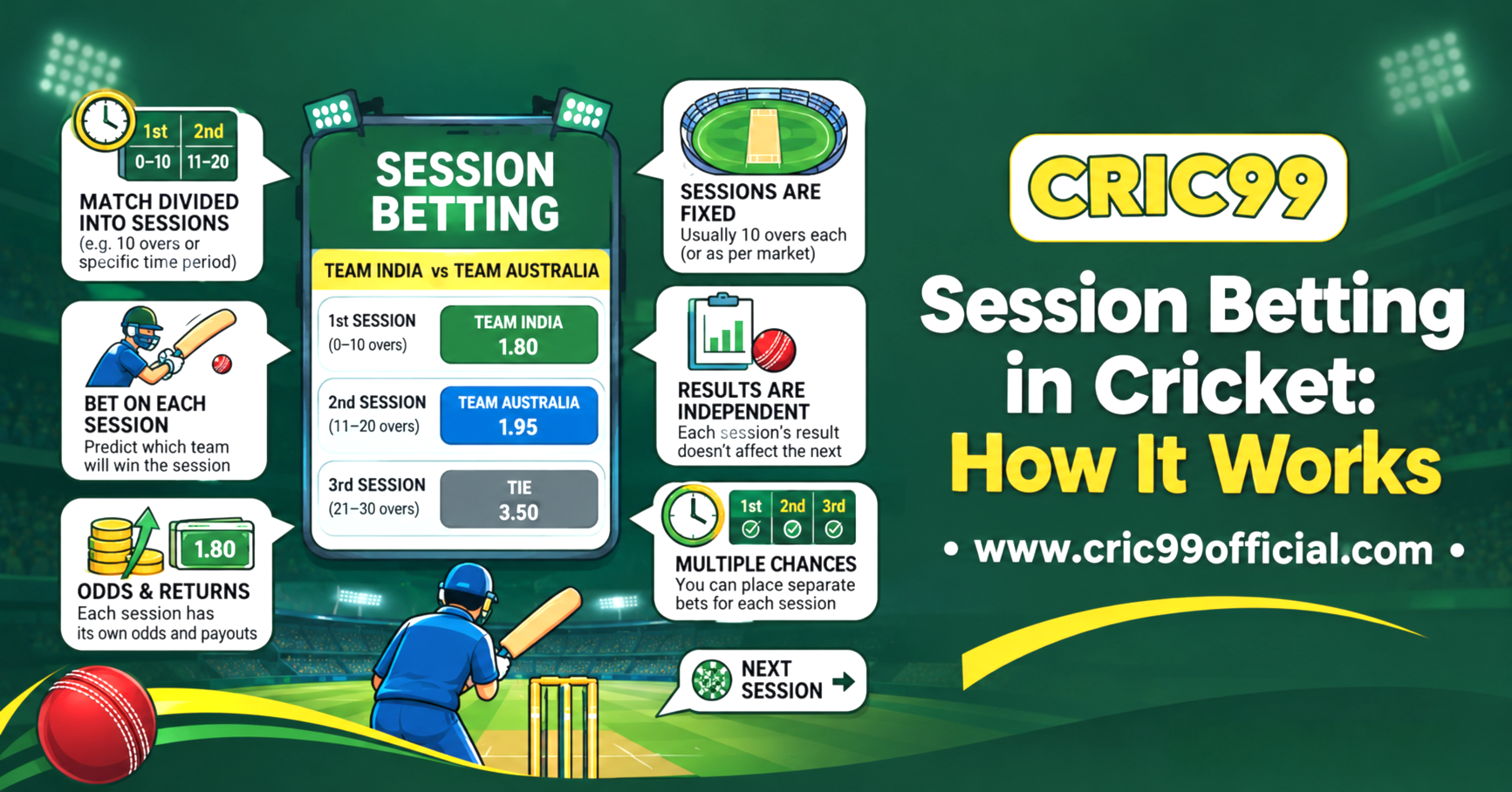
Session betting in cricket refers to markets based on what happens during a specific period of a match, often measured by runs scored or wickets taken within a defined session or number of overs. Instead of focusing on the final match result, these markets concentrate on a shorter part of the game.
For example, a hypothetical session market might set a target of 95.5 runs for a particular period of play. The over selection would require the batting team to score at least 96 runs during that period, while the under selection would require 95 runs or fewer, subject to the market’s settlement rules.
Session betting is especially associated with longer cricket formats, where play is divided into sessions separated by scheduled breaks. However, the exact markets and definitions can vary between competitions and platforms.
This cricket betting guide explains how session markets work, what their different types mean, how odds are displayed, and which rules beginners should understand before interpreting a selection.
What Is Session Betting in Cricket?
A session is a defined period of play within a cricket match. In Test cricket, a day is generally divided into three sessions, with scheduled intervals between them. The precise timing can vary because of weather, delays, the match schedule, and playing conditions.
Session betting uses a specific period as the basis for a market. Depending on the market offered, it may focus on:
- Total runs scored during a session.
- Number of wickets taken during a session.
- Runs scored during a specified group of overs.
- Other events defined by the market rules.
The important point is that a session market does not usually cover the entire match or even necessarily the entire innings. It measures only the period named in the market description.
How Does Session Betting Work?
The basic idea is to identify the session or period being measured and understand the condition attached to the selection.
Consider a hypothetical market for the first session of a Test match:
- Market: First-session total runs
- Run line: 89.5
- Over selection: 90 or more runs
- Under selection: 89 runs or fewer
If the team scores 94 runs during the specified session, the over selection would meet the stated run condition. If it scores 82 runs, the under selection would meet it.
This is a simplified example. Actual settlement depends on the market’s rules, including how the session is defined and what happens if play is interrupted or the scheduled period does not finish normally.
The basic process
Step 1: Identify the session. Check whether the market covers the first, second, or third session, or another specified period.
Step 2: Understand the statistic. Confirm whether the selection concerns runs, wickets, or another event.
Step 3: Read the line. For an over/under market, check the exact number and whether the selection is over or under.
Step 4: Check the odds. Understand the price format and the potential return shown for the selection.
Step 5: Review settlement conditions. Read what happens if rain, bad light, an early interval, or another interruption affects the session.
This process helps explain how cricket betting works in session markets without assuming that all platforms use identical rules.
Common Types of Session Betting Markets
The available options depend on the match, competition, and platform. The following are examples of market types that may be offered.
1. Session Runs
A session-runs market focuses on the total runs scored by the batting team during a specified session.
For example, a hypothetical market might offer an over/under line of 105.5 runs for the second session. The result is based on the runs scored within that defined period, not automatically on the team’s entire innings.
The market rules determine how extras, interruptions, and session boundaries are handled.
2. Session Wickets
A session-wickets market focuses on how many wickets fall during a particular session.
For example, a hypothetical line might be 2.5 wickets:
- Over 2.5 would require at least three wickets to fall.
- Under 2.5 would require two wickets or fewer.
Check the market definition carefully. The number of wickets taken by bowlers and the number of wickets lost by a batting team may not be described in exactly the same way in every market.
3. Session Over/Under
Some session markets use a numerical line to create over and under selections. The line might relate to runs, wickets, or another statistic.
For example, a runs market at 79.5 separates outcomes of 80 or more from outcomes of 79 or fewer, assuming the market is settled on the specified session total.
For a broader explanation of this market format, see Over/Under Betting in Cricket Explained for Beginners.
4. Over-Based Markets
Some markets focus on a specific group of overs rather than a traditional Test-match session. A market might cover the runs scored in the next five overs or during a stated period.
These markets should not automatically be treated as session markets. Check the exact overs included and the time period covered.
5. Session-Specific Events
Depending on the market offered, a selection may relate to a particular event during a session. The wording should identify the event and the period in which it must happen.
Never assume that a market includes an event simply because it occurs on the same day. The session or over range specified in the terms determines the relevant period.
How Are Cricket Sessions Divided?
In Test cricket, a day’s play is generally arranged into three sessions:
| Session | General structure |
|---|---|
| First session | Morning period before the main interval |
| Second session | Period after the main interval and before the next scheduled break |
| Third session | Final scheduled period of play for the day |
The exact start and finish times depend on the match schedule and local conditions. Delays, weather interruptions, slow over rates, and other circumstances can affect the amount of actual playing time.
This matters because a session market must be settled using its stated definition. A market may use a scheduled session, a specified number of overs, or another clearly described period. Do not assume that every platform uses the same boundaries.
Session Betting vs Innings Betting
Session betting and innings betting are related, but they do not measure exactly the same thing.
- Session betting focuses on a defined period of play, such as the first session of a Test-match day.
- Innings betting focuses on an innings or an event within that innings, which may continue across more than one session.
For example, a team could score 90 runs in the first session and continue batting during the second session. A first-session runs market would cover only the first defined period, while a full-innings total would cover the innings according to its market rules.
This distinction is important for anyone learning cricket betting basics. A session result should not be confused with the final innings score.
Session Betting vs Match Betting
Match betting generally concerns the result of the match or another event measured across the match. Session betting focuses on a shorter period.
Imagine a team scores 110 runs during the first session but eventually loses the Test match. A session-runs market and a match-winner market could therefore have completely different outcomes.
A strong session does not guarantee a match victory. The remaining sessions, opposition performance, pitch conditions, and match situation can all influence the final result.
Understanding Odds in Session Markets
Odds represent the quoted price for a selection. They may be displayed in decimal, fractional, or American format.
Consider a hypothetical session selection with decimal odds of 1.90. If a stake of 100 units were placed and the selection settled as a win under the applicable rules, the total return would be 190 units, including the original stake. The profit would be 90 units, before any applicable fees or adjustments.
This is a mathematical illustration, not a prediction or recommendation. Odds do not guarantee that a selection will win.
If you want to understand the plus and minus format, read American Odds Explained: How the Plus and Minus Format Works.
When comparing prices, make sure the markets cover the same session, statistic, and settlement conditions. Similar-looking prices may refer to different periods or rules.
What Can Affect a Cricket Session?
A session can develop differently from expectations because cricket conditions and match situations change throughout the day.
| Factor | How it may affect the session |
|---|---|
| Pitch conditions | The surface may influence batting comfort and bowling effectiveness. |
| Weather | Rain, humidity, and other conditions can affect play or interrupt the session. |
| Light conditions | Poor light may lead to delays or an early end to play. |
| Batting approach | A team may score cautiously or attack depending on the match situation. |
| Bowling changes | Different bowlers and tactics can change the pressure on batters. |
| Wickets lost | Losing wickets may influence the batting team’s approach. |
| Match situation | The score, target, and remaining time can affect tactics. |
| Scheduled breaks | Intervals define session boundaries and can affect the period covered by a market. |
These factors provide context, but they cannot reliably determine how many runs will be scored or wickets taken in a session. Past performance does not guarantee a similar result in future play.
What Happens If a Session Is Interrupted?
Session markets can be affected by circumstances that shorten or interrupt play. Examples include:
- Rain or a wet outfield.
- Bad light.
- An injury or another delay.
- An early end to the day’s play.
- A change to the scheduled session or over period.
The settlement treatment depends on the market’s terms. Some markets may have minimum-play requirements or specific rules for shortened sessions. Others may use a defined over range rather than the scheduled session.
Before interpreting a selection, check whether the market is settled using the scheduled period, the actual time played, or another stated condition. Never assume that an interrupted session is automatically settled as a win, loss, or void.
Session Betting and Cric99
If you use Cric99, check the market description and applicable terms for the specific match. Do not assume that every session market, statistic, or odds format is available for every event.
Market wording and settlement conditions can vary. Confirm which session is covered, what statistic is measured, and how interruptions are handled before relying on the information displayed.
For general platform information, What Is Cric99? Complete Guide to the Cric99 Platform provides an introduction to the platform. Keep your account credentials private and use only access routes you have verified.
Common Mistakes Beginners Should Avoid
When learning cricket betting explained topics, beginners may overlook details that change the meaning of a session market.
- Confusing sessions with innings: A session is a period of play, while an innings can continue across multiple sessions.
- Ignoring the session number: First-session runs and third-session runs are separate measurements.
- Overlooking the market line: A selection at 89.5 runs is different from one at 109.5 runs.
- Assuming fixed session timings: Actual play can be affected by weather, delays, and match conditions.
- Ignoring interruption rules: A shortened session may be treated differently under different market terms.
- Confusing runs with wickets: These are separate statistics and require different interpretations.
- Treating odds as certainty: A price is not a guarantee of the outcome.
- Chasing losses: Increasing stakes to recover previous losses can increase financial harm.
Understanding the market description and settlement rules is more useful than relying on assumptions about how a session will develop.
Frequently Asked Questions
Session betting refers to markets based on events or statistics during a specific period of a cricket match. Common examples include session runs and session wickets.
Session-based markets are commonly associated with Test cricket because a day’s play is generally divided into three sessions. Other period-based markets may be offered in different formats, depending on the platform.
A session-runs market measures how many runs a team scores during a specified session. The market may use an over/under line or another defined scoring condition.
Session betting covers a defined period of play, while innings betting covers an innings or an event within it. An innings may continue across more than one session.
The market sets a numerical line for a statistic, such as runs scored. The over selection requires the result to finish above the line, while the under selection requires it to finish below the line, subject to the settlement rules.
The outcome depends on the market’s specific terms. Some markets may include minimum-play requirements or special rules for shortened sessions, so the settlement conditions should be checked.
Where live session markets are offered, odds may change as the score, wickets, and match situation develop. Markets may also be suspended temporarily.
Final Thoughts
Session betting in cricket focuses on a defined period of play rather than the entire innings or final match result. Understanding session runs, wickets, over/under lines, and interruption rules can help beginners interpret these markets more accurately.
A useful cricket betting guide should explain what is being measured and how the result is settled. This article is for general educational purposes only, not financial advice or a recommendation to bet. Check the laws that apply to you, follow applicable age restrictions, set firm limits, and never use money needed for essential expenses.