
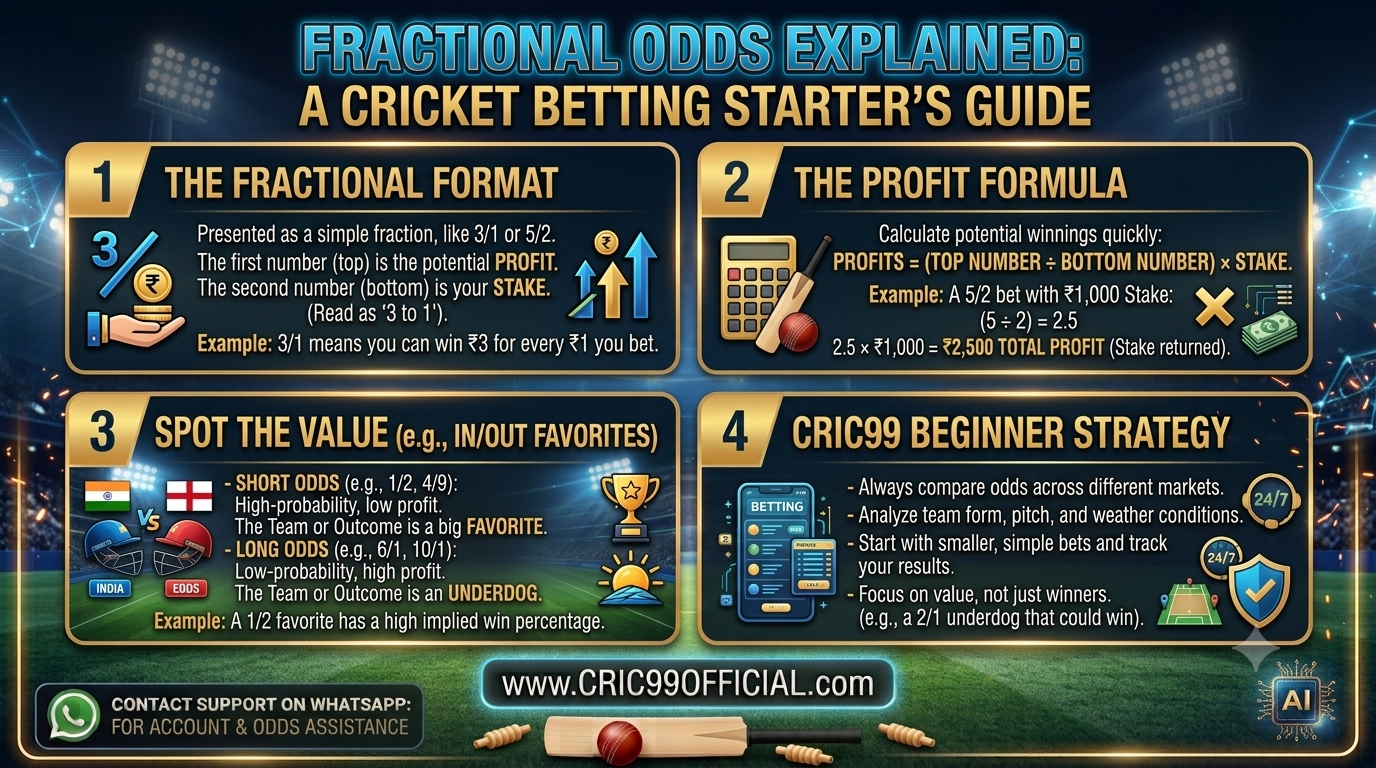
Fractional odds are a traditional way of displaying betting prices. They show the potential profit in relation to the amount staked, rather than showing the total return as decimal odds do.
For example, fractional odds of 2/1 mean that a ₹100 stake could produce ₹200 in profit if the selection wins. The original ₹100 stake would normally be returned as well, making the total return ₹300.
Understanding fractional odds is an important part of cricket betting basics. Once you know how the numbers work, you can compare prices, calculate potential returns, and better understand how cricket betting works.
What Are Fractional Odds?
Fractional odds use two numbers separated by a slash, such as:
- 1/2
- 2/1
- 3/1
- 5/2
- 7/2
The first number represents the potential profit, while the second represents the stake used to calculate that profit.
For example, odds of 3/1 mean that for every ₹1 staked, the potential profit is ₹3.
With a ₹100 stake:
₹100 × 3 = ₹300 potential profit
Add the original ₹100 stake:
₹300 + ₹100 = ₹400 total return
This distinction between profit and total return is one of the first things beginners should understand.
How Do Fractional Odds Work?
The basic calculation is:
Potential profit = Stake × (Numerator ÷ Denominator)
The numerator is the number before the slash, while the denominator is the number after it.
For example, consider fractional odds of 5/2.
With a ₹100 stake:
₹100 × (5 ÷ 2) = ₹250 potential profit
The original ₹100 stake is then added:
₹250 + ₹100 = ₹350 total return
So:
- Stake = ₹100
- Potential profit = ₹250
- Total return = ₹350
This calculation is useful when following a cricket betting guide because it helps you understand exactly what a displayed price means.
What Does 1/1 Mean?
Fractional odds of 1/1 are often called even-money odds.
They mean that the potential profit is equal to the stake.
For a ₹100 stake:
₹100 × (1 ÷ 1) = ₹100 profit
The total return would therefore be:
₹100 profit + ₹100 stake = ₹200
In decimal odds, 1/1 is equivalent to 2.00.
What Does 2/1 Mean?
Odds of 2/1 mean that the potential profit is twice the stake.
With a ₹100 stake:
₹100 × (2 ÷ 1) = ₹200 profit
Total return:
₹200 + ₹100 = ₹300
With a ₹500 stake:
₹500 × 2 = ₹1,000 profit
Total return:
₹1,000 + ₹500 = ₹1,500
The calculation remains the same regardless of the stake.
What Does 3/1 Mean?
Fractional odds of 3/1 mean that the potential profit is three times the stake.
For a ₹100 stake:
₹100 × 3 = ₹300 profit
Total return:
₹300 + ₹100 = ₹400
The higher the fractional price, the greater the potential profit relative to the stake. However, a larger potential return does not mean that an outcome is guaranteed.
What Does 5/2 Mean?
Odds of 5/2 mean that you could potentially make ₹5 in profit for every ₹2 staked.
To calculate the profit on a ₹100 stake:
₹100 × (5 ÷ 2) = ₹250
Total return:
₹250 + ₹100 = ₹350
This is equivalent to decimal odds of 3.50.
Fractional Odds Examples
Here is a simple reference table:
| Fractional Odds | ₹100 Stake | Potential Profit | Total Return |
|---|---|---|---|
| 1/2 | ₹100 | ₹50 | ₹150 |
| 1/1 | ₹100 | ₹100 | ₹200 |
| 3/2 | ₹100 | ₹150 | ₹250 |
| 2/1 | ₹100 | ₹200 | ₹300 |
| 5/2 | ₹100 | ₹250 | ₹350 |
| 3/1 | ₹100 | ₹300 | ₹400 |
| 4/1 | ₹100 | ₹400 | ₹500 |
| 5/1 | ₹100 | ₹500 | ₹600 |
These are mathematical examples only and do not represent predictions of actual cricket results.
Fractional Odds and Implied Probability
Fractional odds can also be converted into an implied probability.
The basic formula is:
Implied probability = Denominator ÷ (Numerator + Denominator) × 100
For example, with odds of 2/1:
1 ÷ (2 + 1) × 100 = 33.33%
For odds of 1/1:
1 ÷ (1 + 1) × 100 = 50%
For odds of 3/1:
1 ÷ (3 + 1) × 100 = 25%
This mathematical probability is useful for understanding what the price represents.
However, real betting markets can include margins, so an implied probability calculated from an individual price should not automatically be treated as the actual probability of an event occurring.
Fractional Odds vs Decimal Odds
If you have already learned decimal odds, fractional odds may initially look more complicated.
The key difference is what each format displays.
Fractional odds show potential profit relative to the stake.
Decimal odds show the total return relative to the stake.
For example:
| Fractional Odds | Decimal Odds | ₹100 Potential Profit | ₹100 Total Return |
|---|---|---|---|
| 1/2 | 1.50 | ₹50 | ₹150 |
| 1/1 | 2.00 | ₹100 | ₹200 |
| 3/2 | 2.50 | ₹150 | ₹250 |
| 2/1 | 3.00 | ₹200 | ₹300 |
| 3/1 | 4.00 | ₹300 | ₹400 |
| 4/1 | 5.00 | ₹400 | ₹500 |
For a deeper look at the other major odds format, Decimal Odds Explained: How They Work in Cricket Betting explains decimal prices, potential returns, and implied probability in more detail.
How to Convert Fractional Odds to Decimal Odds
The conversion formula is:
Decimal odds = (Numerator ÷ Denominator) + 1
For example, 2/1:
(2 ÷ 1) + 1 = 3.00
Therefore:
2/1 = 3.00 decimal odds
Another example is 5/2:
(5 ÷ 2) + 1 = 3.50
Therefore:
5/2 = 3.50 decimal odds
This conversion can make it easier to compare markets displayed using different odds formats.
How to Convert Decimal Odds to Fractional Odds
The reverse calculation starts by subtracting 1 from the decimal price.
Fractional odds = Decimal odds − 1
For example:
3.00 − 1 = 2.00
This can be written as:
2/1
Another example:
2.50 − 1 = 1.50
This becomes:
3/2
Understanding both formats can make cricket betting explained content easier to follow when different websites or resources use different terminology.
Fractional Odds in Cricket Betting Markets
Fractional odds can be used to represent prices across different cricket markets.
Depending on the platform, competition, match, and market, examples can include:
- Match winner
- Team-related markets
- Total runs
- Player performance
- Wickets
- Innings markets
- Other event-specific outcomes
The odds should always be considered alongside the exact market description.
For example, 2/1 for a team to win is not the same type of selection as 2/1 for a particular player to reach a statistical target.
Always identify what the odds refer to before calculating the potential return.
Fractional Odds Before and During a Match
Cricket betting prices can change as the match develops.
Pre-Match Odds
Before a match starts, prices may change as new information becomes available or market activity changes.
Possible factors can include:
- Team news
- Player availability
- Playing conditions
- Weather
- Market activity
Live Odds
During a match, prices can move more quickly because the situation is changing continuously.
In cricket, factors such as:
- Current score
- Wickets lost
- Overs remaining
- Required run rate
- Batting order
- Match situation
can affect the available market prices.
A price shown before a match may therefore be different from the price available later.
Fractional Odds and Betting Exchanges
A betting exchange can use different terminology and market mechanics from a traditional bookmaker.
If you are learning about exchange-style betting, What Is Cric99? Complete Guide to the Cric99 Platform provides an introduction to exchange concepts such as backing, laying, matched bets, and unmatched bets.
On an exchange, the displayed price and the amount available at that price can both matter.
A price is not necessarily the same thing as a guaranteed matched position.
Back and Lay Prices
Beginners may encounter the terms back and lay when exploring exchange-style markets.
A back position generally means taking a position that an outcome will happen.
A lay position generally means taking a position against an outcome.
The calculations for a lay position are different because liability needs to be considered.
This is why simply applying the standard fractional-odds profit formula to every exchange position can lead to incorrect calculations.
Fractional Odds and Cric99 Accounts
If you use Cric99, understanding betting terminology is separate from understanding your account credentials.
Your account ID, password, and other security information should be kept private.
For more information about account identifiers and access terminology, Cric99 Cricket ID Explained: What It Is and How It Works explains the distinction between an account ID, password, and other credentials.
If you need to understand basic account protection, it is also useful to review Cric99 Account Security: How to Protect Your Account before sharing or entering account information.
Always use the official account-access process available to you and avoid sharing sensitive credentials with other people.
Common Mistakes Beginners Make With Fractional Odds
Confusing Profit With Total Return
At 3/1, a ₹100 stake does not produce a ₹300 total return.
It produces:
- ₹300 potential profit
- ₹100 original stake
- ₹400 total return
Reading the Numbers Backwards
With 5/2, the 5 represents the potential profit portion and the 2 represents the stake portion.
The numbers should not be interpreted as a percentage.
Assuming Higher Odds Mean a Better Opportunity
Higher odds mean a larger potential return for the same stake, but they also represent a lower implied probability mathematically.
Potential return and likelihood are different concepts.
Ignoring the Exact Market
Always check what the odds apply to.
A price for a match winner is different from a price for a total-runs market or player market.
Forgetting That Prices Can Move
The odds available at one moment may not be the same later.
This is especially relevant when following live cricket markets.
A Simple Method for Reading Fractional Odds
When you see fractional odds, use this process:
- Identify the exact market.
- Read the fractional price.
- Identify the numerator and denominator.
- Calculate the potential profit.
- Add the original stake to find total return.
- Check whether the price is pre-match or live.
- Review the relevant market rules.
For example, if the price is 7/2 and the stake is ₹200:
₹200 × (7 ÷ 2) = ₹700 potential profit
Total return:
₹700 + ₹200 = ₹900
That is the basic calculation.
Fractional Odds Cheat Sheet
Keep this simple reference in mind:
- 1/2 → ₹50 profit from ₹100
- 1/1 → ₹100 profit from ₹100
- 3/2 → ₹150 profit from ₹100
- 2/1 → ₹200 profit from ₹100
- 5/2 → ₹250 profit from ₹100
- 3/1 → ₹300 profit from ₹100
- 4/1 → ₹400 profit from ₹100
- 5/1 → ₹500 profit from ₹100
The original stake is added to each potential profit figure to calculate the total return.
Responsible Approach to Cricket Betting
Understanding odds is only one part of responsible participation.
Betting involves financial risk, and knowing how to calculate a potential return does not guarantee a particular outcome.
Before using real money, make sure you understand:
- The market you are entering
- The odds being offered
- The potential loss
- The applicable rules
- Any relevant age and legal requirements
Avoid chasing losses or treating betting as a guaranteed source of income. Set limits that fit your circumstances and stop if your activity becomes difficult to control.
These points are an important part of any responsible cricket betting guide, alongside the mathematical explanation of odds.
Frequently Asked Questions
Fractional odds are a traditional odds format that shows potential profit in relation to the stake.
For example, 2/1 means ₹2 potential profit for every ₹1 staked.
At 2/1, a ₹100 stake would produce ₹200 potential profit, plus the original ₹100 stake, for a ₹300 total return.
1/1 means the potential profit equals the stake. A ₹100 stake would produce ₹100 potential profit and ₹200 total return.
They can initially look less intuitive because they display potential profit rather than total return. Once you understand the formula, they are straightforward to calculate.
Use:
Decimal odds = (Numerator ÷ Denominator) + 1
For example, 3/1 becomes:
(3 ÷ 1) + 1 = 4.00
Yes. Cricket market prices can change as the match develops and new information becomes available.
Final Thoughts
Fractional odds become much easier to understand once you separate potential profit from total return.
The key formula is:
Potential profit = Stake × (Numerator ÷ Denominator)
Then add the original stake to calculate the total return.
Learning fractional odds alongside decimal odds gives beginners a stronger foundation for understanding how cricket betting works. It also makes it easier to read different betting resources and compare prices presented in different formats.
The most important cricket betting basics are to understand the market, know what the odds represent, calculate the potential financial outcome correctly, and remember that betting outcomes are never guaranteed.
Disclaimer: This article is provided for general informational purposes only. Betting involves financial risk, and no outcome is guaranteed. Always check applicable laws, age requirements, market rules, and the current terms of any service before participating.