Cric99

What Is Live Odds Movement in Cricket?

Live odds movement in cricket explained with changing match odds, wickets, runs, overs, and other in-play match developments.
Learn what live odds movement means in cricket and how match events can influence prices during an ongoing game.

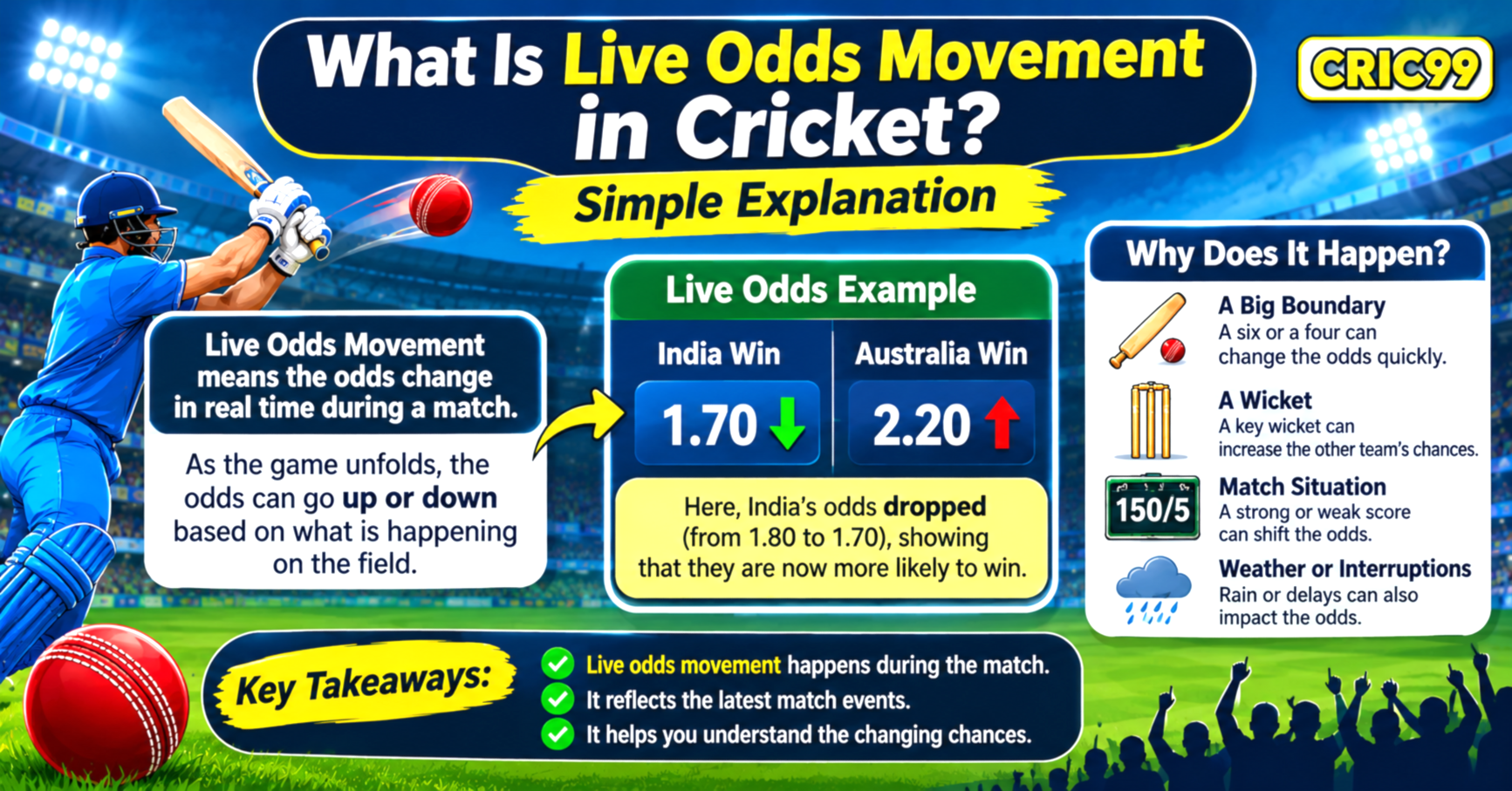
Live odds movement in cricket refers to changes in the displayed odds while a cricket match is in progress. These changes happen as the match develops and new information becomes available, such as wickets, boundaries, partnerships, scoring rates, and changes in playing conditions.

For example, a team’s odds before the first ball may be different after it loses two early wickets. The price can change because the match situation has changed.

Understanding Live Odds Movement in Cricket helps beginners learn how live markets respond to events on the field. This guide explains what odds movement means, why it happens, how to read it, and how it differs from a change in the market line.

What Is Live Odds Movement in Cricket?

Live odds movement is the increase or decrease in the displayed odds for a particular selection during a match.

Odds are not fixed throughout every live market. They may be updated as the balance of the match changes and the available information develops.

Consider a hypothetical T20 match between Team A and Team B:

  • Before the match, Team A is shown at odds of 1.80.
  • Team A loses three early wickets.
  • Its displayed odds move to 2.40.
  • Later, a strong partnership develops and the odds move to 2.00.

These figures are only an illustration. They show how the displayed price might change as the match situation develops. They do not predict the final result.

In simple terms, live odds movement describes a change in the price associated with a particular outcome.

How Does Live Odds Movement Work?

To understand how cricket betting works, beginners should first understand the relationship between match events and displayed prices.

A live market may use information such as:

  1. Current score and overs completed.
  2. Number of wickets lost.
  3. Runs required and overs remaining.
  4. Batter and bowler performance.
  5. Match format and playing conditions.
  6. Weather interruptions or other delays.

The market may be updated when new information changes the assessment of an outcome.

For example, in a limited-overs chase, a team that scores quickly may have a different match outlook from one that struggles to maintain the required run rate.

The odds may respond to that difference. However, the exact calculation and timing of updates depend on the platform and market.

7 Factors That Cause Live Odds Movement in Cricket

Several events can influence live odds. Their impact depends on the match situation and the type of market being considered.

1. Wickets Falling

Wickets can have a noticeable effect on live odds, particularly when an important batter is dismissed.

Imagine a team chasing 180 runs in a T20 match. If it loses three wickets during the powerplay, its position may become more difficult.

The displayed odds for the match winner may change because the batting side has fewer established players available.

However, wickets should always be considered in context. A team with a strong middle order may still have a reasonable opportunity to recover.

2. Boundaries and Fast Scoring

A sequence of boundaries can improve a team’s scoring position.

For example, a batter hitting two sixes and a four in one over can increase the team’s total quickly. This may influence markets connected to the innings total or match result.

The number of overs remaining and wickets in hand also matter. A high-scoring over near the end of an innings may have a different effect from one during the powerplay.

3. Current Run Rate and Required Run Rate

Scoring rates help explain the changing situation in limited-overs cricket.

  • Current run rate: The average runs scored per over so far.
  • Required run rate: The average runs needed per over to reach the target.

If the required run rate increases, the chasing team may face greater pressure. If it decreases after a productive over, the situation may become more manageable.

Live odds may change as these figures develop.

4. Batting Partnerships

A strong partnership can stabilise an innings after early wickets.

When two batters remain at the crease and score consistently, expectations about the team’s final total may change.

A partnership can also end suddenly. If one of the established batters gets dismissed, the market may respond to the new situation.

5. Bowler Performance

A bowler’s performance can influence the match and related player markets.

For example, a bowler who takes two wickets in consecutive overs may put the batting team under pressure. An economical spell can also restrict the scoring rate.

Relevant developments may include:

  • Wickets taken
  • Runs conceded
  • Overs remaining
  • Bowling changes
  • Match-ups between batters and bowlers

The effect on odds depends on the specific market.

6. Weather and Match Interruptions

Rain, poor light, and other interruptions can change the conditions of a cricket match.

In limited-overs cricket, a delay may reduce the number of available overs or lead to a revised target under the applicable playing rules.

These developments can affect the match outlook and may cause live markets to be suspended or updated.

7. Player Injuries and Team Changes

An injury or an unexpected absence can affect a team’s options.

For example, if an established batter cannot continue, the remaining batting order may need to adjust its approach.

Similarly, the absence of a key bowler can influence the team’s bowling plans.

Any effect on live odds depends on the importance of the player, the match situation, and the market being considered.

What Does Shortening and Drifting Odds Mean?

Two common expressions used when discussing live odds movement are shortening and drifting.

Shortening Odds

Odds are said to shorten when the displayed price becomes lower.

For example:

  • Earlier odds: 2.50
  • Updated odds: 2.00

The price has shortened from 2.50 to 2.00.

This may happen when the market assessment becomes more favourable towards that selection. It does not mean the outcome is guaranteed.

Drifting Odds

Odds are said to drift when the displayed price becomes higher.

For example:

  • Earlier odds: 1.70
  • Updated odds: 2.10

The price has drifted from 1.70 to 2.10.

This may happen when the market assessment becomes less favourable towards that selection.

Remember that shortening and drifting describe price movements, not the certainty of an outcome.

Live Odds Movement Example During a T20 Match

The following hypothetical example shows how live odds might change during a match.

Match situationTeam A oddsPossible explanation
Before the match1.80Initial market price
Team A starts strongly1.65Positive start
Team A loses three wickets2.30Batting pressure increases
A strong partnership develops1.95Team A stabilises
Team A loses another key wicket2.20Match situation changes again

These numbers are illustrative, not actual historical or live market data.

The example shows that odds can move in both directions during one innings. A single event does not determine the final outcome.

Live Odds Movement vs Market Line Movement

Live odds movement and market line movement are related, but they describe different changes.

Live odds movementMarket line movement
Changes the displayed priceChanges the numerical threshold
Example: odds move from 1.80 to 2.10Example: total-runs line moves from 150.5 to 158.5
Reflects a change in the priceReflects a change in the market’s numerical condition

For example, an over/under market may originally use a total of 150.5 runs. Later, the line may move to 158.5 runs.

The odds attached to the over and under selections may also change, but the line movement and odds movement are separate adjustments.

For a broader explanation of numerical thresholds, read Over/Under Betting in Cricket Explained for Beginners.

How to Read Live Cricket Odds as a Beginner

If you are new to cricket betting explained content, start by understanding the figures rather than trying to interpret every movement.

Here are some basic points to check:

  1. Identify the market: Is it a match-winner, innings-total, or player-performance market?
  2. Check the previous odds: Compare the earlier price with the updated price.
  3. Understand the match situation: Look at the score, wickets, overs, and required run rate.
  4. Identify the direction: Determine whether the odds have shortened or drifted.
  5. Check for market changes: Make sure the numerical line or settlement conditions have not changed.
  6. Read the rules: Understand how interruptions, abandoned matches, and other situations are handled.

If you want to understand the plus and minus format, American Odds Explained: How the Plus and Minus Format Works covers another common way of displaying odds.

Why Do Live Odds Change So Quickly?

Cricket matches can develop rapidly, particularly in T20 formats.

A single over may include multiple boundaries, a wicket, or a major change in scoring rate. Live markets may respond to these developments as updated information becomes available.

Other reasons for rapid changes include:

  • An umpire review or decision awaiting confirmation
  • A sudden change in the match situation
  • A key player getting injured
  • A change in the number of overs
  • Updated match information
  • A temporary market suspension followed by reopening

The timing of updates can vary between platforms. Some markets may also be unavailable while an important event is being checked.

How Cric99 Relates to Live Cricket Odds Information

Cric99 is a name readers may come across when exploring cricket-related online platform information. The general explanations in this article do not confirm that every type of live market or odds feature is available on a particular platform.

Before using any service, check its current terms, market availability, settlement rules, account requirements, and applicable local laws.

Readers who want general platform information can explore What Is Cric99? Complete Guide to the Cric99 Platform. Always distinguish general cricket betting education from confirmed platform-specific features.

Common Mistakes Beginners Make When Reading Live Odds

Understanding odds movement takes more than noticing whether a number goes up or down.

Avoid these common misunderstandings:

  • Assuming shorter odds guarantee a win: A lower price does not make an outcome certain.
  • Ignoring the match situation: Odds should be understood in the context of the score, wickets, and overs.
  • Confusing odds with market lines: A price change is not necessarily a change in the market threshold.
  • Reacting to every movement: Live prices can change quickly and may reverse.
  • Ignoring settlement rules: Different markets can have different conditions.
  • Treating odds as predictions: Odds represent market prices, not guaranteed future results.

A good cricket betting guide should explain these differences clearly rather than suggesting that price movements provide certain signals.

Frequently Asked Questions

1. What is live odds movement in cricket?

Live odds movement in cricket refers to changes in the displayed odds while a match is taking place. These changes may reflect wickets, boundaries, scoring rates, player performances, and other match developments.

2. Why do live cricket odds increase or decrease?

Odds may increase or decrease when new match information changes the market’s assessment of an outcome. For example, an early wicket or a strong batting partnership may influence the displayed price.

3. What does it mean when cricket odds shorten?

Shortening means the displayed odds become lower. For example, a change from 2.50 to 2.00 is a shortening of the price.

4. What does it mean when cricket odds drift?

Drifting means the displayed odds become higher. For example, a change from 1.70 to 2.10 is a drift in the price.

5. Do wickets affect live odds?

Yes. A wicket may influence match-winner, player-performance, and innings-total markets. Its impact depends on the player dismissed and the overall match situation.

6. Can live odds change without a wicket?

Yes. Boundaries, scoring rates, partnerships, bowling performances, weather interruptions, and other developments can influence live odds.

7. Are live odds movement and market line movement the same?

No. Odds movement refers to a change in the displayed price, while line movement refers to a change in the numerical threshold used by a market.

8. Do changing live odds predict the final cricket result?

No. Odds movement does not guarantee a result. Cricket matches involve uncertainty, and the final outcome can differ from the market’s current assessment.

Final Thoughts

Live odds movement in cricket describes how displayed prices change as a match develops. Wickets, boundaries, partnerships, scoring rates, player performances, and weather conditions can all influence these movements.

For beginners, the most important distinction is between shortening odds, drifting odds, and changes to the market line. Each describes something different.

Understanding these terms can make cricket betting basics easier to follow. However, changing odds should never be treated as a guarantee or a reliable promise of future results.

Betting involves financial risk. Only adults legally permitted to participate in their location should consider it. Set limits, never chase losses, and do not use money needed for essential expenses.
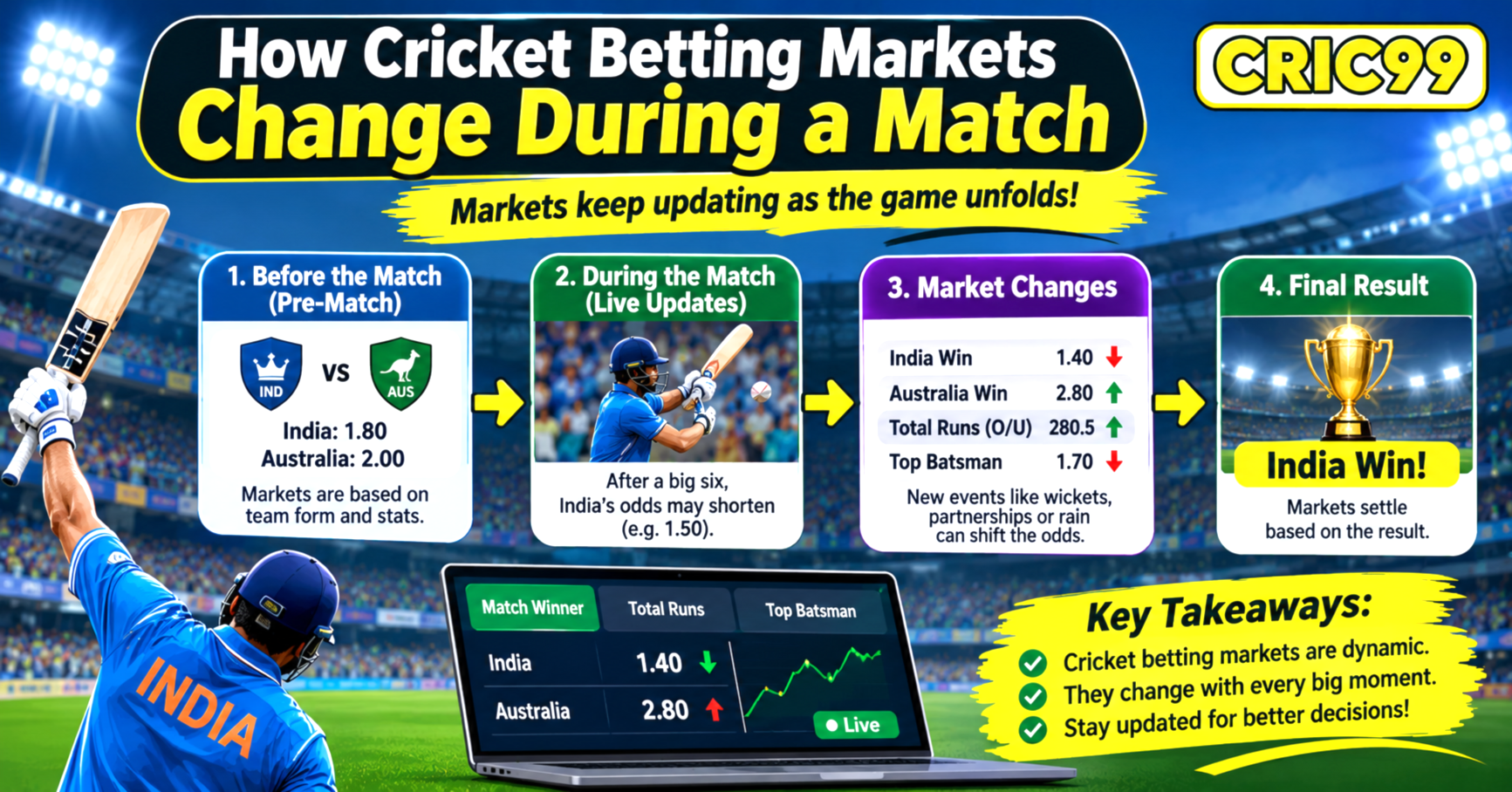
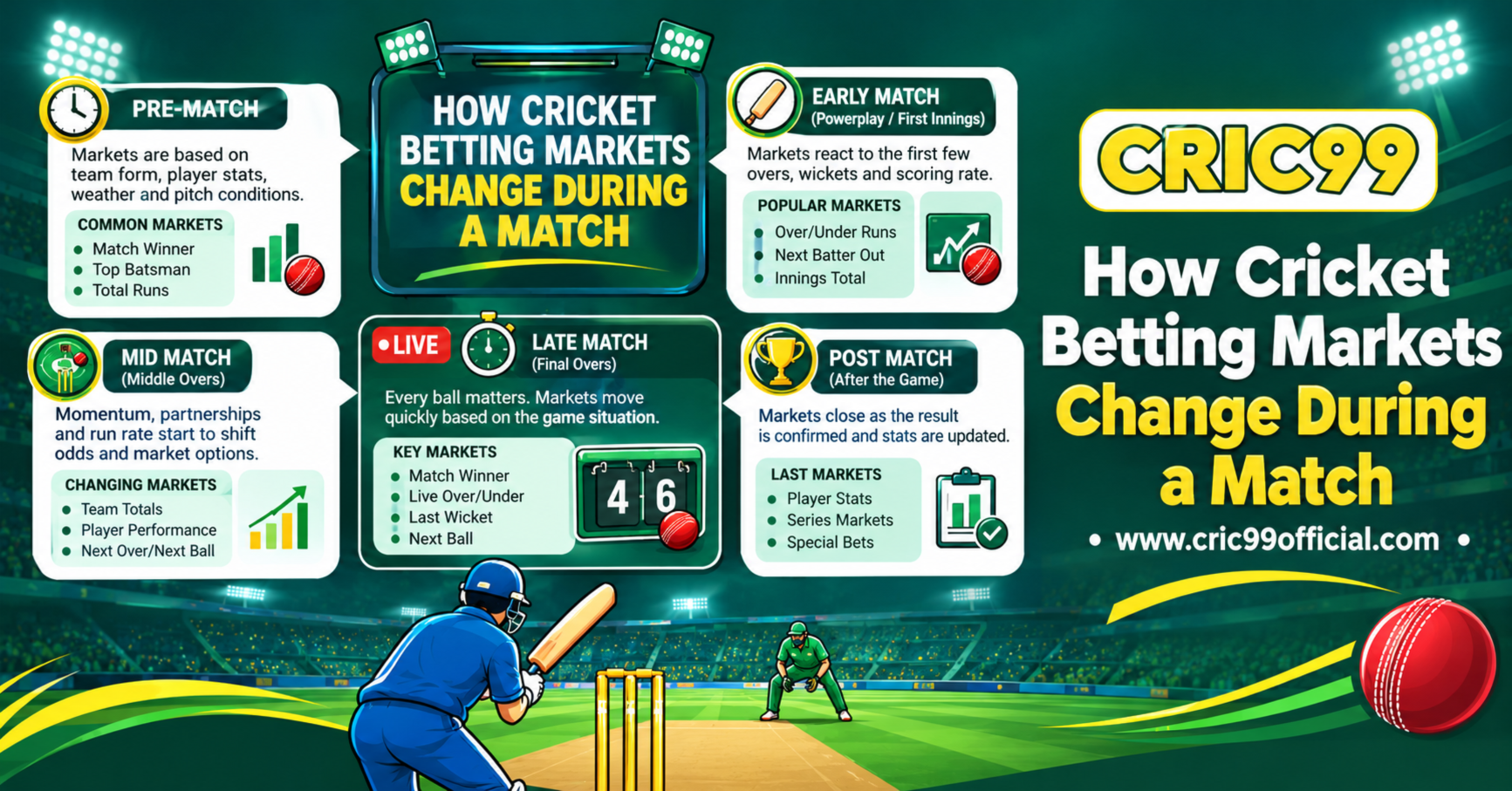
How Cricket Betting Markets Change During a Match

How cricket betting markets change during a match, showing live odds, wickets, runs, overs, and changing in-play market conditions.
Understand how cricket betting markets change during a match, including live odds movements, match events, in-play markets, and market updates.

Cricket betting markets change during a match because the situation on the field is constantly developing. A wicket, boundary, change in scoring rate, or weather interruption can affect how an outcome is viewed. As a result, the odds and available market lines may move throughout the game.

Understanding how Cricket Betting Markets Change During a Match helps beginners recognise why the figures displayed before the first ball may look different a few overs later.

This guide explains the main reasons behind market changes, how live markets respond to match events, and what beginners should understand when learning cricket betting basics.

What Are Cricket Betting Markets?

A cricket betting market is a specific category of possible outcomes connected to a match. Each market focuses on a particular result, event, or statistic.

Common examples include:

  • Match winner: Which team will win the match?
  • Total runs: How many runs will a team or both teams score?
  • Over/under: Will a specified total finish above or below a given line?
  • Player performance: How many runs might a batter score or wickets might a bowler take?
  • Next wicket: Which team or player-related event will be involved in the next dismissal, depending on the market wording?
  • Innings total: How many runs will a team score in a particular innings?

These markets can respond differently to the same match event. For example, a wicket may affect the match-winner market, a batter’s performance market, and the innings-total market in different ways.

If you are new to the subject, What Is a Cricket Betting Market? Simple Explanation provides a useful introduction to the terminology.

How Do Cricket Betting Markets Change During a Match?

Before a match begins, market prices are generally based on information available before play. This may include team strength, player availability, recent performances, match conditions, and other relevant factors.

Once the match starts, new information becomes available with every over. Market prices and lines may adjust to reflect the changing situation.

For example, imagine a hypothetical T20 match:

  • Team A starts with a strong opening partnership.
  • The scoring rate increases after the powerplay.
  • Team A loses two wickets in quick succession.
  • The middle order slows down the scoring.
  • Team A finishes its innings with a lower total than initially expected.

Each event changes the match situation. Markets connected to the innings total, match winner, and individual player performance may respond differently.

This is one reason live cricket betting markets can look very different from pre-match markets.

7 Major Factors That Influence Live Cricket Betting Markets

Several match events can influence market movements. The effect depends on the market, match format, remaining overs, and current score.

1. Wickets Falling

Wickets are among the most noticeable events in cricket. Losing a wicket can change the batting team’s scoring plans, especially when an established batter is dismissed.

For example, if a team loses two experienced batters early in a T20 innings, its remaining players may need to adjust their approach.

This can influence:

  • Match-winner prices
  • Innings-total lines
  • Player-performance markets
  • Over-based scoring markets

However, a wicket does not always have the same impact. A team with strong batting depth may recover quickly.

2. Boundaries and High Scoring Overs

A boundary can change the immediate scoring situation. Several boundaries in one over may increase the run rate and influence expectations about the final total.

Consider a hypothetical example:

A team scores 7 runs in one over, followed by 19 runs in the next. The scoring rate has increased, so markets linked to the innings total may adjust.

The effect depends on how many overs remain and the number of wickets available.

3. Changes in Run Rate

The current run rate and required run rate are important parts of limited-overs cricket.

  • Current run rate: The average number of runs scored per over so far.
  • Required run rate: The average runs per over needed to reach a target.

In a chase, the required run rate may rise when a team scores slowly or loses wickets. It may fall after a productive over.

These changes can influence markets connected to the match result and remaining runs.

4. Player Performance

Individual performances can affect markets related to both players and teams.

For example, a batter scoring quickly may influence expectations about the innings total. A bowler taking multiple wickets may change the outlook for the batting side.

Other relevant developments include:

  • A batter reaching a half-century
  • A bowler completing an economical spell
  • An important player retiring hurt
  • A key batter being dismissed
  • A partnership building momentum

Player-related markets may have their own conditions, so the exact wording should always be checked.

5. Partnerships Between Batters

A stable partnership can change the direction of an innings.

When two batters remain at the crease and score consistently, the batting team may build a stronger position. A partnership can also reduce immediate pressure after early wickets.

However, partnerships can end suddenly. A single dismissal may change the situation again.

6. Weather and Match Interruptions

Weather can have a major effect on cricket matches, particularly in outdoor formats.

Rain, poor light, or other interruptions may reduce the available playing time. In limited-overs matches, revised targets and overs can also affect the match situation under the applicable playing rules.

Possible market effects include:

  • Temporary market suspensions
  • Changes to total-run lines
  • Adjustments to match-result expectations
  • Different settlement outcomes under specific rules

A suspended market does not necessarily mean that the match has been cancelled. It may simply be waiting for the situation to become clear.

7. Changes in Team Strategy

Teams do not always follow the same approach throughout a match.

A batting side may accelerate during the final overs, while a team defending a target may use its main bowlers at particular stages.

Changes in bowling combinations, batting order, field placements, and player availability can influence how a match develops.

These strategic decisions may affect different markets in different ways.

How Different Cricket Markets Respond to Match Events

Not every market reacts to an event in the same way. The following hypothetical examples show the difference.

Match eventMarkets that may be affected
Opening batter gets outPlayer performance, innings total, match winner
Several boundaries in an overOver/under, innings total, match winner
Required run rate increasesMatch winner, remaining-overs markets
Key bowler takes two wicketsPlayer performance, innings total
Rain interrupts playMatch result, total runs, settlement conditions
Strong partnership developsInnings total, player performance, match winner

These are possible effects, not guaranteed market movements. The actual response depends on the event, market rules, and information available at that moment.

Pre-Match Markets vs Live Markets

Pre-match and live markets differ mainly in the timing of the information used to assess an outcome.

Pre-match marketsLive markets
Available before play beginsAvailable during a match when offered
Based on pre-match informationRespond to developing match events
Do not reflect actual in-match scoringMay change after wickets, boundaries, and other events
Usually assessed before the first ballMay be updated throughout the game

For example, a team may be considered stronger before a match begins. However, an early collapse could change the situation once play starts.

To understand the difference in more detail, read Live Cricket Betting Explained: How In-Play Markets Work.

Why Are Live Cricket Betting Markets Sometimes Suspended?

A live market may temporarily stop accepting activity when an important event takes place or its outcome needs confirmation.

Common situations include:

  • A possible wicket under review
  • A boundary or dismissal requiring confirmation
  • A disputed umpire decision
  • A rain interruption
  • A sudden change in match conditions
  • An update to the official score

Once the situation is confirmed, the market may reopen with updated prices or conditions.

Suspension is part of how live markets can operate. It should not automatically be interpreted as a technical problem.

Odds Changes vs Market Line Changes

Beginners sometimes assume that changing odds and changing market lines mean the same thing. They are related, but they are different.

Odds changes mean the displayed price for a particular selection has moved.

Market line changes mean the numerical threshold or condition used by the market has changed.

For example, consider a hypothetical over/under market:

  • Earlier line: 150.5 total runs
  • Updated line: 158.5 total runs

The numerical threshold has changed. The odds attached to the available selections may also change, but these are separate adjustments.

Understanding this distinction makes cricket betting explained content easier to follow.

What Should Beginners Check When Markets Change?

If you are learning how cricket betting works, it is important to understand the information displayed rather than reacting to every movement.

Consider these basic checks:

  1. Check the latest score: Make sure you understand the current match situation.
  2. Look at the overs remaining: The same score can mean different things at different stages.
  3. Check the wickets in hand: A team with several wickets remaining has a different situation from one nearing the end of its batting order.
  4. Understand the market type: A match-winner market and an innings-total market measure different outcomes.
  5. Read the updated line: Do not assume that a previous numerical threshold is still being used.
  6. Check settlement conditions: Rain, abandoned matches, ties, and shortened games may be handled differently.
  7. Avoid rushed decisions: Market movements can happen quickly, and no movement guarantees a particular result.

These points are useful for anyone following a beginner-friendly cricket betting guide.

How Cric99 Relates to Cricket Betting Information

Cric99 is a name readers may encounter while exploring cricket-related online platform information. However, the general market explanations in this article should not be treated as confirmation that every market is available on a particular platform.

Before using any service, check its current terms, available markets, settlement rules, account requirements, and applicable local laws. Do not assume that platform features or market availability remain the same over time.

Readers can also explore Cric99 Terms and Conditions: Important Points to Understand to learn why checking platform-specific rules matters.

Common Misunderstandings About Live Market Movements

Beginners can easily misunderstand why prices or market lines change. Here are some points worth remembering:

  • A favourite can lose: Pre-match expectations do not determine the final result.
  • One wicket does not decide the match: Its effect depends on the match situation.
  • Higher odds do not guarantee a better outcome: Odds are prices, not promises.
  • Every market has different rules: Similar market names may have different settlement conditions.
  • Market movements are not predictions: A change in price does not guarantee what will happen next.
  • Live markets may be unavailable temporarily: Suspensions can occur while events are confirmed.

Understanding these differences is more useful than trying to interpret every movement as a definite signal.

Frequently Asked Questions

1. Why do cricket betting markets change during a match?

They change because new information becomes available as the match progresses. Wickets, boundaries, scoring rates, player performances, and weather interruptions can all influence market prices and lines.

2. Which events affect live cricket betting markets the most?

Important events may include early wickets, big partnerships, high-scoring overs, key player dismissals, and weather interruptions. Their impact depends on the market and match situation.

3. Do cricket betting odds change after every over?

Not necessarily. Odds may change after significant events or updates, but the timing and frequency depend on the market and platform.

4. Why are live cricket betting markets suspended?

Markets may be suspended when an event needs confirmation, such as a possible wicket, boundary, umpire review, or weather interruption.

5. What is the difference between odds movement and line movement?

Odds movement refers to a change in the displayed price. Line movement refers to a change in the numerical threshold used in a market, such as a total-runs figure.

6. Can weather affect cricket betting markets?

Yes. Rain, poor light, and interruptions can change the available playing time and match conditions. They may also affect market availability and settlement.

7. Are pre-match and live cricket betting markets the same?

No. Pre-match markets are based on information available before the game, while live markets may respond to events during play.

Final Thoughts

Understanding how cricket betting markets change during a match starts with understanding the game itself. Wickets, boundaries, partnerships, scoring rates, player performances, and weather conditions can all influence the way markets are displayed.

Different markets respond to different events, and odds changes are not the same as market line changes. Beginners should take time to understand each market’s conditions and settlement rules rather than making assumptions based on a changing price.

Betting involves financial risk and does not provide guaranteed income. Only adults legally permitted to participate in their location should consider it. Set limits, never chase losses, and avoid using money needed for essential expenses.
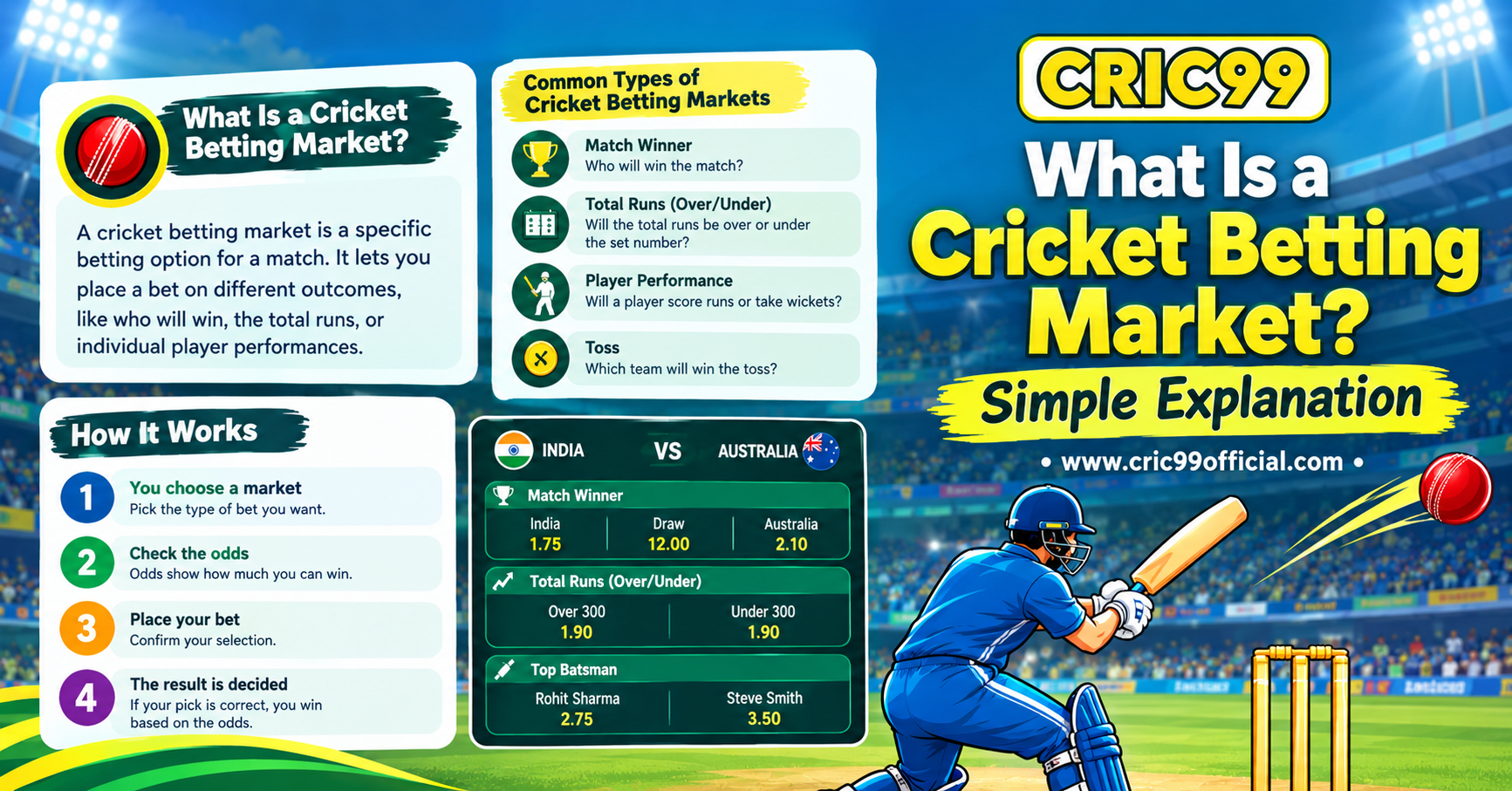
What Is a Cricket Betting Market? Simple Explanation

A simple explanation of a cricket betting market, showing match winner, total runs, player performance, and other market types.
Understand what a cricket betting market means and explore common examples, including match winner, total runs, and player markets.

A cricket betting market is a specific type of bet or outcome offered on a cricket match. It gives users different options to understand, such as which team might win, how many runs a team could score, or how a player might perform.

In simple terms, a betting market defines what outcome is being considered. Instead of focusing only on the final match result, different markets cover individual events and statistics within a game.

For beginners, understanding what a cricket betting market means is an important part of learning the basics. This guide explains common market types, how they differ, and what to check before interpreting them.

What Is a Cricket Betting Market?

A cricket betting market is a category of possible outcomes connected to a cricket match. Each market focuses on a particular event, statistic, or result.

For example, a match may have several separate markets:

  • Match winner: Which team will win the match?
  • Total runs: How many runs will a team or both teams score?
  • Top batter: Which player will score the most runs?
  • Total wickets: How many wickets will fall?
  • Toss result: Which team will win the toss?

These are different markets because each one considers a different part of the match.

A match-winner market is concerned with the final result, while a total-runs market focuses on scoring. A player-performance market looks at an individual cricketer’s contribution.

How Do Cricket Betting Markets Work?

Understanding how cricket betting works starts with identifying the market and the outcome it covers.

A typical market has three basic elements:

  1. Market name: The event or statistic being considered.
  2. Available outcomes: The possible results listed within that market.
  3. Odds or prices: The figures displayed for the available outcomes.

For example, imagine a hypothetical match between Team A and Team B. A match-winner market may list Team A and Team B as the two possible outcomes.

A separate total-runs market might focus on whether the combined score will be above or below a specified number. The market is different, even though it relates to the same match.

The important point is that every market has its own conditions. Users should understand what is being measured before interpreting the displayed odds.

Common Types of Cricket Betting Markets

Cricket has several formats and match events, so markets can cover different aspects of the game. The options available may vary by competition, match format, and platform.

1. Match Winner Market

The match-winner market focuses on which team will win a cricket match.

For example, a hypothetical fixture between India and Australia may list both teams as possible outcomes. The market is based on the final match result, subject to its stated settlement rules.

To understand this market, beginners should distinguish between the match winner and other outcomes, such as the toss winner.

2. Over/Under Market

An over/under market uses a specified numerical line. The available outcomes generally relate to whether the final figure will be above or below that line.

For example, a hypothetical market might use a team total of 160. The two sides could be labelled over 160 and under 160.

The exact settlement conditions matter. Some markets may include rules for an outcome landing exactly on the line.

For more detail, see Over/Under Betting in Cricket Explained for Beginners.

3. Player Performance Market

Player-performance markets focus on an individual cricketer’s statistics.

Depending on the market, these may include:

  • Runs scored by a batter
  • Wickets taken by a bowler
  • Number of sixes hit
  • Player to score the most runs
  • Other specified match statistics

These markets are different from team-based markets because they focus on an individual player’s performance.

4. Toss Market

A toss market relates to the result of the coin toss before a match begins.

The toss winner may choose whether to bat or bowl first, depending on the match format and conditions. However, winning the toss does not automatically mean winning the match.

This distinction is important for beginners who are learning the different types of cricket markets.

5. Team Total Market

A team-total market focuses on the number of runs scored by one particular team.

For example, a hypothetical market may use Team A’s innings total rather than the combined score of both teams.

This is different from a match-total market, which may consider runs scored across both teams or innings, depending on its wording.

6. Live Cricket Betting Market

Live or in-play markets are available during a match when supported by the platform and event.

Their displayed odds or lines may change as the match develops. A wicket, boundary, partnership, or change in the required run rate can affect how a particular outcome is assessed.

Some markets may also be temporarily suspended while an important event is being confirmed.

Cricket Betting Market vs Cricket Betting Odds

These two terms are related, but they do not mean the same thing.

TermSimple meaning
Betting marketThe event or outcome being considered
Betting selectionA particular option within the market
Betting oddsThe price or figure displayed for a selection
Market lineA numerical threshold used in some markets

For example, a match-winner market may offer Team A and Team B as selections. The odds displayed beside each team represent the prices for those selections.

The market tells you what is being considered, while the odds show the displayed price for a particular outcome.

If you want to understand the different odds formats, read American Odds Explained: How the Plus and Minus Format Works.

Why Do Cricket Betting Markets Change?

Cricket is a changing sport. The situation can look very different after a few overs, a quick partnership, or a series of wickets.

Some factors that may influence market prices or available lines include:

  • Wickets: Losing wickets can affect a team’s scoring prospects.
  • Boundaries: A sequence of boundaries can change the match situation.
  • Run rate: The required scoring rate may rise or fall.
  • Player availability: An injury or a player’s absence can affect expectations.
  • Weather: Rain and interruptions may change the match conditions.
  • Match format: Test, ODI, and T20 matches have different structures and scoring patterns.

A market may also be suspended or changed when an event occurs and the result needs to be confirmed. These changes do not guarantee that a particular outcome will happen.

How to Understand a Cricket Betting Market as a Beginner

If you are new to cricket betting, avoid trying to understand every market at once. Start with the basic terminology and read the market conditions carefully.

Here are some useful checks:

  1. Read the market name: Identify exactly what the market is measuring.
  2. Check the available selections: Understand what each option represents.
  3. Understand the odds: Learn how the displayed figures work.
  4. Check the match format: A T20 market may work differently from a Test match market.
  5. Read settlement rules: Check how interruptions, abandoned matches, ties, and other situations are handled.
  6. Avoid assumptions: Similar market names do not always have identical conditions.

A useful cricket betting guide should explain both the market and its settlement rules. Knowing only the market name is not enough to understand how an outcome is determined.

How Cric99 Fits Into Cricket Betting Information

Cric99 is a relevant name for readers exploring cricket-related platform information and account guidance. Before using any online platform, readers should independently check its current terms, available services, eligibility requirements, and applicable local laws.

For general background, you can read What Is Cric99? Complete Guide to the Cric99 Platform. It is also useful to understand Cric99 Responsible Gaming Guide: Safer Ways to Play before engaging with any betting-related activity.

Do not assume that every market described in this article is available on every platform. Market availability, odds, and settlement conditions can differ.

Common Mistakes Beginners Should Avoid

New users sometimes confuse market types or overlook the conditions attached to them. A few common mistakes include:

  • Confusing the toss winner with the match winner.
  • Treating odds and markets as the same thing.
  • Assuming every platform offers identical markets.
  • Ignoring the difference between team totals and match totals.
  • Overlooking rules for rain, abandoned matches, or ties.
  • Assuming that a changing market guarantees a particular result.

Taking time to understand the terminology can help readers interpret cricket betting information more accurately.

Frequently Asked Questions

1. What is a cricket betting market in simple words?

A cricket betting market is a specific event or outcome related to a cricket match. Examples include the match winner, total runs, toss result, and player performance.

2. What are the most common cricket betting markets?

Common examples include match winner, over/under, team totals, player performance, toss result, and live match markets. Availability varies by platform and event.

3. Is a cricket betting market the same as betting odds?

No. A market describes the event or outcome being considered. Odds are the displayed prices associated with the available selections.

4. Can one cricket match have multiple betting markets?

Yes. A single match may have separate markets for the winner, total runs, individual player statistics, wickets, and other events.

5. Why do live cricket betting markets change?

Live markets may change because of match events such as wickets, boundaries, partnerships, scoring rates, weather interruptions, or player availability.

6. Do all cricket betting platforms offer the same markets?

No. Available markets can differ between platforms, competitions, match formats, and individual fixtures. Their terms and settlement rules may also vary.

7. What should beginners check before understanding a market?

Beginners should check the market name, available selections, odds, match format, and settlement conditions. They should also make sure they understand how interruptions and other unusual situations are handled.

Final Thoughts

Understanding what a cricket betting market means is one of the first steps in learning cricket betting basics. A market identifies the specific event or outcome being considered, while selections and odds provide further details about the available options.

From match-winner and over/under markets to player performance and live markets, each type has a different purpose. Beginners should focus on understanding the terminology and reading the relevant rules rather than making assumptions based on market names alone.

Betting involves financial risk. Only adults who are legally permitted to participate in their location should consider it, and they should never treat it as a way to earn guaranteed income. Set personal limits and avoid spending money you cannot afford to lose.

How Cricket Betting Markets Change During a Match

How cricket betting markets change during a match, showing live odds, wickets, runs, overs, and changing in-play market conditions.
Understand how cricket betting markets change during a match, including live odds movements, match events, in-play markets, and market updates.

Cricket betting markets change during a match because the conditions and events on the field are constantly developing. A wicket, boundary, change in the required run rate, weather interruption, or shift in match momentum can affect how a market is priced. Some markets may also be temporarily suspended while an important event is confirmed.

Understanding why these changes happen is an important part of learning how cricket betting works. A market available before the first ball may look different after an innings begins, and a price displayed during one over may change by the next.

This cricket betting guide explains how live cricket markets change, what influences odds and market lines, why selections may disappear temporarily, and what beginners should understand before interpreting in-play prices.

What Are Cricket Betting Markets?

Cricket betting markets are categories of selections based on possible events or outcomes in a match. Each market has its own conditions and settlement rules.

Common examples include:

  • Match winner: Which team wins the match under the stated rules.
  • Innings total: The number of runs scored by a team during a specified innings.
  • Over/under runs: Whether a score finishes above or below a stated line.
  • Player performance: A statistic linked to an individual batter or bowler.
  • Toss result: Which team wins the toss.
  • Session markets: Runs, wickets, or other events during a defined session or period.
  • Next-over markets: Events or scoring outcomes during a specified over, where offered.

Not every platform offers every market for every match. The available options depend on the competition, format, event, and platform.

Why Do Cricket Betting Markets Change During a Match?

Live markets respond to new information as the game progresses. A price or line shown before play is based on the information available at that time. Once the match starts, actual events provide new information that may change the market.

1. Wickets Fall

A wicket can change the balance of an innings. The batting team’s remaining players, current score, and match situation may all affect expectations about its eventual total.

For example, imagine a team is 90 runs for one wicket after 10 overs in a hypothetical T20 match. If it loses three wickets in the next two overs, the situation is different from what it was earlier. A live innings-total line or match-winner price may change in response.

A wicket does not automatically determine the final result. The remaining batters and the match conditions still matter.

2. Boundaries and Fast Scoring

A sequence of fours and sixes can increase the scoring rate quickly. This may affect markets linked to innings totals, match totals, or the next period of play.

Suppose a team scores 25 runs in one over. A live total line may move because the current score and remaining overs have changed. The movement depends on the market and the information used to price it.

3. Required Run Rate Changes

During a chase, the required run rate shows how quickly the batting team needs to score to reach its target within the remaining overs.

If the batting side scores quickly, the required rate may fall. If it loses wickets or scores slowly, the required rate may rise. These developments can influence live match-winner and innings-related markets.

The required run rate is a match statistic, not a guarantee of whether the target will be reached.

4. Player Performance

An individual player’s performance can affect markets connected to runs, wickets, boundaries, or other statistics.

For example, a batter who reaches a quick half-century may influence a player-runs market and could also affect the team’s innings-total market. However, different markets measure different things, so one player’s performance does not determine every market’s outcome.

5. Weather and Match Interruptions

Rain, bad light, or other interruptions can change the amount of play remaining. In limited-overs cricket, a revised target or reduced number of overs may alter the match situation.

Markets may be suspended while the playing conditions or revised match details are confirmed. Settlement rules can also differ depending on the market.

6. Changes in Team or Match Information

A confirmed team change, injury, player retirement, or other significant update may affect markets where that information is relevant. The impact depends on the specific event and market conditions.

How Do Live Cricket Odds Change?

Odds are prices attached to selections. They can move as new match information becomes available.

Consider a hypothetical match-winner market:

  • Before the match, Team A is displayed at decimal odds of 1.80.
  • After Team A loses several wickets, its price may move to a higher number.
  • If Team A later builds a strong partnership, the price may move again.

These figures are illustrative only. They are not current prices or a prediction about any real match.

A higher decimal price generally represents a larger quoted return for a successful selection, while a lower price represents a smaller quoted return. However, odds movement does not guarantee that the market’s new expectation will be correct.

For more detail on how the plus and minus format works, read American Odds Explained: How the Plus and Minus Format Works.

How Market Lines Change During Live Play

Odds are not the only part of a market that can change. The line itself may also move.

For example, a hypothetical innings-total market might begin with a line of 165.5 runs. After a fast-scoring powerplay, the displayed line may rise. If the batting team then loses several wickets, the line may move in another direction.

The exact movement depends on the current score, overs remaining, wickets lost, match format, and market conditions.

Example: A changing innings-total line

Match stageHypothetical market lineWhat has changed
Before the innings165.5 runsInitial market estimate
After a strong powerplay178.5 runsEarly scoring has been faster
After several wickets157.5 runsThe batting side has lost momentum

This table is a simplified illustration of possible line movement, not a record of real market prices. Actual prices and lines may behave differently.

For a beginner-friendly explanation of the over/under format, see Over/Under Betting in Cricket Explained for Beginners.

Which Markets Can Change During a Match?

The markets available during live play vary by platform and event. Some common examples include:

Market typeWhat may influence it
Match winnerCurrent score, wickets, target, and remaining overs
Innings totalRuns scored, wickets lost, and overs remaining
Over/under runsCurrent scoring pace and the remaining period
Player runsThe player’s score, balls faced, and whether they remain at the crease
Bowler wicketsWickets already taken and remaining bowling opportunities
Session marketsRuns or wickets during the defined session
Next-over marketsCurrent match situation and the specific over being assessed

A market may not remain available throughout the match. Some selections are offered only for a limited period, while others may be suspended or removed.

Why Are Live Markets Sometimes Suspended?

A suspended market is temporarily unavailable for new selections. This can happen when the platform needs to update or confirm information before displaying the market again.

Possible reasons include:

  • A wicket has fallen and the score is being updated.
  • A boundary or other important event is being confirmed.
  • An umpire review is taking place.
  • Rain or bad light has interrupted play.
  • A player has been injured or has left the field.
  • The market is being recalculated after a significant match event.

Suspension does not necessarily mean that the market has been permanently closed. It may reopen after the relevant information is confirmed, but reopening is not guaranteed.

The market’s own terms determine how any pending or unsettled selections are handled.

Pre-Match Markets vs Live Markets

Pre-match and live markets use different information because they are available at different stages of the event.

FeaturePre-match marketsLive markets
TimingBefore the match startsDuring the match
InformationTeam news, format, conditions, and other available detailsCurrent score, wickets, overs, and match events
Odds movementMay change before play beginsMay change as the match develops
Market availabilityDepends on the event and platformMay change or be suspended during play
SettlementBased on the relevant final outcome or market conditionBased on the same stated market condition, with any applicable live-market rules

A live market is not automatically more accurate than a pre-match market. It simply reflects a different set of information and conditions.

What Is the Difference Between Odds Movement and Market Movement?

These terms are related but describe different changes.

Odds movement means the displayed price for a selection changes. For example, decimal odds might move from 2.00 to 1.75.

Market-line movement means the numerical condition changes. For example, an innings-total line might move from 150.5 to 160.5 runs.

A market can experience one type of movement or both. Always check the current selection and its conditions rather than relying on an earlier display.

What Should Beginners Check During Live Play?

When learning cricket betting basics, it is important to understand the information shown with a live market.

  1. Check the current score: Confirm the runs and wickets displayed.
  2. Check the overs: Make sure the current over and remaining overs are clear.
  3. Read the market title: Confirm whether the selection covers the match, innings, player, session, or a particular over.
  4. Read the current line: Do not rely on a line displayed earlier in the match.
  5. Check the odds format: Understand whether the price is decimal, fractional, or American.
  6. Look for interruptions: Reviews, rain, injuries, and score updates can affect market availability.
  7. Read the settlement rules: Confirm how the market handles shortened matches, abandoned play, or other unusual circumstances.

Live prices can change quickly. Taking time to understand the market is more important than reacting to every movement.

Cricket Betting Markets and Cric99

If you use Cric99, check the specific event page and market description for current availability and applicable terms. Do not assume that every market type, live option, or odds format is offered for every match.

Market descriptions and settlement conditions can vary. Confirm what a selection measures and how its result is determined before relying on the displayed information.

For general platform background, read What Is Cric99? Complete Guide to the Cric99 Platform. Keep your account credentials private and use only access routes you have verified.

Common Mistakes Beginners Should Avoid

People learning cricket betting explained topics can misunderstand live markets when they focus only on changing prices.

  • Assuming odds movement predicts the result: A price change does not guarantee what will happen next.
  • Using an old market line: The current line may be different from the one shown earlier.
  • Confusing market types: An innings total, team total, and match total can measure different things.
  • Ignoring wickets and overs: Both are important parts of the current match situation.
  • Overlooking suspended markets: A market may be unavailable while information is being confirmed.
  • Assuming all platforms use identical rules: Market availability and settlement conditions can differ.
  • Reacting emotionally to every change: Fast-moving prices can encourage rushed decisions.
  • Chasing losses: Increasing stakes to recover losses can make financial harm worse.

Understanding why markets move can help explain what is happening, but it cannot remove uncertainty or financial risk.

Frequently Asked Questions

Why do cricket betting markets change during a match?

Markets can change because of wickets, boundaries, scoring rates, player performances, weather interruptions, and other match developments. These events provide new information that may affect odds and market lines.

Do live cricket odds change after every ball?

Not necessarily. Odds may change after significant events or updates, but the timing and frequency depend on the market and platform. Some markets may be suspended temporarily.

Why are live cricket markets suspended?

Markets may be suspended while a wicket, review, boundary, injury, interruption, or score update is confirmed. They may reopen when the relevant information is available, depending on the platform.

What is the difference between odds movement and line movement?

Odds movement refers to a change in the displayed price. Line movement refers to a change in the numerical condition, such as an innings-total threshold.

Can a market line change during an innings?

Yes, where live line changes are offered. The current score, wickets, overs remaining, and match situation may influence the displayed line.

Are live markets different from pre-match markets?

Yes. Pre-match markets are based on information available before play, while live markets can reflect events that occur during the match. Their availability and prices may change at different stages.

Does a change in odds mean a team will win?

No. Odds are market prices, not guarantees. A match can develop in unexpected ways, even after a significant change in the displayed price.

What should beginners understand before looking at live markets?

They should understand the market type, current score, overs, wickets, odds format, line, and settlement rules. They should also recognise that live markets can change or be suspended.

Final Thoughts

Cricket betting markets change during a match because new events provide new information. Wickets, boundaries, scoring rates, player performances, and interruptions can influence both odds and market lines. Some markets may also become temporarily unavailable while an event is confirmed.

Understanding these changes is an important part of cricket betting explained content, but market movement should never be treated as a guarantee of a future result.

This article is for general educational purposes only, not financial advice or a recommendation to bet. Betting involves financial risk and may be restricted by age and local law. Check the laws that apply to you, set firm limits, and never use money needed for essential expenses.
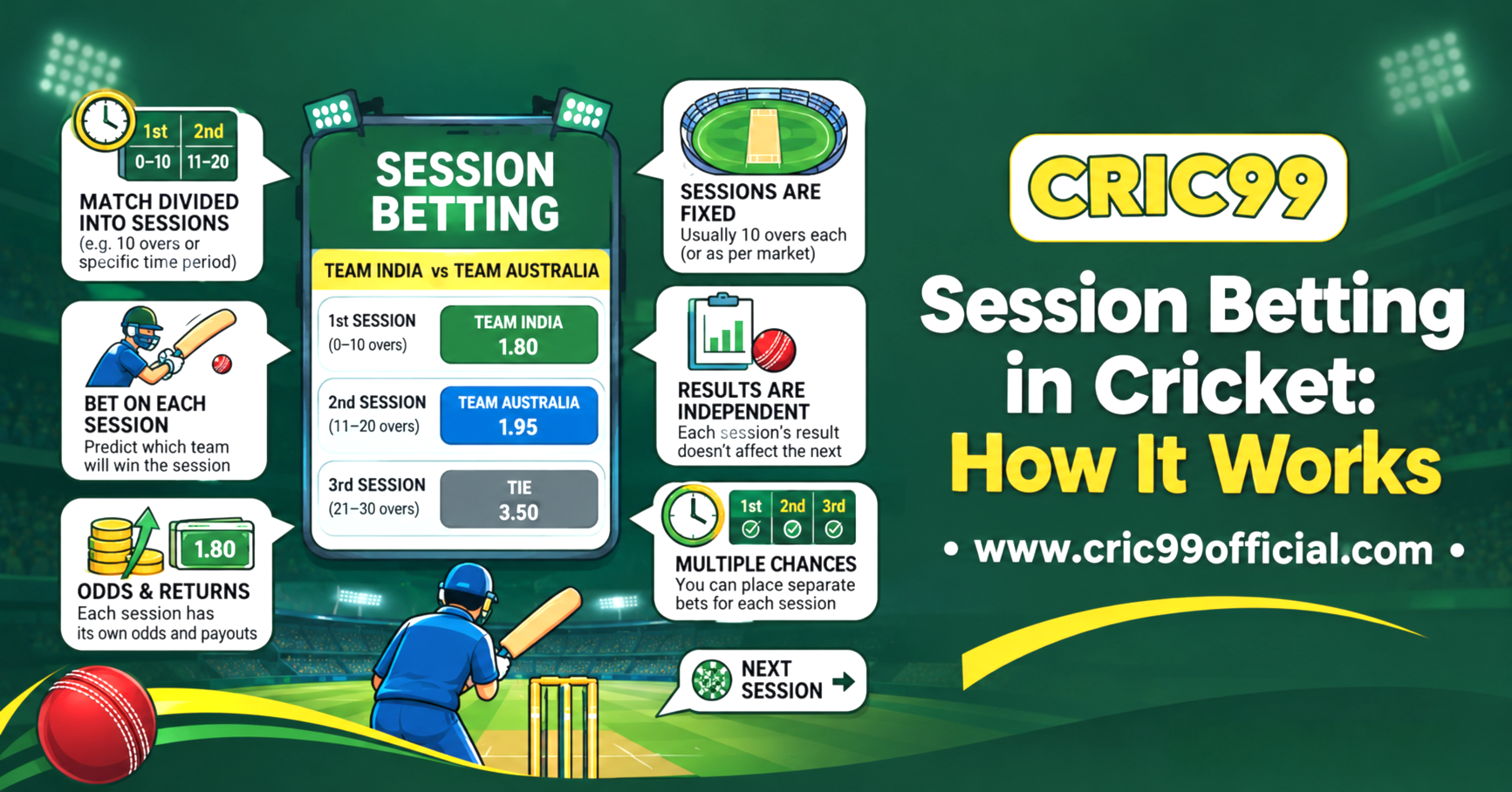
Session Betting in Cricket: How It Works

Session betting in cricket explained with a beginner-friendly overview of session runs, over-based markets, betting lines, and key terms.
Understand cricket session betting with this beginner’s guide to session runs, over-based markets, scoring periods, and settlement rules.

Session betting in cricket refers to markets based on what happens during a specific period of a match, often measured by runs scored or wickets taken within a defined session or number of overs. Instead of focusing on the final match result, these markets concentrate on a shorter part of the game.

For example, a hypothetical session market might set a target of 95.5 runs for a particular period of play. The over selection would require the batting team to score at least 96 runs during that period, while the under selection would require 95 runs or fewer, subject to the market’s settlement rules.

Session betting is especially associated with longer cricket formats, where play is divided into sessions separated by scheduled breaks. However, the exact markets and definitions can vary between competitions and platforms.

This cricket betting guide explains how session markets work, what their different types mean, how odds are displayed, and which rules beginners should understand before interpreting a selection.

What Is Session Betting in Cricket?

A session is a defined period of play within a cricket match. In Test cricket, a day is generally divided into three sessions, with scheduled intervals between them. The precise timing can vary because of weather, delays, the match schedule, and playing conditions.

Session betting uses a specific period as the basis for a market. Depending on the market offered, it may focus on:

  • Total runs scored during a session.
  • Number of wickets taken during a session.
  • Runs scored during a specified group of overs.
  • Other events defined by the market rules.

The important point is that a session market does not usually cover the entire match or even necessarily the entire innings. It measures only the period named in the market description.

How Does Session Betting Work?

The basic idea is to identify the session or period being measured and understand the condition attached to the selection.

Consider a hypothetical market for the first session of a Test match:

  • Market: First-session total runs
  • Run line: 89.5
  • Over selection: 90 or more runs
  • Under selection: 89 runs or fewer

If the team scores 94 runs during the specified session, the over selection would meet the stated run condition. If it scores 82 runs, the under selection would meet it.

This is a simplified example. Actual settlement depends on the market’s rules, including how the session is defined and what happens if play is interrupted or the scheduled period does not finish normally.

The basic process

Step 1: Identify the session. Check whether the market covers the first, second, or third session, or another specified period.

Step 2: Understand the statistic. Confirm whether the selection concerns runs, wickets, or another event.

Step 3: Read the line. For an over/under market, check the exact number and whether the selection is over or under.

Step 4: Check the odds. Understand the price format and the potential return shown for the selection.

Step 5: Review settlement conditions. Read what happens if rain, bad light, an early interval, or another interruption affects the session.

This process helps explain how cricket betting works in session markets without assuming that all platforms use identical rules.

Common Types of Session Betting Markets

The available options depend on the match, competition, and platform. The following are examples of market types that may be offered.

1. Session Runs

A session-runs market focuses on the total runs scored by the batting team during a specified session.

For example, a hypothetical market might offer an over/under line of 105.5 runs for the second session. The result is based on the runs scored within that defined period, not automatically on the team’s entire innings.

The market rules determine how extras, interruptions, and session boundaries are handled.

2. Session Wickets

A session-wickets market focuses on how many wickets fall during a particular session.

For example, a hypothetical line might be 2.5 wickets:

  • Over 2.5 would require at least three wickets to fall.
  • Under 2.5 would require two wickets or fewer.

Check the market definition carefully. The number of wickets taken by bowlers and the number of wickets lost by a batting team may not be described in exactly the same way in every market.

3. Session Over/Under

Some session markets use a numerical line to create over and under selections. The line might relate to runs, wickets, or another statistic.

For example, a runs market at 79.5 separates outcomes of 80 or more from outcomes of 79 or fewer, assuming the market is settled on the specified session total.

For a broader explanation of this market format, see Over/Under Betting in Cricket Explained for Beginners.

4. Over-Based Markets

Some markets focus on a specific group of overs rather than a traditional Test-match session. A market might cover the runs scored in the next five overs or during a stated period.

These markets should not automatically be treated as session markets. Check the exact overs included and the time period covered.

5. Session-Specific Events

Depending on the market offered, a selection may relate to a particular event during a session. The wording should identify the event and the period in which it must happen.

Never assume that a market includes an event simply because it occurs on the same day. The session or over range specified in the terms determines the relevant period.

How Are Cricket Sessions Divided?

In Test cricket, a day’s play is generally arranged into three sessions:

SessionGeneral structure
First sessionMorning period before the main interval
Second sessionPeriod after the main interval and before the next scheduled break
Third sessionFinal scheduled period of play for the day

The exact start and finish times depend on the match schedule and local conditions. Delays, weather interruptions, slow over rates, and other circumstances can affect the amount of actual playing time.

This matters because a session market must be settled using its stated definition. A market may use a scheduled session, a specified number of overs, or another clearly described period. Do not assume that every platform uses the same boundaries.

Session Betting vs Innings Betting

Session betting and innings betting are related, but they do not measure exactly the same thing.

  • Session betting focuses on a defined period of play, such as the first session of a Test-match day.
  • Innings betting focuses on an innings or an event within that innings, which may continue across more than one session.

For example, a team could score 90 runs in the first session and continue batting during the second session. A first-session runs market would cover only the first defined period, while a full-innings total would cover the innings according to its market rules.

This distinction is important for anyone learning cricket betting basics. A session result should not be confused with the final innings score.

Session Betting vs Match Betting

Match betting generally concerns the result of the match or another event measured across the match. Session betting focuses on a shorter period.

Imagine a team scores 110 runs during the first session but eventually loses the Test match. A session-runs market and a match-winner market could therefore have completely different outcomes.

A strong session does not guarantee a match victory. The remaining sessions, opposition performance, pitch conditions, and match situation can all influence the final result.

Understanding Odds in Session Markets

Odds represent the quoted price for a selection. They may be displayed in decimal, fractional, or American format.

Consider a hypothetical session selection with decimal odds of 1.90. If a stake of 100 units were placed and the selection settled as a win under the applicable rules, the total return would be 190 units, including the original stake. The profit would be 90 units, before any applicable fees or adjustments.

This is a mathematical illustration, not a prediction or recommendation. Odds do not guarantee that a selection will win.

If you want to understand the plus and minus format, read American Odds Explained: How the Plus and Minus Format Works.

When comparing prices, make sure the markets cover the same session, statistic, and settlement conditions. Similar-looking prices may refer to different periods or rules.

What Can Affect a Cricket Session?

A session can develop differently from expectations because cricket conditions and match situations change throughout the day.

FactorHow it may affect the session
Pitch conditionsThe surface may influence batting comfort and bowling effectiveness.
WeatherRain, humidity, and other conditions can affect play or interrupt the session.
Light conditionsPoor light may lead to delays or an early end to play.
Batting approachA team may score cautiously or attack depending on the match situation.
Bowling changesDifferent bowlers and tactics can change the pressure on batters.
Wickets lostLosing wickets may influence the batting team’s approach.
Match situationThe score, target, and remaining time can affect tactics.
Scheduled breaksIntervals define session boundaries and can affect the period covered by a market.

These factors provide context, but they cannot reliably determine how many runs will be scored or wickets taken in a session. Past performance does not guarantee a similar result in future play.

What Happens If a Session Is Interrupted?

Session markets can be affected by circumstances that shorten or interrupt play. Examples include:

  • Rain or a wet outfield.
  • Bad light.
  • An injury or another delay.
  • An early end to the day’s play.
  • A change to the scheduled session or over period.

The settlement treatment depends on the market’s terms. Some markets may have minimum-play requirements or specific rules for shortened sessions. Others may use a defined over range rather than the scheduled session.

Before interpreting a selection, check whether the market is settled using the scheduled period, the actual time played, or another stated condition. Never assume that an interrupted session is automatically settled as a win, loss, or void.

Session Betting and Cric99

If you use Cric99, check the market description and applicable terms for the specific match. Do not assume that every session market, statistic, or odds format is available for every event.

Market wording and settlement conditions can vary. Confirm which session is covered, what statistic is measured, and how interruptions are handled before relying on the information displayed.

For general platform information, What Is Cric99? Complete Guide to the Cric99 Platform provides an introduction to the platform. Keep your account credentials private and use only access routes you have verified.

Common Mistakes Beginners Should Avoid

When learning cricket betting explained topics, beginners may overlook details that change the meaning of a session market.

  1. Confusing sessions with innings: A session is a period of play, while an innings can continue across multiple sessions.
  2. Ignoring the session number: First-session runs and third-session runs are separate measurements.
  3. Overlooking the market line: A selection at 89.5 runs is different from one at 109.5 runs.
  4. Assuming fixed session timings: Actual play can be affected by weather, delays, and match conditions.
  5. Ignoring interruption rules: A shortened session may be treated differently under different market terms.
  6. Confusing runs with wickets: These are separate statistics and require different interpretations.
  7. Treating odds as certainty: A price is not a guarantee of the outcome.
  8. Chasing losses: Increasing stakes to recover previous losses can increase financial harm.

Understanding the market description and settlement rules is more useful than relying on assumptions about how a session will develop.

Frequently Asked Questions

What is session betting in cricket?

Session betting refers to markets based on events or statistics during a specific period of a cricket match. Common examples include session runs and session wickets.

Is session betting mainly used in Test cricket?

Session-based markets are commonly associated with Test cricket because a day’s play is generally divided into three sessions. Other period-based markets may be offered in different formats, depending on the platform.

What is a session-runs market?

A session-runs market measures how many runs a team scores during a specified session. The market may use an over/under line or another defined scoring condition.

What is the difference between session betting and innings betting?

Session betting covers a defined period of play, while innings betting covers an innings or an event within it. An innings may continue across more than one session.

How do over and under session markets work?

The market sets a numerical line for a statistic, such as runs scored. The over selection requires the result to finish above the line, while the under selection requires it to finish below the line, subject to the settlement rules.

What happens if rain interrupts a session?

The outcome depends on the market’s specific terms. Some markets may include minimum-play requirements or special rules for shortened sessions, so the settlement conditions should be checked.

Can session odds change during a match?

Where live session markets are offered, odds may change as the score, wickets, and match situation develop. Markets may also be suspended temporarily.

Final Thoughts

Session betting in cricket focuses on a defined period of play rather than the entire innings or final match result. Understanding session runs, wickets, over/under lines, and interruption rules can help beginners interpret these markets more accurately.

A useful cricket betting guide should explain what is being measured and how the result is settled. This article is for general educational purposes only, not financial advice or a recommendation to bet. Check the laws that apply to you, follow applicable age restrictions, set firm limits, and never use money needed for essential expenses.
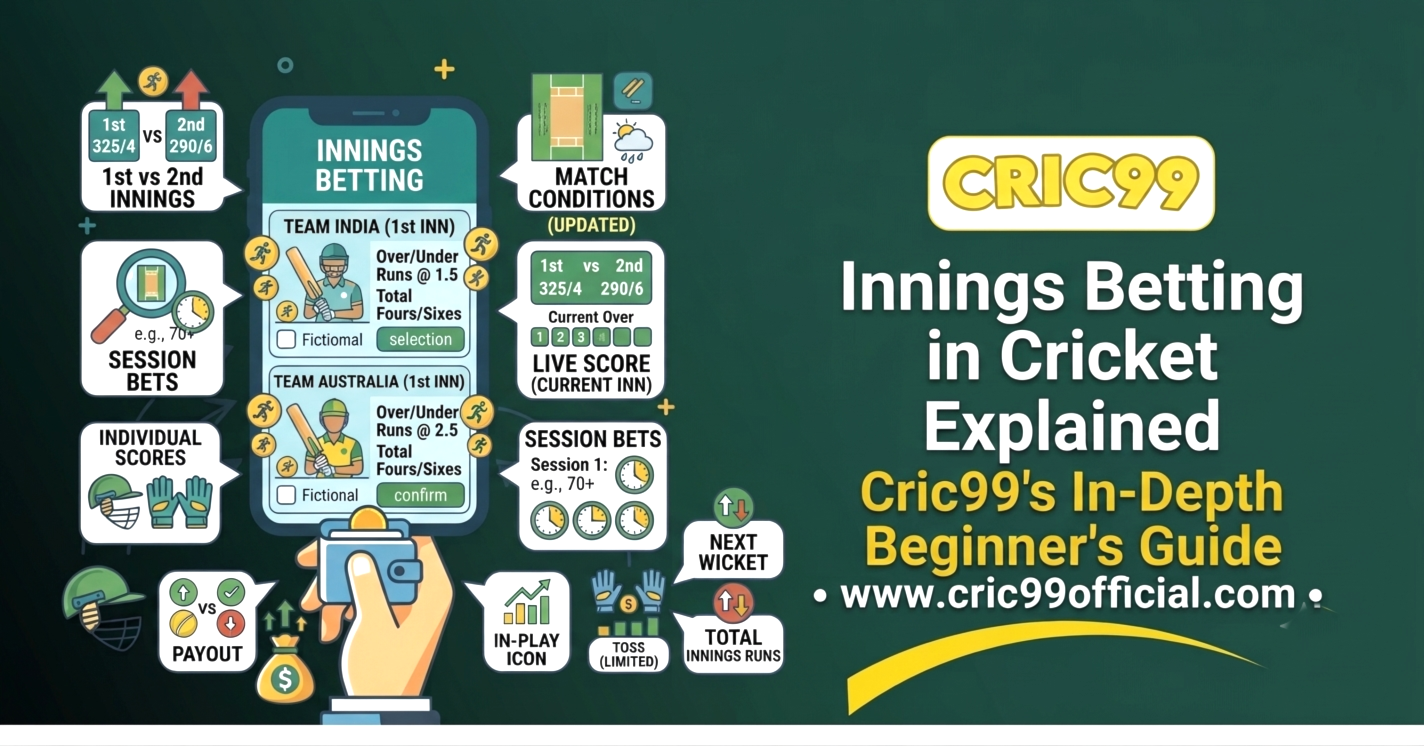
Innings Betting in Cricket Explained

Innings betting in cricket explained with a beginner-friendly overview of innings markets, team runs, wickets, totals, and key betting terms.
Understand cricket innings betting with this beginner’s guide to innings runs, wickets, totals markets, and important settlement conditions.

Innings betting in cricket refers to markets based on what happens during a particular innings, rather than only the final match result. Depending on the market, a selection may relate to an innings’ total runs, a team’s score during a specified period, or another event defined by the market rules.

For example, a hypothetical market might focus on whether a team scores over or under 150.5 runs in its first innings. This is different from predicting which team will win the match because the selection is assessed against the specified innings outcome.

This cricket betting guide explains common innings markets, how they work, how they differ from other cricket markets, and which details beginners should check before interpreting a selection.

What Is Innings Betting in Cricket?

An innings is a period of play in which one team bats and attempts to score runs. The structure of an innings depends on the match format: T20 and ODI cricket generally have limited-overs innings, while Test cricket can include multiple innings for each team.

Innings betting focuses on a defined part of that match. The market description determines which team, innings, statistic, or period is being assessed.

Common examples include:

  • First-innings total: The number of runs scored by a team in its first innings.
  • Second-innings total: The number of runs scored during a team’s second innings.
  • Innings over/under: Whether a specified innings total finishes above or below a stated run line.
  • Overs-based markets: Runs or another statistic recorded during a specified section of an innings.
  • Innings-specific events: A market based on an event that must occur during a particular innings, if that market is offered.

Not every platform or competition offers all these options. The exact market wording and settlement terms determine how a selection is assessed.

Common Types of Innings Betting Markets

1. First-Innings Betting

A first-innings market focuses on the team’s score or another defined event during its first innings.

For example, imagine a hypothetical over/under line of 158.5 runs for Team A’s first innings. The over selection would require Team A to score at least 159 runs, while the under selection would require 158 runs or fewer, assuming the market is settled on the completed innings total and no special rule changes the outcome.

The opposing team’s score is not automatically included. The market is concerned with Team A’s specified first innings.

2. Second-Innings Betting

A second-innings market focuses on the team batting in the second innings. Depending on the format and market, it may measure the team’s total runs or another defined event.

In a limited-overs chase, the batting side might reach its target before using all its scheduled overs. It could also lose all its wickets or have its innings affected by weather. These circumstances can influence settlement, so the market’s terms should be checked rather than assuming that every selection is settled in the same way.

3. Innings Total Over/Under

An innings over/under market sets a run threshold for a particular innings.

Consider a hypothetical line of 145.5 runs:

Final innings scoreOver 145.5Under 145.5
130 runsNot a winning selectionWinning selection
145 runsNot a winning selectionWinning selection
146 runsWinning selectionNot a winning selection
175 runsWinning selectionNot a winning selection

This example assumes the market uses the completed innings score and has no special interruption or settlement condition. Half-run lines avoid an exact tie with a whole-number total, but other markets may use different line formats.

For a fuller explanation of this format, see Over/Under Betting in Cricket Explained for Beginners.

4. Overs-Based Innings Markets

Some markets focus on a defined number of overs rather than an entire innings. For instance, a market might cover the runs scored during the first six overs.

Such a market is different from a full-innings total. Runs scored after the specified period ends do not ordinarily belong to that period’s statistic, but the exact rules must be confirmed.

Check which overs are included, how an interrupted period is handled, and whether the market refers to a particular team or innings.

5. Innings-Specific Player Markets

Some markets may focus on an individual player’s performance during a defined innings. Examples could include a batter’s runs or a bowler’s wickets, depending on what is offered.

A player’s first-innings statistic should not be confused with their total across multiple innings. Always check the player, statistic, and period covered by the selection.

How Does Innings Betting Work?

The basic process is to identify the relevant innings, understand the market’s measurement, and read the terms that determine settlement.

Step 1: Identify the team and innings. Confirm which side is covered and whether the market refers to the first innings, second innings, or a specified section of play.

Step 2: Read the market type. Determine whether it is a total-runs market, an over/under selection, an overs-based market, or another innings-specific option.

Step 3: Check the line or condition. A total of 145.5 runs differs from a total of 165.5 runs. The market condition determines which result qualifies.

Step 4: Understand the odds. Odds show the quoted price for a selection. The format may be decimal, fractional, or American.

Step 5: Review the settlement rules. Check how the market treats shortened innings, rain interruptions, abandoned matches, player non-participation, or other relevant circumstances.

This is the basic idea behind how cricket betting works in an innings market. Understanding the rules helps you interpret the selection, but it cannot make the outcome certain.

Innings Betting Across T20, ODI, and Test Cricket

The meaning of an innings depends partly on the format being played.

T20 cricket

T20 matches generally have one limited-overs innings per team. Innings markets may focus on a team’s total score or a specified segment of its overs. If a team reaches its target early while chasing, the market’s settlement rules become particularly relevant.

ODI cricket

One Day International matches generally have one innings per team, subject to the format’s rules and any interruptions. An innings market may measure a full-innings total or a particular period of play.

Test cricket

Test matches can include two innings per team, although not every innings necessarily takes place in every match. A market described as a team’s first-innings total is therefore distinct from one covering its second innings or the match as a whole.

Never assume that a market label has the same scope across all formats. Confirm the precise innings and period named in the market.

Innings Betting vs Team Totals

Innings betting and team totals can overlap because both may measure runs scored during an innings. However, the terms are not always interchangeable.

  • Innings betting is a broad description of markets tied to a particular innings or an event occurring during it.
  • Team totals specifically focus on the runs scored by a specified team during a defined period.

For example, a first-innings over/under market for Team A’s runs is both innings-specific and a team-total market. A market about an event occurring during the first six overs is also innings-specific, but it does not necessarily measure the team’s full-innings total.

The exact market description is more important than the broad category name.

Innings Betting vs Match-Winner Markets

These markets answer different questions.

A match-winner market concerns which team wins the match under the relevant competition and settlement rules. An innings market may be settled using a score or event from one specified innings, regardless of which team eventually wins the match.

For example, Team A might score 170 runs in its first innings but still lose the match. A first-innings total market and a match-winner market could therefore have different outcomes.

Beginners should avoid treating a strong innings score as a guarantee of victory. Match results depend on the opposition’s performance and the conditions of the game.

Understanding Odds in Innings Markets

Odds show the quoted price for a selection. Different formats display the price differently, but none guarantees a particular outcome.

Imagine a hypothetical selection displayed at decimal odds of 1.80. If a stake of 100 units were placed and the selection settled as a win under the applicable rules, the total return would be 180 units, including the original stake. The profit would be 80 units, before any applicable fees or adjustments.

This is a mathematical illustration only, not a recommendation or prediction.

American odds use positive and negative numbers to express potential profit or the amount associated with a reference stake. For more detail, read American Odds Explained: How the Plus and Minus Format Works.

When comparing odds, check that the selections cover the same innings, statistic, and settlement conditions. Two prices may not be directly comparable if their underlying markets differ.

What Can Affect an Innings Result?

Several factors can influence an innings score or the way an innings develops. These are contextual considerations, not reliable guarantees of a particular outcome.

FactorPossible relevance
Pitch conditionsMay affect batting and bowling conditions.
Batting orderInfluences which players are available at different stages of the innings.
Bowling attackCan affect scoring opportunities and wicket-taking pressure.
Overs remainingDetermines the time available to score in a limited-overs innings.
Wickets lostCan influence batting tactics and which players remain.
Weather interruptionsMay shorten the innings or trigger special settlement rules.
Match situationA target or required scoring rate can change the team’s approach.
Team selectionA change in the playing XI can affect player roles and available options.

No single factor determines an innings result. Cricket contains uncertainty, and previous scores do not ensure that a team will repeat them.

What to Check Before Interpreting an Innings Market

Before relying on a market description, confirm these details:

  1. The exact innings: First innings, second innings, or another specified period.
  2. The team or player: Check which participant the selection concerns.
  3. The statistic: Runs, wickets, or another defined measure.
  4. The line or condition: Read the number and selection wording carefully.
  5. The match format: T20, ODI, and Test cricket have different innings structures.
  6. The interruption policy: Check the terms for rain, reduced overs, abandonment, or an incomplete innings.
  7. The settlement definition: Confirm how the market result is determined.

These checks are central to understanding cricket betting basics. They help prevent confusion between similar market names that measure different outcomes.

Innings Betting and Cric99

If you use Cric99, check the market description and applicable terms for the specific event rather than assuming that every innings market is available. Market options, wording, odds formats, and settlement rules can vary.

For general platform information, What Is Cric99? Complete Guide to the Cric99 Platform explains the platform at a broad level. Review the applicable terms before relying on any market description, and keep your login details private.

Common Mistakes Beginners Should Avoid

When learning cricket betting explained topics, beginners may make mistakes by focusing on a market’s name rather than its exact conditions.

  • Confusing an innings total with the match total: They may measure different scoring periods.
  • Overlooking the innings number: A first-innings selection is not automatically settled using the second innings.
  • Ignoring overs-based conditions: A market covering the first six overs is different from a full-innings market.
  • Assuming all formats work the same way: Test cricket has a different innings structure from limited-overs cricket.
  • Ignoring interruption rules: Rain or an abandoned match may affect settlement.
  • Treating odds as certainty: A quoted price does not guarantee the outcome.
  • Chasing losses: Increasing stakes to recover previous losses can increase financial harm.

Learning the terminology can improve your understanding of a market, but it does not eliminate risk.

Frequently Asked Questions

What does innings betting mean in cricket?

It refers to markets based on a particular innings or an event during that innings. Depending on the market, the selection may concern runs, a defined overs period, or another specified statistic.

What is first-innings betting?

First-innings betting focuses on a market settled using a team’s first innings or an event specified within that innings. The exact market rules determine the outcome.

Is innings betting the same as team-total betting?

Not always. Team-total markets specifically measure a team’s runs over a defined period. Innings betting is broader and can include other events tied to a particular innings.

Can innings betting be available in Test cricket?

Innings-specific markets may be offered for Test matches, depending on the platform and event. Since Test cricket can include multiple innings per team, read the market description carefully.

What happens if rain interrupts an innings?

The result depends on the market’s settlement terms. A shortened innings, abandoned match, or no-result outcome may be handled differently across markets.

Are innings markets the same as match-winner markets?

No. A match-winner market concerns the match result, while an innings market focuses on the defined score or event within a particular innings. The outcomes can differ.

How can beginners understand innings odds?

Start by identifying the innings, team or player, statistic, and market line. Then check the odds format and settlement conditions. Odds describe a price, not a guaranteed result.

Final Thoughts

Innings betting in cricket covers markets connected to a particular innings or a defined event during that period. To understand a selection, check which innings it covers, what statistic is measured, and how the market is settled.

A good cricket betting guide should explain these distinctions clearly without suggesting that any result is certain. This article is for general educational purposes only, not financial advice or a recommendation to bet. Check the laws that apply to you, follow applicable age restrictions, set firm limits, and never use money needed for essential expenses.
Team Totals in Cricket Betting Explained

Team totals in cricket betting explained with a beginner-friendly overview of team runs, total-based markets, betting lines, and market rules.
Understand cricket team totals markets with this beginner’s guide to team runs, over/under lines, innings totals, and common betting terms.

Team totals in cricket betting are markets based on how many runs a particular team scores during a defined period of a match. Instead of predicting which team will win, a team-total market focuses on one side’s scoring performance. Depending on the market, the total may apply to a full innings, a particular innings segment, or another clearly defined period.

For example, a hypothetical team-total market might set a line at 159.5 runs. The over selection would require the team to score at least 160 runs during the specified period, while the under selection would require 159 runs or fewer, subject to the market’s settlement rules.

This cricket betting guide explains how team totals work, how they differ from match totals and cricket handicap betting, and which market details beginners should understand before interpreting the odds.

What Are Team Totals in Cricket Betting?

A team-total market measures the runs scored by one team rather than combining both teams’ scores. It is commonly presented as an over/under selection with a stated run line.

Consider a hypothetical T20 match between Team A and Team B:

  • Team A’s total line: 164.5 runs
  • Team B’s total line: 151.5 runs

These are separate markets. Team A’s total is assessed using Team A’s score, while Team B’s total is assessed using Team B’s score. The two lines do not need to be equal because the market prices and expectations can differ.

The exact options offered depend on the competition, match format, and platform. Always confirm whether the market refers to the first innings, second innings, full match, or a particular period of play.

How Do Team-Total Over and Under Markets Work?

Over/under team totals use a numerical line to define the two outcomes. The selection is assessed against the team’s score for the period specified in the market.

Example: Over or under a team total

Suppose a market sets Team A’s first-innings total at 164.5 runs.

Team A’s final first-innings scoreOver 164.5Under 164.5
148 runsNot a winning selectionWinning selection
164 runsNot a winning selectionWinning selection
165 runsWinning selectionNot a winning selection
190 runsWinning selectionNot a winning selection

This table is a simplified illustration. It assumes the market is settled on the team’s completed first-innings score and that no special abandonment or interruption rule changes the result.

A half-run line such as 164.5 avoids an exact tie with a whole-number team score. Other market formats may use whole-number or quarter-run lines, so check how pushes, partial outcomes, or special settlement conditions are handled.

Common Types of Team-Total Markets

Team totals can be offered over different periods. The market wording matters because a team’s final match score is not always the statistic being assessed.

1. Full innings team total

This market focuses on the runs a team scores during its specified innings. In a T20 or ODI, it may refer to the team’s first innings or second innings. In Test cricket, markets can be tied to a particular innings rather than the entire match.

Check whether extras are included in the total, how the innings is defined, and what happens if it ends early.

2. First-innings team total

A first-innings total applies only to the team’s first innings. For example, a hypothetical market may set a line at 172.5 runs. The result is assessed against that team’s first-innings score, not the combined score of both teams.

3. Second-innings team total

A second-innings total focuses on the batting side’s score in the second innings. In a limited-overs chase, the innings may end before the scheduled overs are completed if the target is reached or the team is all out.

The settlement rules determine how such circumstances affect the market.

4. Partial-innings team total

Some markets focus on a specific section of an innings, such as runs scored during a stated number of overs. A market covering the first six overs is not the same as a full-innings total.

Read the wording carefully to identify the overs included and how interruptions or shortened innings are treated.

5. Team totals in different formats

Team-total markets may be structured differently for T20, ODI, and Test cricket. The length of the format, innings structure, and conditions of play affect how the market is defined. Do not assume that a line or settlement rule used in one format automatically applies to another.

Team Totals vs Match Totals

Team totals and match totals both measure runs, but they use different scoring scopes.

  • Team total: Measures the score of one specified team over the defined period.
  • Match total: May combine the scores of both teams or use another match-wide scoring definition, depending on the market wording.

For example, if Team A scores 170 and Team B scores 155, a full-match combined total would be 325 runs if the market includes both completed innings. A Team A first-innings total would remain 170 runs.

This distinction is important when reading cricket betting explained content because two markets can show similar run lines while measuring different things.

For a closer look at the general over/under format, read Over/Under Betting in Cricket Explained for Beginners.

Team Totals vs Cricket Handicap Betting

Team totals and cricket handicap betting are different types of markets.

Team totals focus on the number of runs scored by one team. A selection might be over or under 164.5 runs for a specified innings.

Cricket handicap betting applies a stated advantage or disadvantage to a team or selection under the market’s rules. The result is assessed after the handicap is applied, according to the specific market conditions.

For instance, a team-total market asks whether a team scores above or below a stated run line. A handicap market asks how the team performs relative to the specified handicap. One is based on a scoring threshold; the other adjusts the result by a stated margin or condition.

Neither market should be treated as a prediction of a guaranteed outcome. Understanding the market definition is more important than relying on the name alone.

How to Read Team-Total Odds

Odds display the quoted price for a particular selection. They can appear in decimal, fractional, or American format, depending on the platform and settings.

Imagine a hypothetical over 159.5 team-total selection displayed at decimal odds of 1.90. If a stake of 100 units were placed and the selection settled as a win under the stated rules, the total return would be 190 units, including the original stake. The profit would be 90 units, before any applicable fees or adjustments.

This is a mathematical example, not a recommendation or a claim about the likelihood of the outcome. Odds alone do not guarantee a result.

If you need help understanding the plus and minus format, see American Odds Explained: How the Plus and Minus Format Works.

What Can Affect a Team’s Total?

A team’s score depends on many factors. These can provide context for understanding a market, but none can reliably predict the final total on its own.

FactorWhy it may matter
Pitch conditionsThe playing surface may affect scoring pace and how batters approach the innings.
Ground dimensionsBoundary distances can influence the difficulty of clearing the field.
Batting orderThe available batters and their roles can affect the innings’ scoring pattern.
Bowling attackThe opposition’s bowling skills and strategy can influence run-scoring opportunities.
Match formatT20, ODI, and Test cricket have different structures and scoring patterns.
Weather and interruptionsRain or other interruptions can shorten an innings or affect market settlement.
Match situationRequired run rate, wickets remaining, and the target can change a team’s approach.
Team selectionChanges in the playing XI may affect the roles available during an innings.

These factors are not a formula for predicting a score. Cricket matches can develop unexpectedly, and past scoring patterns do not ensure the same result in another game.

How Team Totals Work Before and During a Match

Depending on the platform and event, team-total markets may be offered before play or during live action.

Pre-match team totals

Pre-match lines are displayed before the match or relevant innings begins. The available price may reflect expectations about the teams, format, conditions, and other factors. These expectations can change when confirmed team selections or weather updates become available.

Live team totals

Live team-total markets may change as the innings progresses. The current score, overs remaining, wickets lost, and match situation can affect the line and odds. Markets can also be suspended while an event or score is being updated.

Live prices may move quickly, and the available market can change during play. Do not assume that a pre-match line remains available or that the rules are identical across every live selection.

What to Check Before Interpreting a Team-Total Market

A beginner should confirm the following details before interpreting any team-total selection:

  1. Which team is covered? Check the team name rather than assuming the market applies to the batting side you expect.
  2. What period is measured? Confirm whether it is a full innings, first innings, second innings, or a specific group of overs.
  3. What is the run line? Read the number carefully and identify the over or under selection.
  4. What counts toward the score? Check how extras and other scoring events are treated under the market rules.
  5. What happens if the match is interrupted? Review the terms for shortened innings, abandonment, or no-result situations.
  6. How is the market settled? Confirm the applicable settlement conditions rather than relying on assumptions based on the final score alone.

These checks help explain how cricket betting works in a team-total market without confusing it with other scoring or handicap options.

Team Totals and Cric99

If you use Cric99, check the event’s displayed market description and applicable terms rather than assuming that a particular team-total option is available. Market selection, wording, odds format, and settlement conditions can vary.

For general platform context, see What Is Cric99? Complete Guide to the Cric99 Platform. Review the terms relevant to your account and the specific market before relying on any description. Never share passwords or one-time verification codes with another person.

Common Beginner Mistakes

People learning cricket betting basics may overlook important differences between markets. Common mistakes include:

  • Confusing team totals with match totals: One measures a specified team’s score; the other may combine scores across teams.
  • Ignoring the innings or overs covered: A first-six-overs total is different from a full-innings total.
  • Assuming every market has identical rules: Similar labels can have different settlement conditions.
  • Treating a pitch report as a guarantee: Conditions can influence scoring but cannot determine the final total.
  • Ignoring interruptions: Rain, shortened innings, and abandoned matches may affect settlement.
  • Focusing only on the odds: The price does not explain the market’s full conditions or guarantee the result.
  • Chasing losses: Increasing stakes to recover losses can make financial harm worse.

Understanding the terms can help you read a market accurately, but it does not remove uncertainty or financial risk.

Frequently Asked Questions

What are team totals in cricket betting?

Team totals are markets based on the runs scored by one specified team during a defined period, such as an innings or a set number of overs.

How does over/under team-total betting work?

The market sets a run line. The over selection is assessed against whether the team’s score finishes above that line, while the under selection is assessed against whether it finishes below it. The exact settlement rules determine the outcome.

Are team totals the same as match totals?

No. A team total focuses on one team’s score. A match-total market may combine both teams’ scores or use another match-wide scoring definition stated in its terms.

Is team-total betting the same as cricket handicap betting?

No. Team totals use a scoring threshold, while cricket handicap betting applies a stated advantage or disadvantage under the relevant market rules.

Can team-total odds change during a match?

Yes, where live markets are available. Prices and lines can change as the innings develops, and markets may be suspended temporarily.

What happens if rain interrupts the innings?

The outcome depends on the market’s terms. Some markets may have specific conditions for shortened innings, abandonment, or no-result matches, so the applicable rules should be checked in advance.

Are team totals available in T20, ODI, and Test cricket?

Availability and market structure depend on the platform and competition. The period covered by a team-total market can differ between formats, so read the specific market description.

Final Thoughts

Team totals in cricket betting focus on how many runs one team scores during a defined period. To understand them, distinguish team totals from match totals and cricket handicap betting, read the run line carefully, and check the settlement rules for interruptions or incomplete innings.

A useful cricket betting guide explains market terminology without suggesting that any score or outcome is certain. This article is for general educational purposes only, not financial advice or a recommendation to bet. Check the laws that apply to you, follow applicable age restrictions, set firm limits, and never gamble with money needed for essentials.

Player Performance Betting in Cricket Explained

Live cricket betting explained with a beginner-friendly overview of in-play markets, changing odds, match events, and cricket betting terminology.
Live cricket betting markets explained for beginners, covering in-play odds, match events, changing conditions, and common market terms.

Player performance betting in cricket is a type of market where a selection is based on an individual player’s performance rather than only the final match result. Depending on the market, a prediction might involve a batter’s runs, a bowler’s wickets, or another measurable contribution during a match.

Understanding these markets is an important part of learning cricket betting basics. Before looking at any selection, beginners should understand what the market measures, which match conditions apply, and how the result will be settled. The available options and rules can differ between platforms and competitions.

This cricket betting guide explains common player performance markets, how cricket betting works in this context, how odds are displayed, and what to check before interpreting a market.

What Is Player Performance Betting in Cricket?

Player performance betting focuses on a statistic or achievement connected to a particular cricketer. Instead of predicting only which team will win, a market may ask whether a player will score above a stated run total or take a certain number of wickets.

For example, a hypothetical market might offer a batter’s total runs at an over/under line of 29.5. The two possible outcomes would be:

  • Over 29.5 runs: The batter must score at least 30 runs for the over selection to qualify as a win, subject to the market’s settlement rules.
  • Under 29.5 runs: The batter must score 29 runs or fewer for the under selection to qualify as a win, subject to the same rules.

This is an illustrative example, not a live market or a recommendation. The exact line, odds, and settlement conditions depend on the market being offered.

Common Types of Player Performance Markets

Player markets can cover several types of cricket statistics. Not every platform offers every market, and availability can vary by match format.

1. Batter runs

A batter-runs market focuses on how many runs a particular player scores in an innings or another defined period.

A hypothetical line might be 39.5 runs. The over selection would require the batter to score at least 40 runs, while the under selection would require 39 or fewer. The market rules determine how dismissals, interruptions, and incomplete innings are treated.

2. Bowler wickets

A bowler-wickets market focuses on the number of wickets credited to a particular bowler.

For example, a hypothetical line could be 1.5 wickets. An over selection would require at least two credited wickets, while an under selection would require one or none. Beginners should check which dismissals count and how the market handles a bowler who does not complete the expected spell.

3. Player boundaries and sixes

Some markets focus on a batter’s boundary count or number of sixes. These are different statistics: a four and a six may both count as boundaries in some markets, but a sixes market measures only sixes.

Read the market wording carefully. A selection about total boundaries should not be confused with one that counts sixes alone.

4. Player milestones

A market may focus on whether a player reaches a stated milestone, such as scoring a half-century or taking a specified number of wickets. The definition of the milestone and the period in which it must occur should be clear before interpreting the selection.

5. Other player statistics

Depending on the competition and platform, markets may cover additional performance measures. Always confirm the exact statistic, player, innings or time period, and settlement conditions rather than assuming that all platforms use the same rules.

How Does Player Performance Betting Work?

The general process is easier to understand when the market is broken into a few parts.

Step 1: Identify the player and statistic. Check the player’s name and whether the market concerns runs, wickets, boundaries, or another statistic.

Step 2: Read the market line. A line such as 24.5 runs separates the over and under outcomes. A different line can produce a different result from the same player performance.

Step 3: Understand the odds. Odds show the quoted price for a selection. They can be presented in decimal, fractional, or American format.

Step 4: Check the rules. Confirm how the market handles non-participation, substitutions, shortened matches, rain interruptions, retirements, and other unusual circumstances. These rules may differ between markets.

Step 5: Understand settlement. The result is determined using the statistic and conditions specified in the market rules. Do not assume that a selection is settled solely by the final score or by a player’s overall reputation.

This basic process helps explain how cricket betting works, but understanding the market does not make an outcome predictable or guarantee a positive result.

What Can Affect a Player’s Performance?

A player’s statistics can change with match conditions, team decisions, and the role they are given. No single factor reliably predicts an individual result.

FactorWhy it may matter
Batting positionA batter’s position can affect the time and number of balls available to score.
Bowling roleA bowler’s expected overs and place in the attack can affect wicket opportunities.
Pitch and weatherConditions may influence scoring, movement, interruptions, or the length of play.
OppositionThe opposing team’s bowling attack or batting approach can affect opportunities.
Match formatT20, ODI, and Test cricket provide different timeframes and tactical demands.
Team selectionA player’s participation and assigned role may differ from expectations.
Match situationA required run rate, wickets remaining, or innings position can change how a player approaches the game.

These are contextual considerations, not dependable ways to predict a specific statistic. Recent performance alone is not proof that a player will repeat the same result in the next match.

Player Performance Markets and Odds

Odds express the quoted return associated with a selection. The format changes how the price is displayed, but it does not remove the uncertainty of the outcome.

Decimal odds example

Suppose a hypothetical player market shows decimal odds of 2.00 for a selection. If a person places a stake of 100 units and the selection is settled as a win under the stated rules, the total return would be 200 units, including the original stake. The potential profit would be 100 units.

This example is only a mathematical illustration. It does not suggest that the selection is likely to win, and it excludes any fees or special settlement conditions that may apply.

For a more detailed explanation of how plus and minus prices work, see American Odds Explained: How the Plus and Minus Format Works.

Odds can change before an event or during live play. A displayed price is not a guarantee of the eventual result, and prices from different markets may not be directly comparable if their rules or conditions differ.

Player Performance Betting vs Cricket Handicap Betting

Player performance markets and handicap markets are not the same.

  • Player performance betting focuses on an individual player’s statistic, such as runs scored or wickets taken.
  • Cricket handicap betting applies a stated advantage or disadvantage to a team or selection under the market’s rules, often adjusting the effective result by a specified margin.

For example, a batter-runs line measures that batter’s runs, while a team handicap market evaluates the result after applying the stated handicap. Both require careful reading of the market terms, but they answer different questions.

If you are learning cricket betting basics, study the market definition before comparing odds or trying to interpret the outcome.

Player Performance Markets Before and During a Match

Some player markets may be available before the match begins, while others may be offered during live play. Availability depends on the platform, competition, and specific event.

Before the match

Pre-match prices are quoted before play starts. They may reflect expectations about the player’s role, team selection, opposition, format, and conditions. However, team changes or unexpected circumstances can make those assumptions outdated.

During live play

Live markets may change as the innings develops. A batter’s current score, balls faced, wickets remaining, and match situation can affect the available lines and odds. Markets may also be suspended temporarily while an important event is being reviewed or updated.

Live prices can move quickly, and there may be limited time to assess the rules. For more context on live-market mechanics, read Over/Under Betting in Cricket Explained for Beginners.

Understanding the Market Rules

Before interpreting a player market, check the details that determine how it will be settled.

  • Participation: Does the player need to take the field or face a ball for the market to stand?
  • Innings or match period: Does the statistic cover one innings, a complete match, or a specified period?
  • Interrupted matches: What happens if rain or another event shortens play?
  • Retirement or injury: How does the market handle a player who leaves the field or cannot continue?
  • Official statistics: Which source or official scoring record is used to determine the result?
  • Settlement terms: Are there special conditions for abandoned matches, no-result outcomes, or incomplete innings?

Do not assume that two markets with similar names have identical rules. Read the actual terms supplied for the specific selection.

What to Check on Cric99

If you use Cric99, treat the market description and applicable terms as the starting point for understanding what is offered. Do not assume that a particular player market, odds format, or settlement rule is available without checking the information shown for that event.

For account access and general platform information, the What Is Cric99? Complete Guide to the Cric99 Platform article provides background, while Cric99 Account Security: How to Protect Your Account covers basic account-safety considerations.

Keep account credentials private, use only access routes you have verified, and review the applicable terms before using any platform. Availability, market wording, and rules can change, so confirm details directly rather than relying on assumptions.

Common Mistakes Beginners Should Avoid

People learning cricket betting explained topics can overlook important details when they focus only on a player’s name or recent statistics.

  1. Ignoring the exact line: A market at 24.5 runs is different from one at 34.5 runs.
  2. Confusing player and team markets: A player’s statistic is not the same as a team’s total or match result.
  3. Assuming recent form guarantees a result: Past performance does not ensure the same outcome in a future match.
  4. Overlooking participation rules: A market may be affected if a player does not participate or the match is interrupted.
  5. Comparing prices without checking terms: Similar-looking odds can apply to markets with different conditions.
  6. Making rushed live decisions: Fast-moving prices can leave little time to review the details.
  7. Treating betting as income: Outcomes are uncertain, and losses are possible. Never stake money needed for essentials or borrow to participate.

A clear understanding of the market can help you interpret its wording, but it cannot eliminate the financial risk.

Frequently Asked Questions

What is player performance betting in cricket?

It is a market based on an individual player’s statistic or achievement, such as runs scored, wickets taken, or boundaries hit, rather than only the match result.

What are common player performance markets?

Examples include batter runs, bowler wickets, boundaries, sixes, and player milestones. The available markets vary by competition and platform.

How do over and under player markets work?

An over/under market sets a statistical line. The selection is assessed against the player’s result using the market’s stated rules. Half-unit lines, such as 29.5, avoid an exact tie with a whole-number statistic, although other settlement conditions can still matter.

Is player performance betting the same as cricket handicap betting?

No. Player performance betting focuses on an individual statistic, while cricket handicap betting applies a stated advantage or disadvantage under the relevant market rules.

Can player performance odds change during a match?

Yes, where live markets are offered. Prices and lines may change as play develops, and markets can be suspended. Availability and timing depend on the platform and event.

Does a player’s recent form guarantee the outcome?

No. Recent statistics provide context but cannot guarantee a future result. Conditions, player roles, opposition, and match circumstances can all differ.

What should beginners check before interpreting a player market?

Confirm the player, statistic, line, odds format, participation requirements, relevant innings or period, and settlement terms. Avoid relying on the market name alone.

Final Thoughts

Player performance betting in cricket centres on individual statistics rather than only the final match result. Understanding the difference between runs, wickets, boundaries, milestones, and team handicap markets helps beginners read market descriptions more accurately.

A useful cricket betting guide should explain the market’s definition, odds, and settlement conditions without presenting any outcome as certain. Learn the terminology, check the applicable rules, and remember that no analysis can remove the financial risk associated with betting.

Responsible-use note: This article is for general educational purposes only, not financial advice or a recommendation to place a bet. Betting may be restricted by age and local law. Check the laws that apply to you, set firm limits, and do not use money you cannot afford to lose.

Cricket Handicap Betting Explained for Beginners

Cricket handicap betting explained with a beginner-friendly overview of handicap lines, adjusted scores, team comparisons, odds, and market rules.
Understand cricket handicap betting with this beginner’s guide to handicap lines, adjusted scores, team comparisons, and common market terms.

Cricket Handicap Betting is a market in which a team or player starts with a virtual advantage or disadvantage for settlement purposes. Instead of judging only the actual match score or result, the market applies a handicap to one side and evaluates the outcome using the adjusted result.

This guide explains how cricket handicap markets work, how positive and negative handicaps are interpreted, and what beginners should check before reading the odds or market rules.

What Is Cricket Handicap Betting?

Cricket Handicap Betting changes the starting position of a selection by applying a specified adjustment. This adjustment may involve runs, wickets, or another measure defined by the market.

For example, a hypothetical match market might list:

  • Team A: -1.5 runs
  • Team B: +1.5 runs

The minus sign indicates a disadvantage, while the plus sign indicates an advantage for settlement purposes. The exact meaning depends on the market type and its rules.

A handicap does not change what happens on the field. It changes how the result is evaluated for that particular market.

How Cricket Handicap Betting Works

Understanding how cricket betting works begins with identifying the handicap, the selection, and the settlement conditions.

A typical handicap market can be understood through these steps:

  1. Identify the selection: Check which team or player the market refers to.
  2. Read the handicap: Note the number and whether it is positive or negative.
  3. Understand the adjustment: Determine how the handicap is applied to the relevant score or result.
  4. Review the odds: Check the displayed price for the selection.
  5. Read the market rules: Confirm how ties, interruptions, abandoned matches, and other unusual situations are handled.

Different handicap markets can use different calculations. Never assume that a run handicap, wicket handicap, and match-result handicap follow identical rules.

Cricket Handicap Betting Examples

Consider a simplified example involving a hypothetical run handicap.

Team A is listed at -10.5 runs, while Team B is listed at +10.5 runs. Assume the market rules apply the adjustment to the relevant final team scores.

Actual score differenceTeam A -10.5Team B +10.5
Team A wins by 20 runsAdjusted margin is +9.5; Team A coversTeam B does not cover
Team A wins by 10 runsAdjusted margin is -0.5; Team A does not coverTeam B covers
Team B wins the matchTeam A does not coverTeam B covers

This illustration assumes the handicap is applied to the score difference in the way described. Actual markets may define the calculation differently, so the provider’s rules take priority.

The important distinction is that a team can win the real match without covering its handicap. A handicap market evaluates the adjusted result, not simply who wins on the field.

What Do Positive and Negative Handicaps Mean?

Negative handicap

A negative handicap places a disadvantage on the selected team for market settlement.

For example, a team listed at -1.5 in a market based on a defined margin would need to overcome that adjustment under the market’s rules for the selection to succeed.

The precise requirement depends on what the market measures. A handicap applied to runs is not automatically equivalent to one applied to wickets or match results.

Positive handicap

A positive handicap gives the selected team a virtual advantage for settlement purposes.

For example, a team listed at +1.5 may be able to cover the handicap even if it loses by a narrow margin, depending on the market’s calculation.

A positive handicap does not mean the team receives actual runs or has a changed score on the field. It is an adjustment used to evaluate the market.

What Is an Asian Handicap in Cricket?

Some providers use Asian-style handicap lines, which commonly feature quarter increments such as -0.25, +0.25, -0.75, or +0.75. These lines can split a stake across two related handicap selections, creating different settlement possibilities.

For instance, a quarter-line handicap may result in a split settlement rather than a single win or loss. The exact calculation depends on the market and the rules provided.

Not every cricket provider offers Asian handicaps, and the term should not be assumed to describe every market with a plus or minus number. Always check the market definition before interpreting the line.

Cricket Handicap Betting vs Over/Under Betting

Handicap and over/under markets use numbers, but they answer different questions.

FeatureHandicap bettingOver/under betting
Main purposeEvaluates a selection after applying an adjustmentEvaluates whether a statistic finishes above or below a line
Typical focusAdjusted team or player resultRuns, wickets, or another specified total
Key detailHandicap and adjustment methodTotal line and measured statistic
SettlementBased on the adjusted result and market rulesBased on the final statistic and market rules

For example, a handicap market may ask whether a team covers a run disadvantage, while an over/under market may ask whether the combined total exceeds a specified number.

For a related explanation, read Over/Under Betting in Cricket Explained for Beginners.

How Handicap Odds Work

The odds attached to a handicap selection show the price for that selection. They do not guarantee that the team will cover the handicap.

For example, at decimal odds of 1.90, a hypothetical 100-unit stake would have a potential total return of 190 units if the selection wins and settles as expected. That total includes the original stake, so the potential profit would be 90 units before applicable deductions.

Formula:

Potential total return = Stake × Decimal odds

Handicap odds may change with team news, match conditions, market activity, or other information. A shorter price does not guarantee success, and a higher price does not automatically mean a selection offers better value.

What Should Beginners Check Before Reading a Handicap Market?

A useful cricket betting guide should explain the market details that are easy to overlook.

Before interpreting a handicap, check:

  • The statistic being adjusted: Is the handicap based on runs, wickets, or another outcome?
  • The selected team or player: Make sure the selection matches the intended side.
  • The sign and number: A plus and a minus handicap can have very different settlement consequences.
  • The market format: Determine whether it is a standard handicap or a different type of handicap market.
  • The settlement conditions: Check what happens in the event of a tie, interruption, abandoned match, or exact adjusted result.
  • The financial risk: Any money placed at risk can be lost.

These checks are more useful than assuming every handicap market uses the same calculation.

How Match Format Can Affect Cricket Handicap Markets

Cricket formats differ in length, scoring patterns, and possible outcomes. These differences can affect how handicap markets are defined.

T20 cricket

T20 matches have a limited number of overs, and relatively small changes in scoring can influence the margin between teams. The handicap still needs to be interpreted according to the specific market rules.

One-day international cricket

ODIs generally involve longer innings than T20 matches. The final margin may be affected by wickets, scoring rates, interruptions, and revised targets.

Test cricket

Test matches can last several days and may end in a win, draw, or tie. A handicap market may therefore have settlement conditions that differ from those used in limited-overs cricket.

Do not transfer assumptions from one format to another without checking the market’s definition.

Cricket Handicap Betting and Cric99

When reviewing Cric99, confirm the exact market name, handicap line, odds, and settlement rules shown for the fixture. Availability and market conditions can vary, so do not assume that every match offers the same handicap options.

Users should also understand the applicable service terms and account-safety considerations. Cric99 Account Security: How to Protect Your Account explains general account-safety practices, while Cric99 Terms and Conditions: Important Points to Understand is relevant to understanding why service-specific rules matter.

A displayed handicap is not a guarantee of a result. Check the terms carefully, use only services that are lawful where you live, and understand the financial risk before using any betting-related service.

Common Mistakes Beginners Should Avoid

When learning cricket betting basics, avoid these common misunderstandings:

  • Confusing a real score with an adjusted score: A handicap changes market settlement, not the score on the field.
  • Ignoring the sign: A positive handicap and a negative handicap can produce different outcomes.
  • Assuming all handicaps use runs: Some markets may measure another statistic or use a different settlement method.
  • Overlooking quarter lines: Some handicap formats can produce split settlements.
  • Ignoring match interruptions: The rules may specify how an interrupted or abandoned match is handled.
  • Treating odds as certainty: No displayed price guarantees that a selection will succeed.

Understanding these distinctions helps beginners interpret market terminology more accurately.

Frequently Asked Questions

What is Cricket Handicap Betting?

Cricket Handicap Betting is a market that applies a virtual advantage or disadvantage to a team or player for settlement purposes. The exact calculation depends on the type of market

How does a cricket handicap work?

The market applies a specified adjustment to the relevant score or result. The adjusted outcome is then assessed under the market’s rules to determine settlement.

What does a minus handicap mean?


A minus handicap generally places a disadvantage on the selected side. The team must overcome that adjustment under the applicable market calculation for the selection to succeed.

What does a plus handicap mean?

A plus handicap generally gives the selected side a virtual advantage for settlement purposes. The exact effect depends on the market’s definition and rules.

Is handicap betting the same as over/under betting?

No. Handicap markets evaluate a selection after applying an adjustment, while over/under markets evaluate whether a specified statistic finishes above or below a line.

Can a team win but fail to cover the handicap?

Yes. A team can win the actual match but fail to cover its handicap if the adjusted result does not satisfy the market conditions.

Are handicap odds a guarantee of success?

No. Odds represent a price for a selection, not a guarantee of the result. Cricket outcomes remain uncertain.

Final Thoughts

Cricket Handicap Betting uses a virtual adjustment to evaluate a team or player’s result. To understand a handicap market, beginners need to identify the statistic being measured, read the handicap correctly, understand the odds, and check the settlement conditions.

Learning these cricket betting basics can help explain how the market is structured, but it cannot remove uncertainty or financial risk.

Responsible-use note: Betting may be restricted by law and should only be considered by adults who are legally permitted to participate. Never risk money needed for essential expenses, and seek support if gambling becomes difficult to control.

Disclaimer: This article is for general informational and educational purposes only. It does not guarantee results or provide financial advice. Always check applicable laws and the specific terms and market rules of any service before using it.

Over/Under Betting in Cricket Explained for Beginners

Over/under betting in cricket is a market based on whether a specified statistic, such as total runs or wickets, will finish above or below a number set by the market. Instead of choosing which team will win, the market focuses on whether the final result will be higher or lower than the stated line.

This guide explains how over/under markets work, how to read the line and odds, and what beginners should understand about market rules and financial risk.

What Is Over/Under Betting in Cricket?

Over/under betting is a type of cricket market that focuses on a statistical total. The market displays a number, often called the line, and the available selections relate to whether the final total will be over or under that number.

For example, a market might set a line of 320.5 total runs for a specified match or innings.

  • Over 320.5: The relevant total must be 321 runs or more for the selection to win.
  • Under 320.5: The relevant total must be 320 runs or fewer for the selection to win.

The example assumes the market measures the final total for the stated period. The actual market description and settlement rules determine which runs count and what happens if the match is interrupted.

Over/under markets can apply to different statistics, so always check what the displayed line represents.

How Over/Under Cricket Betting Works

Understanding how cricket betting works starts with identifying three things: the statistic, the line, and the settlement conditions.

  1. Identify the market: Check whether it covers total match runs, an innings, a team total, or another statistic.
  2. Read the line: Note the number that separates the over and under selections.
  3. Understand the odds: Review the price attached to each selection.
  4. Check the rules: Find out how interruptions, shortened matches, abandoned games, or other unusual situations are handled.
  5. Understand the risk: Any money placed at risk can be lost, even when a selection seems likely.

These steps help you interpret the market. They do not provide a reliable way to guarantee the result.

Common Types of Over/Under Markets in Cricket

The exact markets available depend on the match, competition, and provider. Common examples include the following.

Total match runs

This market relates to the combined runs scored by both teams, if that is what the market definition specifies. Check whether extras and other scoring details are included under the stated rules.

Team total runs

A team total focuses on one team’s score rather than the combined match total. For example, a market might set a line of 165.5 runs for a team’s innings.

First-innings total

This market focuses on the score made in the first innings. The conditions may differ between T20, ODI, and Test cricket, so the exact innings covered must be clear.

Runs in a particular over

Some markets focus on the number of runs scored in a specified over. These markets have a much narrower scope than a full-innings total, and the relevant delivery and settlement rules matter.

Wickets or player statistics

Depending on the provider, a market may use over/under lines for wickets or other player statistics. Do not assume every type of statistic is available for every fixture.

For a broader introduction to the different options, read What Is Cric99? Complete Guide to the Cric99 Platform.

Over/Under Betting Examples

Consider a hypothetical T20 innings with an over/under line of 165.5 runs.

Final innings totalOver 165.5Under 165.5
150 runsDoes not winWins
165 runsDoes not winWins
166 runsWinsDoes not win
180 runsWinsDoes not win

Because the line ends in .5, the total cannot equal the line in this example. A whole-number final score will fall either above or below it.

Some markets use whole-number lines instead. Those can have different settlement outcomes, including a possible push or refund if the total exactly matches the line. The specific rules determine how that situation is handled.

What Do Over and Under Odds Mean?

Odds express the price attached to a selection. Decimal odds are commonly used to show the potential total return, including the original stake, if a selection wins and settles as expected.

For example, suppose a hypothetical over selection is priced at decimal odds of 1.90.

With a 100-unit stake:

Potential total return = 100 × 1.90 = 190 units

The potential profit would be 90 units, because the total return includes the original 100-unit stake. This example excludes any applicable fees or deductions and does not imply that the selection is likely to win.

Over and under prices can differ. A lower price does not guarantee a result, and a higher price does not automatically represent better value.

Over/Under vs Match Winner Betting

These markets focus on different questions.

FeatureOver/under marketMatch winner market
Main questionWill a statistic finish above or below a line?Which team will win?
Main focusA specified total or statisticThe match result
Possible outcomesOver or under, depending on the marketOne or more result selections
Important rulesThe statistic, line, and relevant periodMatch result and settlement conditions

A team can win a match without exceeding a particular run total. Likewise, a total-runs selection can win even if the team expected to score more does not win the match.

To understand match-result markets separately, see Match Winner Betting Explained: How Cricket Markets Work.

How Match Format Affects Over/Under Markets

The format of a cricket match matters because the length of an innings and the possible scoring patterns vary.

T20 cricket

T20 matches have a limited number of overs per side, so total-runs markets often focus on relatively short innings. Early wickets, scoring rates, and remaining overs can affect the match situation.

One-day international cricket

ODIs generally have longer innings than T20 matches. Run totals depend on the overs available, wickets remaining, playing conditions, and any interruptions or revised targets.

Test cricket

Test matches can extend over several days and include multiple innings. A market might refer to a particular innings, a team total, or another defined period. Always confirm exactly which statistic and timeframe are covered.

Do not compare over/under lines across different formats without first understanding the match conditions and market definition.

What Happens if Rain Interrupts a Match?

Weather interruptions can affect over/under markets, particularly in limited-overs cricket where the number of available overs may change.

Depending on the market rules, an interrupted match might be settled using a defined condition, adjusted under specified rules, or treated as void. There is no universal settlement rule that applies to every provider or market.

Before interpreting a line, check:

  • Whether the market requires a completed innings or match.
  • Whether revised targets or shortened innings affect settlement.
  • How abandoned or abandoned-after-start matches are treated.
  • Whether the market refers to the original line or a particular defined period.

These details are important because the same market name does not guarantee identical conditions across services.

Common Mistakes Beginners Should Avoid

A useful cricket betting guide should explain the mistakes that can lead to confusion.

  • Ignoring the line: Over or under only makes sense in relation to the exact number displayed.
  • Confusing team totals with match totals: One may cover a single team, while the other may combine both teams’ scores.
  • Assuming a whole-number line works like a half-number line: An exact match with a whole-number line may have a different settlement outcome.
  • Ignoring match interruptions: Rain or a shortened innings may affect settlement under the market rules.
  • Treating odds as predictions: Odds express a price, not certainty about the final total.
  • Assuming a high-scoring team always clears the line: A team’s reputation does not guarantee a particular score.
  • Risking more because the market looks simple: Every selection carries financial risk.

Understanding the market definition is more useful than making assumptions from a team’s name or previous results.

Over/Under Markets and Cric99

When reviewing Cric99, check the exact market description, line, odds, and settlement rules displayed for the relevant fixture. Market availability and conditions can vary, so do not assume every match offers the same over/under options.

If you use an account-based service, take time to understand account access and security. Cric99 Account Security: How to Protect Your Account explains general account-safety practices, while the service’s own terms should be checked for its specific conditions.

Never assume that a displayed price guarantees an outcome or removes the possibility of losing money. Use only services that are lawful where you live and meet the applicable eligibility requirements.

A Beginner’s Checklist

Before interpreting an over/under market, check the following:

  • What statistic does the market measure?
  • Does the line apply to a team, an innings, an over, or the whole match?
  • Is the line a whole number or a half number?
  • Do I understand the displayed odds?
  • Have I checked the rules for rain, interruptions, and abandoned matches?
  • Do I understand the amount I could lose?

This checklist helps clarify what a market means without treating the outcome as certain.

Frequently Asked Questions

What does over/under mean in cricket?

It refers to a market in which the outcome depends on whether a specified statistic finishes above or below a stated line. The statistic might be total runs, a team total, or another defined measure.

How does over/under betting work?

You identify the statistic and line, review the available over and under selections, understand the odds, and check the settlement conditions. The result depends on the final statistic under the stated market rules.

What is the difference between over/under and match winner betting?

Over/under markets focus on a specified total or statistic. Match winner markets focus on which team wins the match. They measure different outcomes.

What happens if the total equals the line?

It depends on the line and the market rules. A half-number line such as 165.5 cannot be matched by a whole-number score. A whole-number line may have a push, refund, or another specified settlement condition.


Can rain affect over/under markets?

Yes. Rain can shorten an innings or interrupt a match, and the applicable rules determine how the market is settled.

Are over/under odds a guarantee of the result?

No. Odds represent a price and do not guarantee the final score or statistic.

Final Thoughts

Over/under betting in cricket focuses on whether a specified statistic finishes above or below a market line. To understand it, beginners need to identify the statistic, read the line correctly, understand the odds, and check the rules for interruptions and settlement.

Learning these cricket betting basics can help you interpret market terminology more clearly, but it cannot remove uncertainty or financial risk.

Responsible-use note: Betting may be restricted by law and should only be considered by adults who are legally permitted to participate. Never use money needed for essential expenses, and seek support if gambling becomes difficult to control.

Disclaimer: This article is for general informational and educational purposes only. It does not guarantee results or provide financial advice. Always check applicable laws and the specific terms and market rules of any service before using it.