
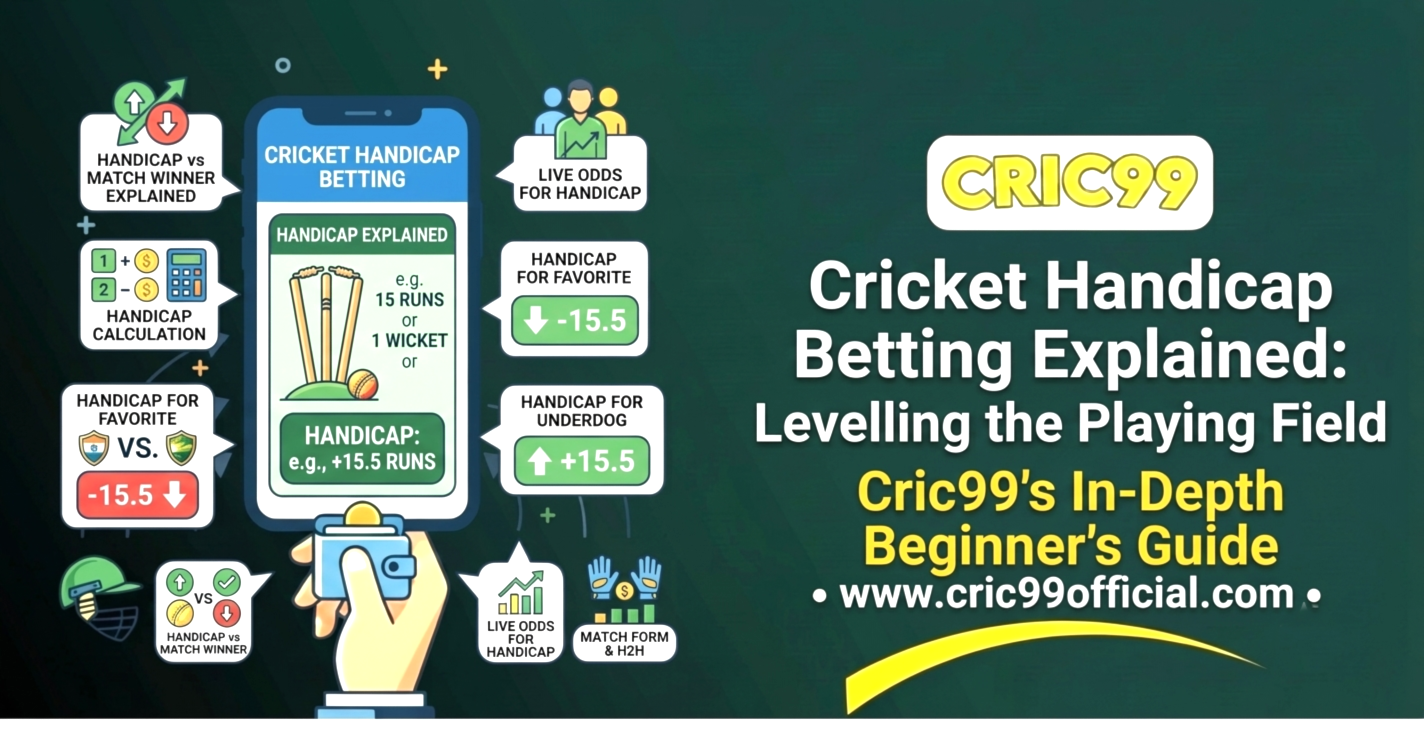
Cricket Handicap Betting is a market in which a team or player starts with a virtual advantage or disadvantage for settlement purposes. Instead of judging only the actual match score or result, the market applies a handicap to one side and evaluates the outcome using the adjusted result.
This guide explains how cricket handicap markets work, how positive and negative handicaps are interpreted, and what beginners should check before reading the odds or market rules.
What Is Cricket Handicap Betting?
Cricket Handicap Betting changes the starting position of a selection by applying a specified adjustment. This adjustment may involve runs, wickets, or another measure defined by the market.
For example, a hypothetical match market might list:
- Team A: -1.5 runs
- Team B: +1.5 runs
The minus sign indicates a disadvantage, while the plus sign indicates an advantage for settlement purposes. The exact meaning depends on the market type and its rules.
A handicap does not change what happens on the field. It changes how the result is evaluated for that particular market.
How Cricket Handicap Betting Works
Understanding how cricket betting works begins with identifying the handicap, the selection, and the settlement conditions.
A typical handicap market can be understood through these steps:
- Identify the selection: Check which team or player the market refers to.
- Read the handicap: Note the number and whether it is positive or negative.
- Understand the adjustment: Determine how the handicap is applied to the relevant score or result.
- Review the odds: Check the displayed price for the selection.
- Read the market rules: Confirm how ties, interruptions, abandoned matches, and other unusual situations are handled.
Different handicap markets can use different calculations. Never assume that a run handicap, wicket handicap, and match-result handicap follow identical rules.
Cricket Handicap Betting Examples
Consider a simplified example involving a hypothetical run handicap.
Team A is listed at -10.5 runs, while Team B is listed at +10.5 runs. Assume the market rules apply the adjustment to the relevant final team scores.
| Actual score difference | Team A -10.5 | Team B +10.5 |
|---|---|---|
| Team A wins by 20 runs | Adjusted margin is +9.5; Team A covers | Team B does not cover |
| Team A wins by 10 runs | Adjusted margin is -0.5; Team A does not cover | Team B covers |
| Team B wins the match | Team A does not cover | Team B covers |
This illustration assumes the handicap is applied to the score difference in the way described. Actual markets may define the calculation differently, so the provider’s rules take priority.
The important distinction is that a team can win the real match without covering its handicap. A handicap market evaluates the adjusted result, not simply who wins on the field.
What Do Positive and Negative Handicaps Mean?
Negative handicap
A negative handicap places a disadvantage on the selected team for market settlement.
For example, a team listed at -1.5 in a market based on a defined margin would need to overcome that adjustment under the market’s rules for the selection to succeed.
The precise requirement depends on what the market measures. A handicap applied to runs is not automatically equivalent to one applied to wickets or match results.
Positive handicap
A positive handicap gives the selected team a virtual advantage for settlement purposes.
For example, a team listed at +1.5 may be able to cover the handicap even if it loses by a narrow margin, depending on the market’s calculation.
A positive handicap does not mean the team receives actual runs or has a changed score on the field. It is an adjustment used to evaluate the market.
What Is an Asian Handicap in Cricket?
Some providers use Asian-style handicap lines, which commonly feature quarter increments such as -0.25, +0.25, -0.75, or +0.75. These lines can split a stake across two related handicap selections, creating different settlement possibilities.
For instance, a quarter-line handicap may result in a split settlement rather than a single win or loss. The exact calculation depends on the market and the rules provided.
Not every cricket provider offers Asian handicaps, and the term should not be assumed to describe every market with a plus or minus number. Always check the market definition before interpreting the line.
Cricket Handicap Betting vs Over/Under Betting
Handicap and over/under markets use numbers, but they answer different questions.
| Feature | Handicap betting | Over/under betting |
|---|---|---|
| Main purpose | Evaluates a selection after applying an adjustment | Evaluates whether a statistic finishes above or below a line |
| Typical focus | Adjusted team or player result | Runs, wickets, or another specified total |
| Key detail | Handicap and adjustment method | Total line and measured statistic |
| Settlement | Based on the adjusted result and market rules | Based on the final statistic and market rules |
For example, a handicap market may ask whether a team covers a run disadvantage, while an over/under market may ask whether the combined total exceeds a specified number.
For a related explanation, read Over/Under Betting in Cricket Explained for Beginners.
How Handicap Odds Work
The odds attached to a handicap selection show the price for that selection. They do not guarantee that the team will cover the handicap.
For example, at decimal odds of 1.90, a hypothetical 100-unit stake would have a potential total return of 190 units if the selection wins and settles as expected. That total includes the original stake, so the potential profit would be 90 units before applicable deductions.
Formula:
Potential total return = Stake × Decimal odds
Handicap odds may change with team news, match conditions, market activity, or other information. A shorter price does not guarantee success, and a higher price does not automatically mean a selection offers better value.
What Should Beginners Check Before Reading a Handicap Market?
A useful cricket betting guide should explain the market details that are easy to overlook.
Before interpreting a handicap, check:
- The statistic being adjusted: Is the handicap based on runs, wickets, or another outcome?
- The selected team or player: Make sure the selection matches the intended side.
- The sign and number: A plus and a minus handicap can have very different settlement consequences.
- The market format: Determine whether it is a standard handicap or a different type of handicap market.
- The settlement conditions: Check what happens in the event of a tie, interruption, abandoned match, or exact adjusted result.
- The financial risk: Any money placed at risk can be lost.
These checks are more useful than assuming every handicap market uses the same calculation.
How Match Format Can Affect Cricket Handicap Markets
Cricket formats differ in length, scoring patterns, and possible outcomes. These differences can affect how handicap markets are defined.
T20 cricket
T20 matches have a limited number of overs, and relatively small changes in scoring can influence the margin between teams. The handicap still needs to be interpreted according to the specific market rules.
One-day international cricket
ODIs generally involve longer innings than T20 matches. The final margin may be affected by wickets, scoring rates, interruptions, and revised targets.
Test cricket
Test matches can last several days and may end in a win, draw, or tie. A handicap market may therefore have settlement conditions that differ from those used in limited-overs cricket.
Do not transfer assumptions from one format to another without checking the market’s definition.
Cricket Handicap Betting and Cric99
When reviewing Cric99, confirm the exact market name, handicap line, odds, and settlement rules shown for the fixture. Availability and market conditions can vary, so do not assume that every match offers the same handicap options.
Users should also understand the applicable service terms and account-safety considerations. Cric99 Account Security: How to Protect Your Account explains general account-safety practices, while Cric99 Terms and Conditions: Important Points to Understand is relevant to understanding why service-specific rules matter.
A displayed handicap is not a guarantee of a result. Check the terms carefully, use only services that are lawful where you live, and understand the financial risk before using any betting-related service.
Common Mistakes Beginners Should Avoid
When learning cricket betting basics, avoid these common misunderstandings:
- Confusing a real score with an adjusted score: A handicap changes market settlement, not the score on the field.
- Ignoring the sign: A positive handicap and a negative handicap can produce different outcomes.
- Assuming all handicaps use runs: Some markets may measure another statistic or use a different settlement method.
- Overlooking quarter lines: Some handicap formats can produce split settlements.
- Ignoring match interruptions: The rules may specify how an interrupted or abandoned match is handled.
- Treating odds as certainty: No displayed price guarantees that a selection will succeed.
Understanding these distinctions helps beginners interpret market terminology more accurately.
Frequently Asked Questions
Cricket Handicap Betting is a market that applies a virtual advantage or disadvantage to a team or player for settlement purposes. The exact calculation depends on the type of market
The market applies a specified adjustment to the relevant score or result. The adjusted outcome is then assessed under the market’s rules to determine settlement.
A minus handicap generally places a disadvantage on the selected side. The team must overcome that adjustment under the applicable market calculation for the selection to succeed.
A plus handicap generally gives the selected side a virtual advantage for settlement purposes. The exact effect depends on the market’s definition and rules.
No. Handicap markets evaluate a selection after applying an adjustment, while over/under markets evaluate whether a specified statistic finishes above or below a line.
Yes. A team can win the actual match but fail to cover its handicap if the adjusted result does not satisfy the market conditions.
No. Odds represent a price for a selection, not a guarantee of the result. Cricket outcomes remain uncertain.
Final Thoughts
Cricket Handicap Betting uses a virtual adjustment to evaluate a team or player’s result. To understand a handicap market, beginners need to identify the statistic being measured, read the handicap correctly, understand the odds, and check the settlement conditions.
Learning these cricket betting basics can help explain how the market is structured, but it cannot remove uncertainty or financial risk.
Responsible-use note: Betting may be restricted by law and should only be considered by adults who are legally permitted to participate. Never risk money needed for essential expenses, and seek support if gambling becomes difficult to control.
Disclaimer: This article is for general informational and educational purposes only. It does not guarantee results or provide financial advice. Always check applicable laws and the specific terms and market rules of any service before using it.