
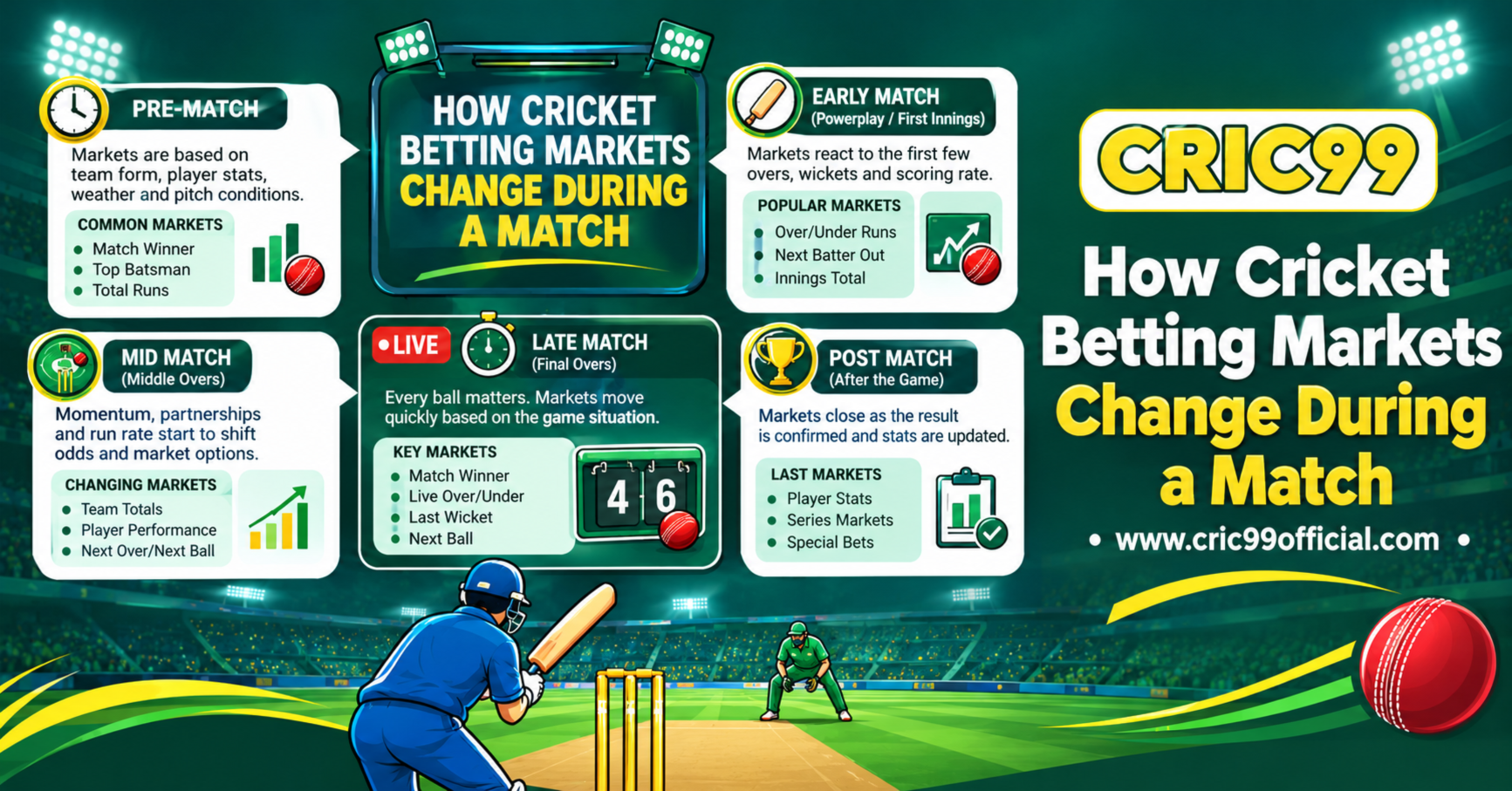
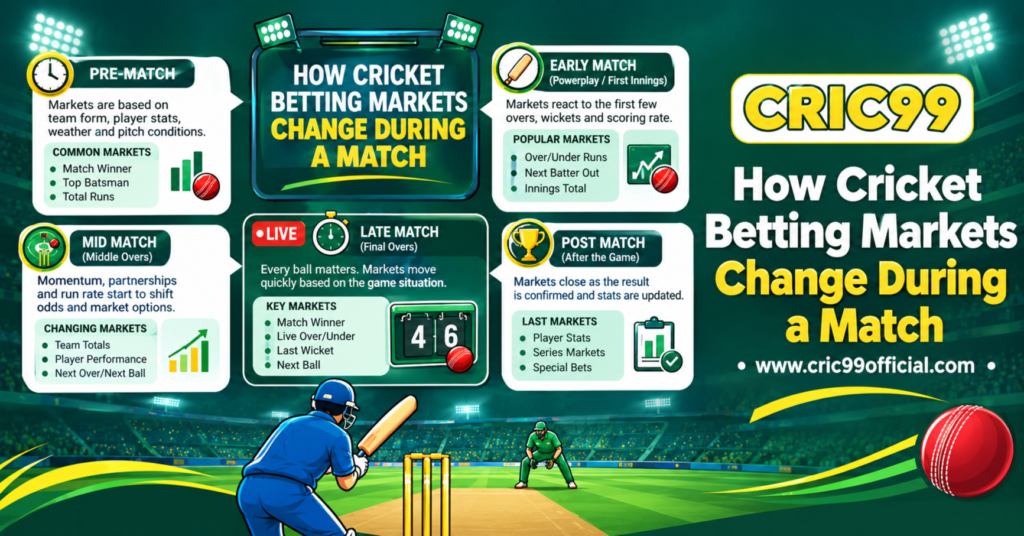
Cricket betting markets change during a match because the conditions and events on the field are constantly developing. A wicket, boundary, change in the required run rate, weather interruption, or shift in match momentum can affect how a market is priced. Some markets may also be temporarily suspended while an important event is confirmed.
Understanding why these changes happen is an important part of learning how cricket betting works. A market available before the first ball may look different after an innings begins, and a price displayed during one over may change by the next.
This cricket betting guide explains how live cricket markets change, what influences odds and market lines, why selections may disappear temporarily, and what beginners should understand before interpreting in-play prices.
What Are Cricket Betting Markets?
Cricket betting markets are categories of selections based on possible events or outcomes in a match. Each market has its own conditions and settlement rules.
Common examples include:
- Match winner: Which team wins the match under the stated rules.
- Innings total: The number of runs scored by a team during a specified innings.
- Over/under runs: Whether a score finishes above or below a stated line.
- Player performance: A statistic linked to an individual batter or bowler.
- Toss result: Which team wins the toss.
- Session markets: Runs, wickets, or other events during a defined session or period.
- Next-over markets: Events or scoring outcomes during a specified over, where offered.
Not every platform offers every market for every match. The available options depend on the competition, format, event, and platform.
Why Do Cricket Betting Markets Change During a Match?
Live markets respond to new information as the game progresses. A price or line shown before play is based on the information available at that time. Once the match starts, actual events provide new information that may change the market.
1. Wickets Fall
A wicket can change the balance of an innings. The batting team’s remaining players, current score, and match situation may all affect expectations about its eventual total.
For example, imagine a team is 90 runs for one wicket after 10 overs in a hypothetical T20 match. If it loses three wickets in the next two overs, the situation is different from what it was earlier. A live innings-total line or match-winner price may change in response.
A wicket does not automatically determine the final result. The remaining batters and the match conditions still matter.
2. Boundaries and Fast Scoring
A sequence of fours and sixes can increase the scoring rate quickly. This may affect markets linked to innings totals, match totals, or the next period of play.
Suppose a team scores 25 runs in one over. A live total line may move because the current score and remaining overs have changed. The movement depends on the market and the information used to price it.
3. Required Run Rate Changes
During a chase, the required run rate shows how quickly the batting team needs to score to reach its target within the remaining overs.
If the batting side scores quickly, the required rate may fall. If it loses wickets or scores slowly, the required rate may rise. These developments can influence live match-winner and innings-related markets.
The required run rate is a match statistic, not a guarantee of whether the target will be reached.
4. Player Performance
An individual player’s performance can affect markets connected to runs, wickets, boundaries, or other statistics.
For example, a batter who reaches a quick half-century may influence a player-runs market and could also affect the team’s innings-total market. However, different markets measure different things, so one player’s performance does not determine every market’s outcome.
5. Weather and Match Interruptions
Rain, bad light, or other interruptions can change the amount of play remaining. In limited-overs cricket, a revised target or reduced number of overs may alter the match situation.
Markets may be suspended while the playing conditions or revised match details are confirmed. Settlement rules can also differ depending on the market.
6. Changes in Team or Match Information
A confirmed team change, injury, player retirement, or other significant update may affect markets where that information is relevant. The impact depends on the specific event and market conditions.
How Do Live Cricket Odds Change?
Odds are prices attached to selections. They can move as new match information becomes available.
Consider a hypothetical match-winner market:
- Before the match, Team A is displayed at decimal odds of 1.80.
- After Team A loses several wickets, its price may move to a higher number.
- If Team A later builds a strong partnership, the price may move again.
These figures are illustrative only. They are not current prices or a prediction about any real match.
A higher decimal price generally represents a larger quoted return for a successful selection, while a lower price represents a smaller quoted return. However, odds movement does not guarantee that the market’s new expectation will be correct.
For more detail on how the plus and minus format works, read American Odds Explained: How the Plus and Minus Format Works.
How Market Lines Change During Live Play
Odds are not the only part of a market that can change. The line itself may also move.
For example, a hypothetical innings-total market might begin with a line of 165.5 runs. After a fast-scoring powerplay, the displayed line may rise. If the batting team then loses several wickets, the line may move in another direction.
The exact movement depends on the current score, overs remaining, wickets lost, match format, and market conditions.
Example: A changing innings-total line
| Match stage | Hypothetical market line | What has changed |
|---|---|---|
| Before the innings | 165.5 runs | Initial market estimate |
| After a strong powerplay | 178.5 runs | Early scoring has been faster |
| After several wickets | 157.5 runs | The batting side has lost momentum |
This table is a simplified illustration of possible line movement, not a record of real market prices. Actual prices and lines may behave differently.
For a beginner-friendly explanation of the over/under format, see Over/Under Betting in Cricket Explained for Beginners.
Which Markets Can Change During a Match?
The markets available during live play vary by platform and event. Some common examples include:
| Market type | What may influence it |
|---|---|
| Match winner | Current score, wickets, target, and remaining overs |
| Innings total | Runs scored, wickets lost, and overs remaining |
| Over/under runs | Current scoring pace and the remaining period |
| Player runs | The player’s score, balls faced, and whether they remain at the crease |
| Bowler wickets | Wickets already taken and remaining bowling opportunities |
| Session markets | Runs or wickets during the defined session |
| Next-over markets | Current match situation and the specific over being assessed |
A market may not remain available throughout the match. Some selections are offered only for a limited period, while others may be suspended or removed.
Why Are Live Markets Sometimes Suspended?
A suspended market is temporarily unavailable for new selections. This can happen when the platform needs to update or confirm information before displaying the market again.
Possible reasons include:
- A wicket has fallen and the score is being updated.
- A boundary or other important event is being confirmed.
- An umpire review is taking place.
- Rain or bad light has interrupted play.
- A player has been injured or has left the field.
- The market is being recalculated after a significant match event.
Suspension does not necessarily mean that the market has been permanently closed. It may reopen after the relevant information is confirmed, but reopening is not guaranteed.
The market’s own terms determine how any pending or unsettled selections are handled.
Pre-Match Markets vs Live Markets
Pre-match and live markets use different information because they are available at different stages of the event.
| Feature | Pre-match markets | Live markets |
|---|---|---|
| Timing | Before the match starts | During the match |
| Information | Team news, format, conditions, and other available details | Current score, wickets, overs, and match events |
| Odds movement | May change before play begins | May change as the match develops |
| Market availability | Depends on the event and platform | May change or be suspended during play |
| Settlement | Based on the relevant final outcome or market condition | Based on the same stated market condition, with any applicable live-market rules |
A live market is not automatically more accurate than a pre-match market. It simply reflects a different set of information and conditions.
What Is the Difference Between Odds Movement and Market Movement?
These terms are related but describe different changes.
Odds movement means the displayed price for a selection changes. For example, decimal odds might move from 2.00 to 1.75.
Market-line movement means the numerical condition changes. For example, an innings-total line might move from 150.5 to 160.5 runs.
A market can experience one type of movement or both. Always check the current selection and its conditions rather than relying on an earlier display.
What Should Beginners Check During Live Play?
When learning cricket betting basics, it is important to understand the information shown with a live market.
- Check the current score: Confirm the runs and wickets displayed.
- Check the overs: Make sure the current over and remaining overs are clear.
- Read the market title: Confirm whether the selection covers the match, innings, player, session, or a particular over.
- Read the current line: Do not rely on a line displayed earlier in the match.
- Check the odds format: Understand whether the price is decimal, fractional, or American.
- Look for interruptions: Reviews, rain, injuries, and score updates can affect market availability.
- Read the settlement rules: Confirm how the market handles shortened matches, abandoned play, or other unusual circumstances.
Live prices can change quickly. Taking time to understand the market is more important than reacting to every movement.
Cricket Betting Markets and Cric99
If you use Cric99, check the specific event page and market description for current availability and applicable terms. Do not assume that every market type, live option, or odds format is offered for every match.
Market descriptions and settlement conditions can vary. Confirm what a selection measures and how its result is determined before relying on the displayed information.
For general platform background, read What Is Cric99? Complete Guide to the Cric99 Platform. Keep your account credentials private and use only access routes you have verified.
Common Mistakes Beginners Should Avoid
People learning cricket betting explained topics can misunderstand live markets when they focus only on changing prices.
- Assuming odds movement predicts the result: A price change does not guarantee what will happen next.
- Using an old market line: The current line may be different from the one shown earlier.
- Confusing market types: An innings total, team total, and match total can measure different things.
- Ignoring wickets and overs: Both are important parts of the current match situation.
- Overlooking suspended markets: A market may be unavailable while information is being confirmed.
- Assuming all platforms use identical rules: Market availability and settlement conditions can differ.
- Reacting emotionally to every change: Fast-moving prices can encourage rushed decisions.
- Chasing losses: Increasing stakes to recover losses can make financial harm worse.
Understanding why markets move can help explain what is happening, but it cannot remove uncertainty or financial risk.
Frequently Asked Questions
Why do cricket betting markets change during a match?
Markets can change because of wickets, boundaries, scoring rates, player performances, weather interruptions, and other match developments. These events provide new information that may affect odds and market lines.
Do live cricket odds change after every ball?
Not necessarily. Odds may change after significant events or updates, but the timing and frequency depend on the market and platform. Some markets may be suspended temporarily.
Why are live cricket markets suspended?
Markets may be suspended while a wicket, review, boundary, injury, interruption, or score update is confirmed. They may reopen when the relevant information is available, depending on the platform.
What is the difference between odds movement and line movement?
Odds movement refers to a change in the displayed price. Line movement refers to a change in the numerical condition, such as an innings-total threshold.
Can a market line change during an innings?
Yes, where live line changes are offered. The current score, wickets, overs remaining, and match situation may influence the displayed line.
Are live markets different from pre-match markets?
Yes. Pre-match markets are based on information available before play, while live markets can reflect events that occur during the match. Their availability and prices may change at different stages.
Does a change in odds mean a team will win?
No. Odds are market prices, not guarantees. A match can develop in unexpected ways, even after a significant change in the displayed price.
What should beginners understand before looking at live markets?
They should understand the market type, current score, overs, wickets, odds format, line, and settlement rules. They should also recognise that live markets can change or be suspended.
Final Thoughts
Cricket betting markets change during a match because new events provide new information. Wickets, boundaries, scoring rates, player performances, and interruptions can influence both odds and market lines. Some markets may also become temporarily unavailable while an event is confirmed.
Understanding these changes is an important part of cricket betting explained content, but market movement should never be treated as a guarantee of a future result.
This article is for general educational purposes only, not financial advice or a recommendation to bet. Betting involves financial risk and may be restricted by age and local law. Check the laws that apply to you, set firm limits, and never use money needed for essential expenses.