
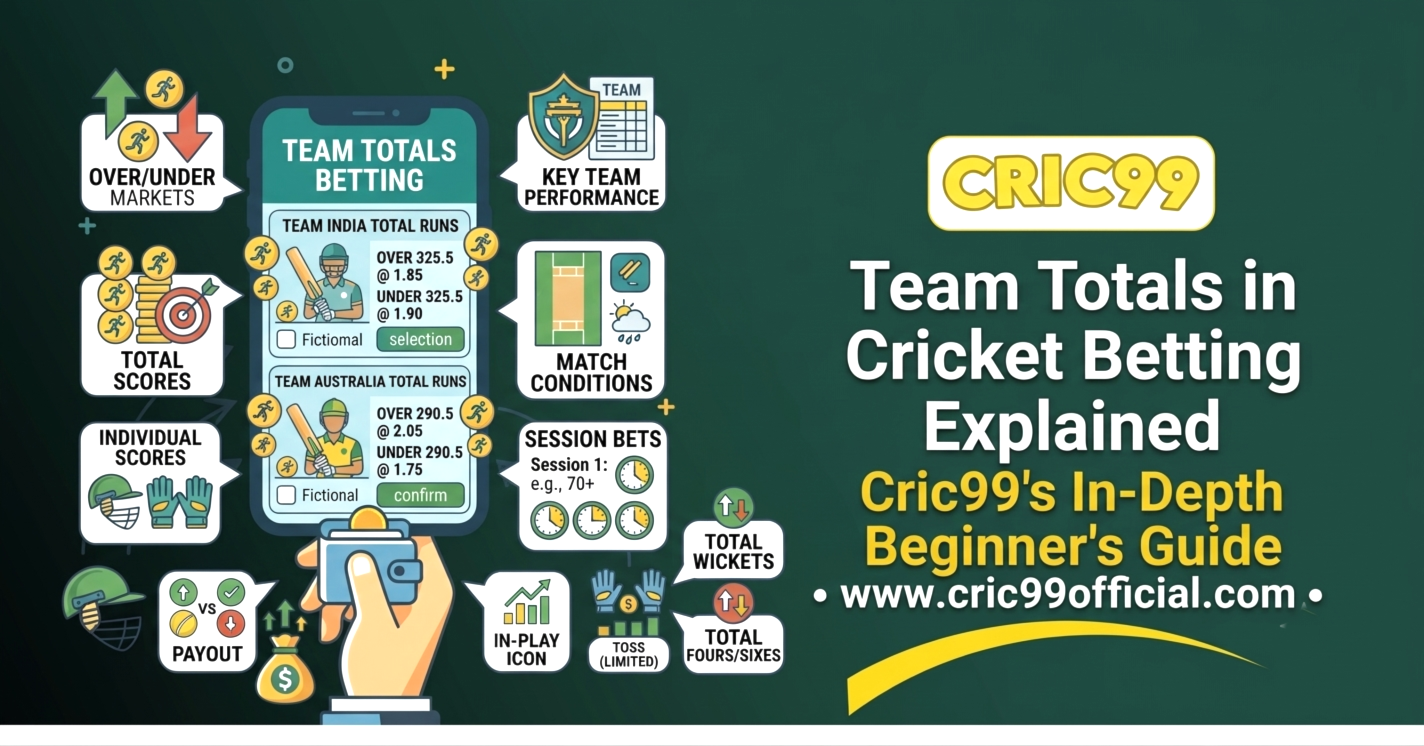
Team totals in cricket betting are markets based on how many runs a particular team scores during a defined period of a match. Instead of predicting which team will win, a team-total market focuses on one side’s scoring performance. Depending on the market, the total may apply to a full innings, a particular innings segment, or another clearly defined period.
For example, a hypothetical team-total market might set a line at 159.5 runs. The over selection would require the team to score at least 160 runs during the specified period, while the under selection would require 159 runs or fewer, subject to the market’s settlement rules.
This cricket betting guide explains how team totals work, how they differ from match totals and cricket handicap betting, and which market details beginners should understand before interpreting the odds.
What Are Team Totals in Cricket Betting?
A team-total market measures the runs scored by one team rather than combining both teams’ scores. It is commonly presented as an over/under selection with a stated run line.
Consider a hypothetical T20 match between Team A and Team B:
- Team A’s total line: 164.5 runs
- Team B’s total line: 151.5 runs
These are separate markets. Team A’s total is assessed using Team A’s score, while Team B’s total is assessed using Team B’s score. The two lines do not need to be equal because the market prices and expectations can differ.
The exact options offered depend on the competition, match format, and platform. Always confirm whether the market refers to the first innings, second innings, full match, or a particular period of play.
How Do Team-Total Over and Under Markets Work?
Over/under team totals use a numerical line to define the two outcomes. The selection is assessed against the team’s score for the period specified in the market.
Example: Over or under a team total
Suppose a market sets Team A’s first-innings total at 164.5 runs.
| Team A’s final first-innings score | Over 164.5 | Under 164.5 |
|---|---|---|
| 148 runs | Not a winning selection | Winning selection |
| 164 runs | Not a winning selection | Winning selection |
| 165 runs | Winning selection | Not a winning selection |
| 190 runs | Winning selection | Not a winning selection |
This table is a simplified illustration. It assumes the market is settled on the team’s completed first-innings score and that no special abandonment or interruption rule changes the result.
A half-run line such as 164.5 avoids an exact tie with a whole-number team score. Other market formats may use whole-number or quarter-run lines, so check how pushes, partial outcomes, or special settlement conditions are handled.
Common Types of Team-Total Markets
Team totals can be offered over different periods. The market wording matters because a team’s final match score is not always the statistic being assessed.
1. Full innings team total
This market focuses on the runs a team scores during its specified innings. In a T20 or ODI, it may refer to the team’s first innings or second innings. In Test cricket, markets can be tied to a particular innings rather than the entire match.
Check whether extras are included in the total, how the innings is defined, and what happens if it ends early.
2. First-innings team total
A first-innings total applies only to the team’s first innings. For example, a hypothetical market may set a line at 172.5 runs. The result is assessed against that team’s first-innings score, not the combined score of both teams.
3. Second-innings team total
A second-innings total focuses on the batting side’s score in the second innings. In a limited-overs chase, the innings may end before the scheduled overs are completed if the target is reached or the team is all out.
The settlement rules determine how such circumstances affect the market.
4. Partial-innings team total
Some markets focus on a specific section of an innings, such as runs scored during a stated number of overs. A market covering the first six overs is not the same as a full-innings total.
Read the wording carefully to identify the overs included and how interruptions or shortened innings are treated.
5. Team totals in different formats
Team-total markets may be structured differently for T20, ODI, and Test cricket. The length of the format, innings structure, and conditions of play affect how the market is defined. Do not assume that a line or settlement rule used in one format automatically applies to another.
Team Totals vs Match Totals
Team totals and match totals both measure runs, but they use different scoring scopes.
- Team total: Measures the score of one specified team over the defined period.
- Match total: May combine the scores of both teams or use another match-wide scoring definition, depending on the market wording.
For example, if Team A scores 170 and Team B scores 155, a full-match combined total would be 325 runs if the market includes both completed innings. A Team A first-innings total would remain 170 runs.
This distinction is important when reading cricket betting explained content because two markets can show similar run lines while measuring different things.
For a closer look at the general over/under format, read Over/Under Betting in Cricket Explained for Beginners.
Team Totals vs Cricket Handicap Betting
Team totals and cricket handicap betting are different types of markets.
Team totals focus on the number of runs scored by one team. A selection might be over or under 164.5 runs for a specified innings.
Cricket handicap betting applies a stated advantage or disadvantage to a team or selection under the market’s rules. The result is assessed after the handicap is applied, according to the specific market conditions.
For instance, a team-total market asks whether a team scores above or below a stated run line. A handicap market asks how the team performs relative to the specified handicap. One is based on a scoring threshold; the other adjusts the result by a stated margin or condition.
Neither market should be treated as a prediction of a guaranteed outcome. Understanding the market definition is more important than relying on the name alone.
How to Read Team-Total Odds
Odds display the quoted price for a particular selection. They can appear in decimal, fractional, or American format, depending on the platform and settings.
Imagine a hypothetical over 159.5 team-total selection displayed at decimal odds of 1.90. If a stake of 100 units were placed and the selection settled as a win under the stated rules, the total return would be 190 units, including the original stake. The profit would be 90 units, before any applicable fees or adjustments.
This is a mathematical example, not a recommendation or a claim about the likelihood of the outcome. Odds alone do not guarantee a result.
If you need help understanding the plus and minus format, see American Odds Explained: How the Plus and Minus Format Works.
What Can Affect a Team’s Total?
A team’s score depends on many factors. These can provide context for understanding a market, but none can reliably predict the final total on its own.
| Factor | Why it may matter |
|---|---|
| Pitch conditions | The playing surface may affect scoring pace and how batters approach the innings. |
| Ground dimensions | Boundary distances can influence the difficulty of clearing the field. |
| Batting order | The available batters and their roles can affect the innings’ scoring pattern. |
| Bowling attack | The opposition’s bowling skills and strategy can influence run-scoring opportunities. |
| Match format | T20, ODI, and Test cricket have different structures and scoring patterns. |
| Weather and interruptions | Rain or other interruptions can shorten an innings or affect market settlement. |
| Match situation | Required run rate, wickets remaining, and the target can change a team’s approach. |
| Team selection | Changes in the playing XI may affect the roles available during an innings. |
These factors are not a formula for predicting a score. Cricket matches can develop unexpectedly, and past scoring patterns do not ensure the same result in another game.
How Team Totals Work Before and During a Match
Depending on the platform and event, team-total markets may be offered before play or during live action.
Pre-match team totals
Pre-match lines are displayed before the match or relevant innings begins. The available price may reflect expectations about the teams, format, conditions, and other factors. These expectations can change when confirmed team selections or weather updates become available.
Live team totals
Live team-total markets may change as the innings progresses. The current score, overs remaining, wickets lost, and match situation can affect the line and odds. Markets can also be suspended while an event or score is being updated.
Live prices may move quickly, and the available market can change during play. Do not assume that a pre-match line remains available or that the rules are identical across every live selection.
What to Check Before Interpreting a Team-Total Market
A beginner should confirm the following details before interpreting any team-total selection:
- Which team is covered? Check the team name rather than assuming the market applies to the batting side you expect.
- What period is measured? Confirm whether it is a full innings, first innings, second innings, or a specific group of overs.
- What is the run line? Read the number carefully and identify the over or under selection.
- What counts toward the score? Check how extras and other scoring events are treated under the market rules.
- What happens if the match is interrupted? Review the terms for shortened innings, abandonment, or no-result situations.
- How is the market settled? Confirm the applicable settlement conditions rather than relying on assumptions based on the final score alone.
These checks help explain how cricket betting works in a team-total market without confusing it with other scoring or handicap options.
Team Totals and Cric99
If you use Cric99, check the event’s displayed market description and applicable terms rather than assuming that a particular team-total option is available. Market selection, wording, odds format, and settlement conditions can vary.
For general platform context, see What Is Cric99? Complete Guide to the Cric99 Platform. Review the terms relevant to your account and the specific market before relying on any description. Never share passwords or one-time verification codes with another person.
Common Beginner Mistakes
People learning cricket betting basics may overlook important differences between markets. Common mistakes include:
- Confusing team totals with match totals: One measures a specified team’s score; the other may combine scores across teams.
- Ignoring the innings or overs covered: A first-six-overs total is different from a full-innings total.
- Assuming every market has identical rules: Similar labels can have different settlement conditions.
- Treating a pitch report as a guarantee: Conditions can influence scoring but cannot determine the final total.
- Ignoring interruptions: Rain, shortened innings, and abandoned matches may affect settlement.
- Focusing only on the odds: The price does not explain the market’s full conditions or guarantee the result.
- Chasing losses: Increasing stakes to recover losses can make financial harm worse.
Understanding the terms can help you read a market accurately, but it does not remove uncertainty or financial risk.
Frequently Asked Questions
Team totals are markets based on the runs scored by one specified team during a defined period, such as an innings or a set number of overs.
The market sets a run line. The over selection is assessed against whether the team’s score finishes above that line, while the under selection is assessed against whether it finishes below it. The exact settlement rules determine the outcome.
No. A team total focuses on one team’s score. A match-total market may combine both teams’ scores or use another match-wide scoring definition stated in its terms.
No. Team totals use a scoring threshold, while cricket handicap betting applies a stated advantage or disadvantage under the relevant market rules.
Yes, where live markets are available. Prices and lines can change as the innings develops, and markets may be suspended temporarily.
The outcome depends on the market’s terms. Some markets may have specific conditions for shortened innings, abandonment, or no-result matches, so the applicable rules should be checked in advance.
Availability and market structure depend on the platform and competition. The period covered by a team-total market can differ between formats, so read the specific market description.
Final Thoughts
Team totals in cricket betting focus on how many runs one team scores during a defined period. To understand them, distinguish team totals from match totals and cricket handicap betting, read the run line carefully, and check the settlement rules for interruptions or incomplete innings.
A useful cricket betting guide explains market terminology without suggesting that any score or outcome is certain. This article is for general educational purposes only, not financial advice or a recommendation to bet. Check the laws that apply to you, follow applicable age restrictions, set firm limits, and never gamble with money needed for essentials.