
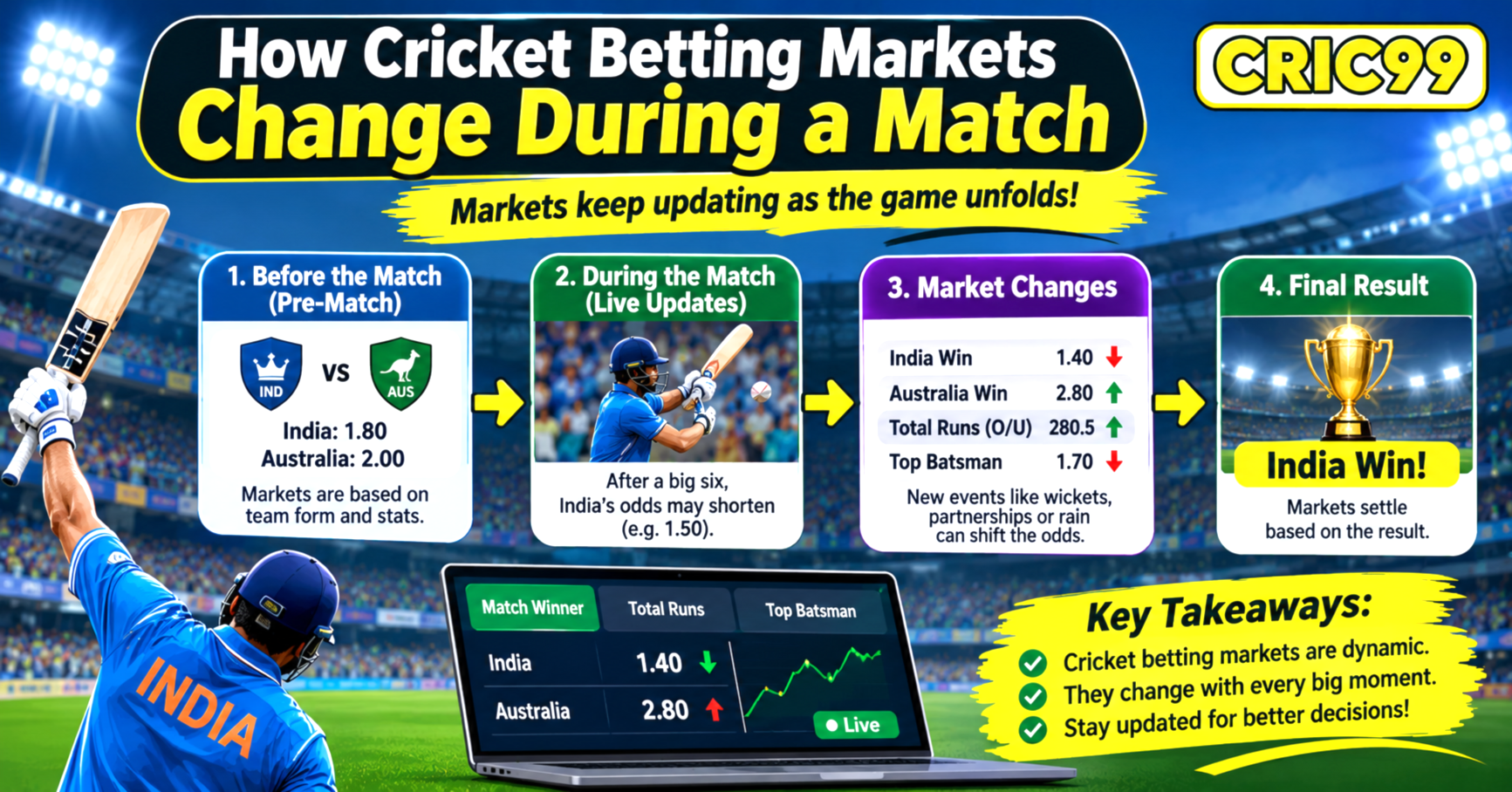
Cricket betting markets change during a match because the situation on the field is constantly developing. A wicket, boundary, change in scoring rate, or weather interruption can affect how an outcome is viewed. As a result, the odds and available market lines may move throughout the game.
Understanding how Cricket Betting Markets Change During a Match helps beginners recognise why the figures displayed before the first ball may look different a few overs later.
This guide explains the main reasons behind market changes, how live markets respond to match events, and what beginners should understand when learning cricket betting basics.
What Are Cricket Betting Markets?
A cricket betting market is a specific category of possible outcomes connected to a match. Each market focuses on a particular result, event, or statistic.
Common examples include:
- Match winner: Which team will win the match?
- Total runs: How many runs will a team or both teams score?
- Over/under: Will a specified total finish above or below a given line?
- Player performance: How many runs might a batter score or wickets might a bowler take?
- Next wicket: Which team or player-related event will be involved in the next dismissal, depending on the market wording?
- Innings total: How many runs will a team score in a particular innings?
These markets can respond differently to the same match event. For example, a wicket may affect the match-winner market, a batter’s performance market, and the innings-total market in different ways.
If you are new to the subject, What Is a Cricket Betting Market? Simple Explanation provides a useful introduction to the terminology.
How Do Cricket Betting Markets Change During a Match?
Before a match begins, market prices are generally based on information available before play. This may include team strength, player availability, recent performances, match conditions, and other relevant factors.
Once the match starts, new information becomes available with every over. Market prices and lines may adjust to reflect the changing situation.
For example, imagine a hypothetical T20 match:
- Team A starts with a strong opening partnership.
- The scoring rate increases after the powerplay.
- Team A loses two wickets in quick succession.
- The middle order slows down the scoring.
- Team A finishes its innings with a lower total than initially expected.
Each event changes the match situation. Markets connected to the innings total, match winner, and individual player performance may respond differently.
This is one reason live cricket betting markets can look very different from pre-match markets.
7 Major Factors That Influence Live Cricket Betting Markets
Several match events can influence market movements. The effect depends on the market, match format, remaining overs, and current score.
1. Wickets Falling
Wickets are among the most noticeable events in cricket. Losing a wicket can change the batting team’s scoring plans, especially when an established batter is dismissed.
For example, if a team loses two experienced batters early in a T20 innings, its remaining players may need to adjust their approach.
This can influence:
- Match-winner prices
- Innings-total lines
- Player-performance markets
- Over-based scoring markets
However, a wicket does not always have the same impact. A team with strong batting depth may recover quickly.
2. Boundaries and High Scoring Overs
A boundary can change the immediate scoring situation. Several boundaries in one over may increase the run rate and influence expectations about the final total.
Consider a hypothetical example:
A team scores 7 runs in one over, followed by 19 runs in the next. The scoring rate has increased, so markets linked to the innings total may adjust.
The effect depends on how many overs remain and the number of wickets available.
3. Changes in Run Rate
The current run rate and required run rate are important parts of limited-overs cricket.
- Current run rate: The average number of runs scored per over so far.
- Required run rate: The average runs per over needed to reach a target.
In a chase, the required run rate may rise when a team scores slowly or loses wickets. It may fall after a productive over.
These changes can influence markets connected to the match result and remaining runs.
4. Player Performance
Individual performances can affect markets related to both players and teams.
For example, a batter scoring quickly may influence expectations about the innings total. A bowler taking multiple wickets may change the outlook for the batting side.
Other relevant developments include:
- A batter reaching a half-century
- A bowler completing an economical spell
- An important player retiring hurt
- A key batter being dismissed
- A partnership building momentum
Player-related markets may have their own conditions, so the exact wording should always be checked.
5. Partnerships Between Batters
A stable partnership can change the direction of an innings.
When two batters remain at the crease and score consistently, the batting team may build a stronger position. A partnership can also reduce immediate pressure after early wickets.
However, partnerships can end suddenly. A single dismissal may change the situation again.
6. Weather and Match Interruptions
Weather can have a major effect on cricket matches, particularly in outdoor formats.
Rain, poor light, or other interruptions may reduce the available playing time. In limited-overs matches, revised targets and overs can also affect the match situation under the applicable playing rules.
Possible market effects include:
- Temporary market suspensions
- Changes to total-run lines
- Adjustments to match-result expectations
- Different settlement outcomes under specific rules
A suspended market does not necessarily mean that the match has been cancelled. It may simply be waiting for the situation to become clear.
7. Changes in Team Strategy
Teams do not always follow the same approach throughout a match.
A batting side may accelerate during the final overs, while a team defending a target may use its main bowlers at particular stages.
Changes in bowling combinations, batting order, field placements, and player availability can influence how a match develops.
These strategic decisions may affect different markets in different ways.
How Different Cricket Markets Respond to Match Events
Not every market reacts to an event in the same way. The following hypothetical examples show the difference.
| Match event | Markets that may be affected |
|---|---|
| Opening batter gets out | Player performance, innings total, match winner |
| Several boundaries in an over | Over/under, innings total, match winner |
| Required run rate increases | Match winner, remaining-overs markets |
| Key bowler takes two wickets | Player performance, innings total |
| Rain interrupts play | Match result, total runs, settlement conditions |
| Strong partnership develops | Innings total, player performance, match winner |
These are possible effects, not guaranteed market movements. The actual response depends on the event, market rules, and information available at that moment.
Pre-Match Markets vs Live Markets
Pre-match and live markets differ mainly in the timing of the information used to assess an outcome.
| Pre-match markets | Live markets |
|---|---|
| Available before play begins | Available during a match when offered |
| Based on pre-match information | Respond to developing match events |
| Do not reflect actual in-match scoring | May change after wickets, boundaries, and other events |
| Usually assessed before the first ball | May be updated throughout the game |
For example, a team may be considered stronger before a match begins. However, an early collapse could change the situation once play starts.
To understand the difference in more detail, read Live Cricket Betting Explained: How In-Play Markets Work.
Why Are Live Cricket Betting Markets Sometimes Suspended?
A live market may temporarily stop accepting activity when an important event takes place or its outcome needs confirmation.
Common situations include:
- A possible wicket under review
- A boundary or dismissal requiring confirmation
- A disputed umpire decision
- A rain interruption
- A sudden change in match conditions
- An update to the official score
Once the situation is confirmed, the market may reopen with updated prices or conditions.
Suspension is part of how live markets can operate. It should not automatically be interpreted as a technical problem.
Odds Changes vs Market Line Changes
Beginners sometimes assume that changing odds and changing market lines mean the same thing. They are related, but they are different.
Odds changes mean the displayed price for a particular selection has moved.
Market line changes mean the numerical threshold or condition used by the market has changed.
For example, consider a hypothetical over/under market:
- Earlier line: 150.5 total runs
- Updated line: 158.5 total runs
The numerical threshold has changed. The odds attached to the available selections may also change, but these are separate adjustments.
Understanding this distinction makes cricket betting explained content easier to follow.
What Should Beginners Check When Markets Change?
If you are learning how cricket betting works, it is important to understand the information displayed rather than reacting to every movement.
Consider these basic checks:
- Check the latest score: Make sure you understand the current match situation.
- Look at the overs remaining: The same score can mean different things at different stages.
- Check the wickets in hand: A team with several wickets remaining has a different situation from one nearing the end of its batting order.
- Understand the market type: A match-winner market and an innings-total market measure different outcomes.
- Read the updated line: Do not assume that a previous numerical threshold is still being used.
- Check settlement conditions: Rain, abandoned matches, ties, and shortened games may be handled differently.
- Avoid rushed decisions: Market movements can happen quickly, and no movement guarantees a particular result.
These points are useful for anyone following a beginner-friendly cricket betting guide.
How Cric99 Relates to Cricket Betting Information
Cric99 is a name readers may encounter while exploring cricket-related online platform information. However, the general market explanations in this article should not be treated as confirmation that every market is available on a particular platform.
Before using any service, check its current terms, available markets, settlement rules, account requirements, and applicable local laws. Do not assume that platform features or market availability remain the same over time.
Readers can also explore Cric99 Terms and Conditions: Important Points to Understand to learn why checking platform-specific rules matters.
Common Misunderstandings About Live Market Movements
Beginners can easily misunderstand why prices or market lines change. Here are some points worth remembering:
- A favourite can lose: Pre-match expectations do not determine the final result.
- One wicket does not decide the match: Its effect depends on the match situation.
- Higher odds do not guarantee a better outcome: Odds are prices, not promises.
- Every market has different rules: Similar market names may have different settlement conditions.
- Market movements are not predictions: A change in price does not guarantee what will happen next.
- Live markets may be unavailable temporarily: Suspensions can occur while events are confirmed.
Understanding these differences is more useful than trying to interpret every movement as a definite signal.
Frequently Asked Questions
1. Why do cricket betting markets change during a match?
They change because new information becomes available as the match progresses. Wickets, boundaries, scoring rates, player performances, and weather interruptions can all influence market prices and lines.
2. Which events affect live cricket betting markets the most?
Important events may include early wickets, big partnerships, high-scoring overs, key player dismissals, and weather interruptions. Their impact depends on the market and match situation.
3. Do cricket betting odds change after every over?
Not necessarily. Odds may change after significant events or updates, but the timing and frequency depend on the market and platform.
4. Why are live cricket betting markets suspended?
Markets may be suspended when an event needs confirmation, such as a possible wicket, boundary, umpire review, or weather interruption.
5. What is the difference between odds movement and line movement?
Odds movement refers to a change in the displayed price. Line movement refers to a change in the numerical threshold used in a market, such as a total-runs figure.
6. Can weather affect cricket betting markets?
Yes. Rain, poor light, and interruptions can change the available playing time and match conditions. They may also affect market availability and settlement.
7. Are pre-match and live cricket betting markets the same?
No. Pre-match markets are based on information available before the game, while live markets may respond to events during play.
Final Thoughts
Understanding how cricket betting markets change during a match starts with understanding the game itself. Wickets, boundaries, partnerships, scoring rates, player performances, and weather conditions can all influence the way markets are displayed.
Different markets respond to different events, and odds changes are not the same as market line changes. Beginners should take time to understand each market’s conditions and settlement rules rather than making assumptions based on a changing price.
Betting involves financial risk and does not provide guaranteed income. Only adults legally permitted to participate in their location should consider it. Set limits, never chase losses, and avoid using money needed for essential expenses.