
Cric99

Toss Betting in Cricket Explained How It Works

Toss betting in cricket explained with a beginner-friendly overview of coin toss outcomes, toss markets, odds, and important betting rules.
Understand cricket toss betting with this beginner’s guide to toss outcomes, market rules, odds terminology, and how toss markets work.

Toss betting in cricket refers to a market based on which team wins the coin toss before a match begins. Unlike match-winner markets, which focus on the final result, a toss market focuses on the outcome of the toss itself. Understanding this distinction is an important part of learning cricket betting basics.

This guide explains how cricket toss markets work, how their odds are displayed, how toss results differ from match results, and which market rules beginners should understand.

What Is Toss Betting in Cricket?

A cricket toss takes place before the match begins. The two team captains participate in the toss, and the winning captain generally gets to choose whether their team will bat or bowl first, subject to the format and competition rules.

A toss-winner market focuses on which team wins that toss. For example, before a hypothetical India versus Australia match, the market may list India and Australia as the two possible selections.

The toss result does not determine the match winner. A team can win the toss and still lose the match.

How Toss Betting in Cricket Works

Understanding how cricket betting works begins with knowing what the market measures.

A typical toss-winner market can be understood through these steps:

  1. Identify the fixture: Check that the correct teams and match are listed.
  2. Find the toss market: Confirm that the market specifically refers to the toss winner, not the match winner or another outcome.
  3. Review the odds: Understand the displayed price for each team.
  4. Check the rules: Read the conditions for postponed, abandoned, or cancelled matches and any other exceptional circumstances.
  5. Understand settlement: The result should be determined according to the market’s stated rules and the official toss outcome.

These steps explain the structure of a toss market. They do not provide a reliable way to predict or guarantee the result of a coin toss.

Toss Winner vs Match Winner

One of the most common beginner misunderstandings is confusing the toss winner with the match winner. They are separate outcomes.

FeatureToss-winner marketMatch-winner market
What it measuresWhich team wins the tossWhich team wins the match
When the outcome is determinedBefore the match startsAfter the match result is established
Main eventThe coin tossThe match itself
Can the outcomes differ?YesYes

For example, Australia might win the toss and choose to bowl first, but India could still win the match. The toss result and the final result are not the same event.

For a detailed explanation of match-result markets, read Match Winner Betting Explained: How Cricket Markets Work.

What Do Toss Market Odds Mean?

Odds express the price associated with a selection. They are not a guarantee of the outcome.

For example, a hypothetical toss market might display these decimal odds:

TeamExample decimal odds
Team A1.90
Team B1.90

These figures are illustrative only and do not represent live or verified prices. The odds shown by a provider may differ.

Decimal odds can be converted into an implied probability using this formula:

Implied probability (%) = (1 ÷ decimal odds) × 100

At odds of 1.90, the implied probability is approximately 52.63%. However, that figure is a mathematical conversion of the displayed price, not proof that the selection has that exact chance of occurring. Market prices may include a margin.

A coin toss has two possible sides, but the market’s rules, pricing, and settlement conditions still matter. Do not treat odds as a guarantee.

Does Winning the Toss Give a Team an Advantage?

Winning the toss gives the captain the opportunity to choose whether to bat or bowl first, where the format and competition rules allow that choice. The decision may depend on several match conditions.

Pitch conditions

A captain may consider whether the pitch is expected to change as the match progresses. The significance of pitch conditions varies by venue and match format.

Weather and dew

Weather forecasts and expected dew can influence a captain’s decision in some matches. These conditions do not guarantee that batting or bowling first will be better.

Match format

The considerations in a T20 match can differ from those in an ODI or Test match. The length of the game and the competition rules can affect the decision.

Team strategy

A captain may consider the team’s batting depth, bowling options, and preferred match approach.

These factors relate mainly to the decision made after winning the toss. They should not be confused with the toss result itself, which is determined independently of how the teams perform during the match.

Can You Predict the Toss Winner?

The toss is designed to be a random event. Team rankings, recent form, player statistics, and previous match results do not reliably establish which side will win the next toss.

Historical records may show how often a team has won tosses in the past, but past outcomes do not guarantee future results. A short sequence of toss wins or losses should not be treated as a dependable prediction method.

For beginners, the most useful approach is to understand what the market measures, how its odds are displayed, and how the result is settled rather than assuming a pattern will continue.

Toss Markets in T20, ODI, and Test Cricket

A toss takes place before many organised cricket matches, but market availability and rules depend on the competition and provider.

  • T20 cricket: The toss takes place before the short-format match, and the captain’s decision may influence the initial batting or bowling order.
  • One-day international cricket: The toss occurs before the ODI, with the captain choosing whether to bat or bowl first under the competition’s rules.
  • Test cricket: The toss takes place before the match, and the decision may be influenced by pitch conditions, weather, and the length of the game.

The toss market remains distinct from markets based on the score, player performances, or final match result. Always check the specific market description rather than assuming that every provider offers the same options.

Toss Betting vs Over/Under Markets

Toss-winner and over/under markets measure different events.

FeatureToss-winner marketOver/under market
Main questionWhich team wins the toss?Will a specified statistic finish above or below a line?
Relevant outcomeOfficial toss resultRuns, wickets, or another defined statistic
TimingBefore the match beginsMay be available before or during the match
Main rules to checkToss result and exceptional circumstancesLine, measured period, and settlement conditions

For more information about total-based markets, read Over/Under Betting in Cricket Explained for Beginners.

Understanding Toss Markets on Cric99

When reviewing Cric99, check the exact fixture, market description, displayed odds, and settlement rules. Market availability can vary, so do not assume that every match includes a toss-winner market.

If you use an account-based service, review its terms, eligibility requirements, and account-safety information. The guide Cric99 Terms and Conditions: Important Points to Understand provides a useful internal reference for understanding why service-specific rules matter.

Do not assume that a displayed price guarantees an outcome. Use only services that are lawful where you live, and understand the financial risks before using any betting-related service.

Common Mistakes Beginners Should Avoid

When learning cricket betting basics, keep these common mistakes in mind:

  • Confusing the toss with the match result: Winning the toss does not mean a team will win the game.
  • Treating past toss results as a prediction: Previous toss outcomes do not reliably determine the next one.
  • Assuming odds guarantee the outcome: Prices represent a market price, not certainty.
  • Ignoring the market description: Confirm that the market refers to the toss winner.
  • Overlooking settlement conditions: Postponed, abandoned, or cancelled matches may be handled according to specific rules.
  • Assuming every platform offers identical markets: Availability and conditions can differ between providers.

Understanding the event and its rules is more useful than making assumptions based on team reputation or past results.

Frequently Asked Questions

What is toss betting in cricket?

It refers to a market based on which team wins the coin toss before a cricket match begins. The exact settlement conditions depend on the market rules.

Does the toss winner always win the match?

No. The toss winner chooses whether to bat or bowl first where the rules allow, but the final match result is a separate outcome.

Can past toss results predict the next toss?

No reliable prediction can be made from past toss results alone. Each toss is intended to be a random event.

Are toss-winner odds the same as match-winner odds?

No. Toss-winner odds relate to the toss result, while match-winner odds relate to the final match result. They measure different outcomes.

What happens if a match is cancelled before the toss?

The settlement depends on the specific market’s terms. Check the provider’s rules for cancelled, postponed, or abandoned fixtures rather than assuming a universal outcome.

What should beginners learn first?

Start by understanding the difference between a toss market and a match-result market, how odds are displayed, and which settlement rules apply. These concepts form part of a basic cricket betting guide.

Final Thoughts

Toss betting in cricket focuses on which team wins the coin toss before the match begins. It is different from match-winner and over/under markets because it measures a separate event rather than the final score or result.

Learning how cricket betting works means understanding market definitions, odds, and settlement conditions without treating any outcome as certain.

Responsible-use note: Betting may be restricted by law and should only be considered by adults who are legally permitted to participate. Never risk money needed for essential expenses, and seek support if gambling becomes difficult to control.

Disclaimer: This article is for general informational and educational purposes only. It does not guarantee results or provide financial advice. Check applicable laws and the specific terms and market rules of any service before using it.
Cricket Betting Markets Explained: A Beginner’s Guide 2026

Cricket betting markets guide explaining match winner, totals, player markets, runs, wickets, and common market types for beginners.
A beginner-friendly guide to cricket betting markets covering match winner, totals, player performance, runs, wickets, and common market types.

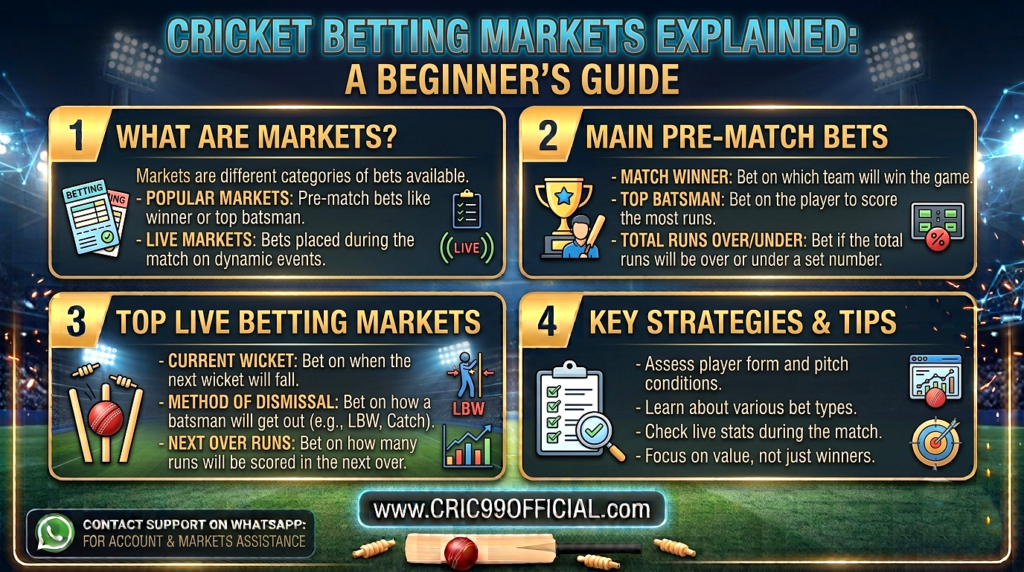
Cricket Betting Markets are the different types of outcomes or events that can be selected when looking at a cricket match. Instead of focusing only on which team will win, a market can cover match results, runs, wickets, player performances, innings outcomes, and other match-related events.

For beginners, understanding the market is just as important as understanding the odds. The odds tell you the price of a selection, while the market tells you what you are actually predicting.

This is one of the most important parts of cricket betting basics because a price has no useful meaning until you know exactly what outcome it represents.

What Are Cricket Betting Markets?

A betting market is a specific category of possible outcomes for a sporting event.

For example, a cricket match might have a Match Winner market with two selections:

  • Team A
  • Team B

Another market for the same match could focus on total runs, such as:

  • Over a specified total
  • Under a specified total

A player market could instead focus on an individual player’s performance.

The available markets can vary depending on the match, competition, timing, and service being used. Therefore, never assume that every market will be available for every cricket fixture.

Why Are Cricket Betting Markets Important?

Understanding markets helps you answer three basic questions:

  1. What event am I looking at?
  2. What does each selection mean?
  3. What do the displayed odds apply to?

For example, odds of 2.00 might look simple, but they could relate to a team winning, a total going over a certain number, or a player reaching a particular performance level.

Those are completely different selections.

A good cricket betting guide should therefore explain the market before focusing heavily on the price.

Match Winner Market

The Match Winner market is one of the easiest markets for beginners to understand.

The basic question is:

Which team will win the match?

For example:

SelectionExample Odds
Team A1.80
Team B2.10

The odds are attached to each team’s potential match outcome.

Before considering any price, you should understand the competition rules and how the market handles situations such as ties, abandoned matches, or no-result games.

Market rules can differ, so always check the applicable terms.

Toss Winner Market

A toss-related market focuses on the result of the pre-match coin toss rather than the final match result.

For example:

  • Team A wins the toss
  • Team B wins the toss

The toss winner and match winner are completely different outcomes.

A team can lose the toss and still win the cricket match.

This is a useful example of why identifying the market should always come before interpreting the odds.

Total Runs Markets

Total-runs markets focus on the number of runs scored.

A market may be based on:

  • Match total runs
  • Team total runs
  • Innings total
  • A specified over or period

Depending on the market, selections may be presented around a particular line.

For example, a hypothetical market could use a total of 300 runs:

  • Over 300
  • Under 300

The exact rules, settlement conditions, and available lines can vary.

Over/Under Markets

Over/under markets ask whether a particular statistic will finish above or below a specified number.

For example:

Total Match Runs — 300.5

Possible selections:

  • Over 300.5
  • Under 300.5

If the final total is 301 or more, the over selection would meet the numerical condition in this simplified example.

If the total is 300 or fewer, the under selection would meet it.

The actual settlement of any real market depends on its stated rules.

Team Total Markets

Team-total markets focus on one team’s performance rather than the entire match.

For example:

Team A Total Runs — 165.5

Possible selections might be:

  • Over 165.5
  • Under 165.5

This is different from a full-match total because only the specified team’s score is relevant to the market.

Understanding this distinction is a basic part of how cricket betting works.

Player Performance Markets

Player markets focus on individual performances.

Depending on the competition and service, examples can include:

  • Player runs
  • Player wickets
  • Player catches
  • Other performance statistics

For example, a hypothetical player-runs market could show:

Player X — 40.5 runs

Selections might include:

  • Over 40.5
  • Under 40.5

The exact statistics and markets available can vary.

Always check what statistic is being measured and how it is settled.

Top Batter Markets

A top-batter market focuses on which player will finish as the leading run scorer according to the relevant market rules.

For example:

  • Player A
  • Player B
  • Player C
  • Player D

The important point is that this market is not asking which team will win.

A player could finish as the top batter even if their team loses.

Top Bowler Markets

Top-bowler markets work in a similar way.

The selection relates to which player records the relevant bowling achievement, often based on wickets under the market’s rules.

For example:

  • Bowler A
  • Bowler B
  • Bowler C

Again, the market is different from the match winner market.

Understanding exactly what is being measured prevents confusion when comparing selections.

First Innings Markets

Some cricket markets focus specifically on the first innings.

Depending on the format and available markets, these can relate to:

  • First-innings total
  • Team score
  • Runs during a particular period
  • Other innings-specific events

The market description should always be checked carefully because similar-looking markets can use different settlement rules.

Over-Specific Markets

Some markets focus on a particular over or group of overs.

Examples could include:

  • Runs in an over
  • Wickets in an over
  • Team score after a specified number of overs
  • Other over-specific outcomes

These markets can be more difficult for beginners because the outcome depends on a much smaller part of the match.

They also require you to understand exactly which over or period the market refers to.

Wicket Markets

Wicket-related markets can focus on different aspects of a match.

Examples may include:

  • Total wickets
  • Team wickets
  • Player wickets
  • Wickets during a particular period

The wording matters because the settlement condition may be different from one market to another.

For example, a player-wickets market is not the same as a total-match-wickets market.

Partnership Markets

Some cricket markets can focus on partnerships between batters.

A partnership market may relate to:

  • Runs scored by a partnership
  • Whether a partnership reaches a particular number
  • Other partnership-related outcomes

These markets require careful attention because the outcome can change with every delivery.

Boundary Markets

Depending on the match and service, markets can sometimes focus on boundaries.

Possible statistics include:

  • Number of fours
  • Number of sixes
  • Team boundaries
  • Player boundaries

A boundary market is different from a total-runs market because the statistic being measured is specific.

For example, a team could score many runs without necessarily producing the same number of boundaries expected by a particular market.

First-Innings and Match Markets

It is useful to separate markets according to the part of the match they cover.

Match-Level Markets

These consider the overall match outcome or statistics.

Examples include:

  • Match winner
  • Match total runs
  • Total wickets

Innings-Level Markets

These focus on one innings.

Examples include:

  • First-innings total
  • Team innings total
  • Innings-specific statistics

Player-Level Markets

These focus on individual performances.

Examples include:

  • Player runs
  • Player wickets
  • Player performance statistics

Knowing this structure makes cricket betting explained content much easier to follow.

Pre-Match Cricket Betting Markets

Pre-match markets are available before the cricket match begins.

At this stage, information may include:

  • Team selections
  • Player availability
  • Recent performances
  • Venue information
  • Weather conditions
  • Match format

Market prices can change as new information becomes available.

The odds displayed before the match are therefore not necessarily fixed until the event begins.

Live Cricket Betting Markets

Live markets operate while the match is taking place.

Cricket can produce rapid changes because every ball can affect the match situation.

Factors such as:

  • Wickets
  • Runs
  • Required run rate
  • Overs remaining
  • Batting partnerships
  • Bowling changes

can influence available prices and markets.

Live markets can therefore be more difficult for beginners to follow.

Cricket Betting Markets and Odds

Markets and odds serve different purposes.

Market = what outcome you are selecting.

Odds = the price attached to that selection.

For example:

Market: Match Winner
Selection: Team A
Odds: 1.80

Another example:

Market: Team Total Runs
Selection: Over 165.5
Odds: 1.90

The numbers alone do not tell you what the bet represents.

This is why understanding markets should come before trying to compare prices.

Cricket Betting Markets and Implied Probability

Odds can also be converted into implied probability.

For example, decimal odds of 2.00 correspond mathematically to a 50% implied probability.

1 ÷ 2.00 × 100 = 50%

If you are learning about probability, What Is Implied Probability in Betting Odds? explains how odds can be converted into percentages and why market margins mean those percentages should not automatically be treated as exact predictions.

Cricket Betting Markets and Different Odds Formats

The same market price can sometimes be displayed using different odds formats.

For example:

DecimalFractionalAmerican
1.501/2−200
2.001/1+100
2.503/2+150
3.002/1+200
4.003/1+300

The market remains the same; only the way the price is displayed changes.

Understanding decimal, fractional, and American odds can make it easier to read cricket markets presented in different formats.

Cricket Betting Markets and Cric99

If you are researching Cric99, it is important to distinguish between understanding cricket markets generally and knowing which markets are currently available on a particular platform.

Market availability can vary by match, competition, timing, and service.

For broader platform terminology, What Is Cric99? Complete Guide to the Cric99 Platform explains the basic concepts behind an account-based cricket platform and exchange-style terminology.

Do not assume that a specific market, competition, feature, or betting option is currently available without checking the relevant service information.

Understanding Exchange-Style Markets

Exchange-style markets can introduce terminology that differs from a traditional bookmaker.

For example, users may encounter terms such as:

  • Back
  • Lay
  • Matched
  • Unmatched
  • Liability

A back position generally means taking a position that an outcome will happen.

A lay position generally means taking a position against an outcome.

The financial calculation for a lay position can be different from a simple back calculation because liability needs to be considered.

If you are unfamiliar with account terminology, Cric99 Cricket ID Explained: What It Is and How It Works explains the difference between an account ID, password, and other account credentials.

How Beginners Should Read a Cricket Market

Before looking at the odds, use this simple checklist:

1. Identify the Market

Ask what the market is measuring.

Is it:

  • Match winner?
  • Total runs?
  • Player runs?
  • Wickets?
  • Innings score?

2. Identify the Selection

Read the exact selection attached to the price.

3. Check the Line

If the market uses a number such as 165.5, make sure you understand what that number represents.

4. Check the Time Period

Is the market for:

  • The whole match?
  • One innings?
  • A specific over?
  • A live period?

5. Read the Rules

Settlement rules can vary between markets.

6. Only Then Look at the Odds

Once you know what the selection means, the price becomes much easier to interpret.

Common Cricket Betting Market Mistakes

Choosing a Market Without Reading It

A market title can look familiar while having a different settlement condition.

Always read the details.

Confusing Match and Team Totals

A match total includes the relevant combined score, while a team total focuses on one side.

Confusing Player Markets With Match Markets

A player performance market is based on an individual statistic rather than simply who wins the match.

Ignoring the Time Period

An over-specific market and a full-match market can look similar but measure completely different events.

Assuming Every Market Is Available

Markets can vary depending on the fixture, competition and timing.

Focusing Only on Odds

A high or low price means little if you do not understand the outcome attached to it.

How Cricket Betting Markets Can Change During a Match

Live cricket markets can change as the match develops.

Imagine Team A starts strongly and is priced at a particular level before the match. After several wickets fall, the available market prices may change.

The same can happen after:

  • A rapid scoring period
  • A wicket
  • A major partnership
  • A change in required run rate
  • A rain interruption
  • A change in the number of overs

This is one reason live cricket markets can be more difficult to interpret than pre-match markets.

A Simple Example of Different Markets

Imagine a hypothetical T20 match between Team A and Team B.

Several different markets could exist:

MarketExample SelectionWhat It Measures
Match WinnerTeam AOverall match result
Team TotalTeam A Over 165.5Team A’s score
Match TotalOver 320.5Combined match score
Player RunsPlayer X Over 35.5Player X’s runs
Player WicketsPlayer Y Over 1.5Player Y’s wickets
Top BatterPlayer XLeading batter under market rules

The examples show why identifying the market is essential.

The same match can contain many different questions, each with its own selection and price.

Responsible Approach to Cricket Betting Markets

Understanding markets can help you read cricket information more clearly, but it does not eliminate financial risk.

No market provides a guaranteed outcome.

If you choose to participate in betting, understand the market rules, know how much money is at risk, and use only an amount you can afford to lose.

Avoid chasing losses or treating betting as a guaranteed source of income.

A responsible cricket betting guide should explain the mechanics of markets while also acknowledging the uncertainty involved in sporting outcomes.

Frequently Asked Questions

What are cricket betting markets?

Cricket betting markets are categories of possible outcomes related to a cricket match. They can cover match results, runs, wickets, player performances, innings events, and other statistics.

What is the easiest cricket market for beginners?

A match-winner market is usually one of the simplest concepts to understand because it focuses on which team will win. However, beginners should still read the applicable settlement rules.

What is a cricket total-runs market?


A total-runs market focuses on the number of runs scored over a specified period or by a specified team, depending on the market.

What are player betting markets?

Player markets focus on individual performances, such as runs or wickets, depending on the market and available options.

What is the difference between a match market and a team market?

A match market can consider the overall match or both teams, while a team market focuses specifically on one team’s performance.

Do cricket betting markets change during live matches?

Yes. Live markets and prices can change as the match develops and new information becomes available.

Final Thoughts

Understanding Cricket Betting Markets is one of the most useful starting points for anyone learning how cricket betting works.

The key is to identify exactly what each market measures before looking at the odds. Match winners, team totals, match totals, player performances, wickets, innings events, and live markets can all work differently.

Once you understand the market, you can then look at the odds, calculate potential returns or implied probability, and review the relevant rules.

The goal of good cricket betting explained content is not simply to list markets. It should help beginners understand what each market means and why the details matter.

Disclaimer: This article is for general informational purposes only. Betting involves financial risk, and outcomes cannot be guaranteed. Check applicable laws, age requirements, market rules, and the current terms of any service before participating.

Cric99 Login Problems: Common Issues and What to Check

Cric99 login problems guide explaining common access issues, password checks, browser troubleshooting, verification steps, and account login tips.
Cric99 login problems explained with practical checks for passwords, account access, browser issues, verification, and common login errors.

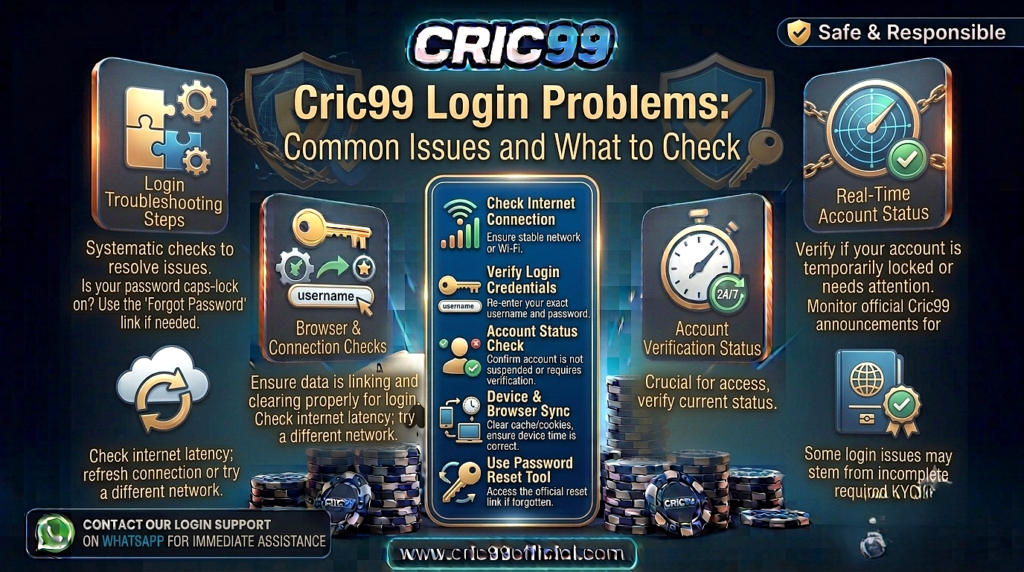
Cric99 login problems can happen for several reasons, and an incorrect password is only one of them. An old password saved in the browser, a mistyped account ID, delayed verification code, unstable internet connection or account-related restriction can all prevent normal access.

The quickest way to deal with a Cric99 login error is to identify where the login is failing before changing anything. If the website itself will not open, resetting your password probably will not help. If the page loads normally but rejects your credentials, checking the account ID and password makes more sense.

This guide takes a problem-first approach to Cric99 access. Find the situation that matches what you are seeing, complete the relevant checks, and only move to account recovery or support when the simpler explanations have been ruled out.

First, Identify Your Cric99 Access Problem

Before troubleshooting, look at what actually happens when you try to sign in.

What You SeeWhere to Start
Website does not openConnection/browser
Login page opens but credentials failID/password
OTP does not arriveVerification/contact method
Page keeps refreshingBrowser/session
Login works on one device onlyDevice/browser
Password was recently changedSaved credentials
Account says verification requiredAccount verification
Account shows restricted/lockedAccount status
Login succeeds but a feature does not workFeature-specific issue

This distinction matters because “I cannot login Cric99” can describe several completely different situations.

Start with the symptom rather than assuming the cause.

Problem 1: Cric99 Says Your ID or Password Is Incorrect

If the login page opens normally but rejects your credentials, enter both pieces of information again carefully.

Do not rush this step.

Check for accidental spaces, incorrect capitalization and typing mistakes. Mobile keyboards can also automatically capitalize the first character or replace text unexpectedly.

If your browser fills the credentials automatically, clear both fields and enter them manually.

This is particularly useful if you changed your password recently. Your browser may still be supplying the old password every time you open the login page.

If manual entry works, update or remove the outdated saved credential.

Problem 2: You Have Forgotten Your Password

A forgotten password is different from a password that you believe is correct but that suddenly stopped working.

If you genuinely cannot remember the password, repeated guessing is usually not useful.

Use the password-recovery option available for the account.

Depending on the recovery process, you may need access to a registered contact method or complete another authentication step.

Choose a new password that you have not used elsewhere.

For the complete recovery process, see Cric99 Password Reset: What to Do If You Cannot Log In. That guide focuses specifically on forgotten passwords, recovery verification and what to do when a new password is still rejected.

Problem 3: You Reset the Password but Still Cannot Log In

This is where many users immediately reset the password a second time.

Don’t.

First make sure the login form is actually using the new password.

Password managers and browsers can continue inserting the previous credential after a reset. Delete the autofilled password and manually type the new one.

Also check that you are using the correct account ID.

If both are correct, close and reopen the browser before trying again.

The important question is whether the new password itself is being rejected or whether an old saved password keeps replacing it.

Those are different problems.

Problem 4: Cric99 Login OTP Is Not Arriving

If the login process asks for an OTP but you do not receive one, repeatedly pressing “send again” may make the situation more confusing.

Start with your phone.

Check that it has a mobile signal and can receive ordinary SMS messages. If the registered number is visible, confirm that it is correct.

Wait briefly for a delayed message before requesting another code.

If several OTPs eventually arrive, older codes may no longer be valid. Use the code associated with the most recent active request.

Most importantly, keep the OTP private.

A person offering to solve a login problem does not need you to read out an authentication code so that they can “check” the account.

Problem 5: You Receive an OTP Without Trying to Log In

This deserves a different response.

If you did not initiate a login, password reset or verification process, do not share or enter the unexpected code.

Someone may simply have entered the wrong information, but an unexpected OTP can also indicate an attempted account action.

If it happens repeatedly, consider reviewing the security of your account and changing the password if you have reason to believe someone else knows it.

Our Cric99 Account Security: How to Protect Your Account guide explains unexpected OTPs, phishing links, reused passwords and suspected unauthorized access in more detail.

Problem 6: The Cric99 Login Page Will Not Open

If the login page itself is unavailable, there is little value in changing your credentials yet.

Test another website first.

Other Websites Do Not Load

The problem may be your internet connection.

Check Wi-Fi or mobile data and reconnect if necessary.

Other Websites Load Normally

Now the issue is more specific.

Refresh the Cric99 page, close and reopen the browser, and check the address you entered.

If you are using a smartphone, switching between your normal Wi-Fi and mobile data can help identify whether the problem is connection-specific.

Do not respond to an unavailable page by searching for random alternative login domains and entering your credentials into the first one that works.

Problem 7: Cric99 Keeps Refreshing After Login

A page that repeatedly returns to the login screen can indicate a browser or session issue rather than an incorrect password.

Try closing the browser completely and reopening it.

If the problem continues, test the account in another current browser on the same device.

This is a useful diagnostic step:

Works in Browser A but not Browser B?
The issue may be browser-specific.

Fails in both browsers?
Look at the account or connection next.

Avoid changing five settings simultaneously. Troubleshooting is much easier when you change one thing and observe what happens.

Problem 8: Cric99 Works on Desktop but Not on Your Phone

If the same credentials work on a computer but fail on a smartphone, your account itself is probably not the first thing to investigate.

Check the mobile browser and saved credentials.

Your phone may have an old password stored even though the desktop has the new one.

Also check whether the mobile page is loading correctly and whether your phone has a stable internet connection.

For mobile-specific troubleshooting, Cric99 Mobile Guide: How to Access Cric99 on Your Phone covers browser access, mobile layouts, connections and smartphone security.

The fact that one device works is valuable information. Use it to narrow the problem instead of resetting an account that is already functioning elsewhere.

Problem 9: The App Is Not Letting You Log In

Again, separate the application from the account.

Try browser-based access if it is available.

If the browser accepts the same credentials but the app does not, the Cric99 access problem may be limited to the application.

If both reject the credentials, investigate the account login instead.

Do not download a different APK from an unfamiliar website simply because your existing app stops working.

Cric99 App Guide: What Users Should Know About Mobile Access explains app availability, browser access, APKs and home-screen shortcuts separately.

Problem 10: Login Requires Account Verification

Sometimes a user can enter the correct credentials but still cannot proceed normally because another account requirement appears.

If the screen specifically asks you to verify account information, treat it as a verification issue.

Read what information is being requested.

Do not repeatedly reset the password if the account is clearly telling you that identity or account verification is required.

The relevant resource in that situation is Cric99 Account Verification: Why KYC May Be Required, which explains why verification can appear and how it differs from ordinary login authentication.

Solving the right problem is usually faster than trying every available account option.

Problem 11: Your Account Shows as Restricted or Locked

A restricted account should not automatically be treated as a forgotten-password issue.

Read the notice shown on the account or login page.

If it gives a reason or next step, start there.

Avoid creating another account simply to bypass a restriction. Account ownership and multiple-account rules may apply, and a second registration may not solve whatever affected the original account.

Our Cric99 Terms and Conditions: Important Points to Understand explains why users should check current account rules concerning eligibility, verification, account use and restrictions.

If the restriction is unclear and normal account options do not resolve it, that may be the point where support becomes relevant.

Problem 12: Login Works, but Deposits or Withdrawals Don’t

This is technically not a login problem.

If you can enter your account and reach the account area, your login has succeeded.

A failed deposit should be investigated as a payment problem.

A pending withdrawal should be investigated as a payout or verification problem.

Resetting your password because a withdrawal has not arrived adds an unrelated change to the situation.

For money-related troubleshooting, use Cric99 Payment Methods Explained: Deposits and Withdrawals rather than continuing to troubleshoot login.

This distinction may sound obvious, but it prevents a surprising amount of unnecessary account recovery.

Did You Recently Change Your Cric99 Account Details?

Think about what happened immediately before the login problem began.

Did you:

  • Change the password?
  • Change registered contact information?
  • Switch to a new phone?
  • Clear your browser data?
  • Start using a different browser?
  • Install or remove an application?
  • Lose access to your registered mobile number?

The timing can reveal the cause.

For example, a login problem beginning immediately after changing a password makes outdated saved credentials worth checking.

A problem beginning after switching phones makes device configuration or access to the registered contact method more relevant.

Troubleshooting should follow the evidence you have rather than a fixed list of resets.

Be Careful When Searching for a Cric99 Login Page

Login problems can make users less cautious because they are focused on regaining access.

If your normal page is not working, do not enter your ID and password into every Cric99-branded page you find.

A fake login page can be designed to collect credentials.

Check the website address before entering account information and be particularly careful with links sent through WhatsApp, Telegram, SMS or unsolicited email.

If someone messages you immediately after you mention a login problem publicly and offers to “restore” the account, do not send them your password or OTP.

The urgency of needing access should not override normal security checks.

When Should You Stop Troubleshooting and Request Help?

Not every login problem requires support.

A mistyped password, weak connection or stale browser credential can often be resolved without account-specific assistance.

Support becomes more relevant when:

  • Correct credentials continue to be rejected after basic checks.
  • Account recovery does not work.
  • You no longer have access to a required recovery method.
  • The account shows a restriction you cannot resolve.
  • Verification prevents access and the normal process is not progressing.
  • You suspect unauthorized account changes.

Before requesting Cric99 help, note the exact error message and what you have already tried.

Cric99 Support Guide: What to Check Before Requesting Help explains how to prepare a useful support request without exposing sensitive information.

What to Include When Reporting a Login Problem

A useful login report can be short.

For example:

“My account ID is being accepted, but my password is rejected. I completed password recovery and manually entered the new password rather than using autofill. The same error continues in two browsers.”

That tells someone much more than:

“Cric99 login not working.”

Mention the device, browser and exact error where relevant.

Do not include the password itself.

There is no reason to prove that your password is correct by sending it to another person.

A Quick Cric99 Login Troubleshooting Order

If you are unsure where to start, use this order:

1. Does the website load?
If no, investigate connection/browser access.

2. Are you on the intended login page?
Check before entering credentials.

3. Is the account ID correct?
Enter it manually.

4. Is the password correct?
Remove old autofill and type it manually.

5. Forgotten password?
Use account recovery.

6. OTP required?
Check your registered contact method and keep codes private.

7. Verification message displayed?
Follow the verification process rather than resetting the password again.

8. Account restricted?
Read the account notice and applicable rules.

9. Works on another device/browser?
Investigate the original device rather than the account.

10. Still unresolved?
Prepare the error details and use the appropriate support route.

This sequence moves from simple technical explanations toward account-specific ones without changing unnecessary settings along the way.

Frequently Asked Questions About Cric99 Login Problems

Why can’t I log in to Cric99?

Possible causes include incorrect credentials, an old autofilled password, connectivity problems, browser issues, incomplete verification or an account-specific restriction. The exact error shown during login is the best place to start.

What should I do if I get a Cric99 login error?

Read the error first. If it concerns credentials, manually re-enter your ID and password. If it concerns verification or account status, follow the instructions associated with that issue instead.

Why does Cric99 say my password is wrong when I changed it?

Your browser or password manager may still be filling the old password. Clear the field and manually enter the new credential.

What should I do if the Cric99 OTP is not arriving?

Check your mobile connection and registered contact information where available. Wait briefly before requesting another code and use the newest valid OTP. Never disclose the code to another person.

Why can I access Cric99 on my computer but not my phone?

The problem may involve the phone’s browser, connection or saved credentials. If the account works elsewhere, investigate the affected device before resetting the account.

What if Cric99 asks for verification when I log in?

Read the verification request and complete the legitimate account process where required. Verification is separate from entering the correct password.

Should I create a new Cric99 account if my old login does not work?

Do not create another account simply to solve an access problem. Try account recovery first and review applicable rules concerning multiple accounts.

When should I contact Cric99 support about a login problem?

Consider support after basic troubleshooting and normal account recovery have failed, or when the issue involves an unresolved restriction, verification problem or suspected unauthorized account change.

Conclusion

Cric99 login problems become much easier to troubleshoot when you stop treating every access failure as a password problem.

First identify what is actually happening. If the website will not load, investigate the connection. If credentials are rejected, manually check the ID and password. If an OTP is missing, focus on verification delivery. And if the account specifically says verification or restriction is required, deal with that issue rather than repeatedly resetting your password.

Testing another browser or device can also tell you whether you have an account problem or simply a local technical issue.

Most importantly, do not let the urgency of regaining access lead you to unsafe shortcuts. Check login pages carefully, keep passwords and OTPs private, and use account recovery or appropriate support when the basic checks no longer explain the problem.

Disclaimer: This article provides general information about Cric99 login troubleshooting. Specific login procedures, verification requirements, account restrictions and recovery options may change and should be checked through the current platform. Never share passwords or OTPs with another person. Users should also comply with applicable minimum-age requirements, platform terms and laws in their jurisdiction. Real-money betting involves financial risk and does not guarantee profit.