
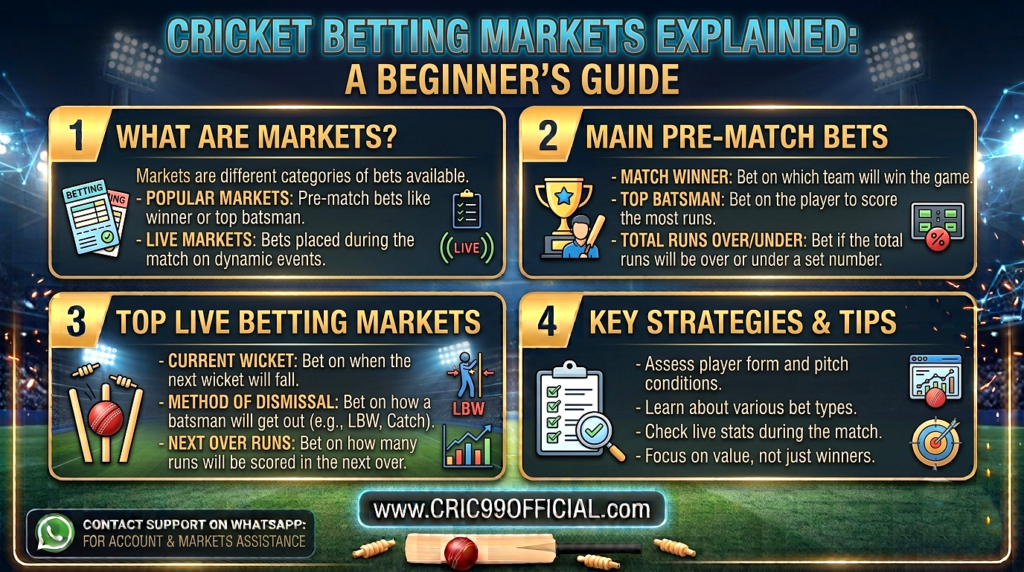
Cricket Betting Markets are the different types of outcomes or events that can be selected when looking at a cricket match. Instead of focusing only on which team will win, a market can cover match results, runs, wickets, player performances, innings outcomes, and other match-related events.
For beginners, understanding the market is just as important as understanding the odds. The odds tell you the price of a selection, while the market tells you what you are actually predicting.
This is one of the most important parts of cricket betting basics because a price has no useful meaning until you know exactly what outcome it represents.
What Are Cricket Betting Markets?
A betting market is a specific category of possible outcomes for a sporting event.
For example, a cricket match might have a Match Winner market with two selections:
- Team A
- Team B
Another market for the same match could focus on total runs, such as:
- Over a specified total
- Under a specified total
A player market could instead focus on an individual player’s performance.
The available markets can vary depending on the match, competition, timing, and service being used. Therefore, never assume that every market will be available for every cricket fixture.
Why Are Cricket Betting Markets Important?
Understanding markets helps you answer three basic questions:
- What event am I looking at?
- What does each selection mean?
- What do the displayed odds apply to?
For example, odds of 2.00 might look simple, but they could relate to a team winning, a total going over a certain number, or a player reaching a particular performance level.
Those are completely different selections.
A good cricket betting guide should therefore explain the market before focusing heavily on the price.
Match Winner Market
The Match Winner market is one of the easiest markets for beginners to understand.
The basic question is:
Which team will win the match?
For example:
| Selection | Example Odds |
|---|---|
| Team A | 1.80 |
| Team B | 2.10 |
The odds are attached to each team’s potential match outcome.
Before considering any price, you should understand the competition rules and how the market handles situations such as ties, abandoned matches, or no-result games.
Market rules can differ, so always check the applicable terms.
Toss Winner Market
A toss-related market focuses on the result of the pre-match coin toss rather than the final match result.
For example:
- Team A wins the toss
- Team B wins the toss
The toss winner and match winner are completely different outcomes.
A team can lose the toss and still win the cricket match.
This is a useful example of why identifying the market should always come before interpreting the odds.
Total Runs Markets
Total-runs markets focus on the number of runs scored.
A market may be based on:
- Match total runs
- Team total runs
- Innings total
- A specified over or period
Depending on the market, selections may be presented around a particular line.
For example, a hypothetical market could use a total of 300 runs:
- Over 300
- Under 300
The exact rules, settlement conditions, and available lines can vary.
Over/Under Markets
Over/under markets ask whether a particular statistic will finish above or below a specified number.
For example:
Total Match Runs — 300.5
Possible selections:
- Over 300.5
- Under 300.5
If the final total is 301 or more, the over selection would meet the numerical condition in this simplified example.
If the total is 300 or fewer, the under selection would meet it.
The actual settlement of any real market depends on its stated rules.
Team Total Markets
Team-total markets focus on one team’s performance rather than the entire match.
For example:
Team A Total Runs — 165.5
Possible selections might be:
- Over 165.5
- Under 165.5
This is different from a full-match total because only the specified team’s score is relevant to the market.
Understanding this distinction is a basic part of how cricket betting works.
Player Performance Markets
Player markets focus on individual performances.
Depending on the competition and service, examples can include:
- Player runs
- Player wickets
- Player catches
- Other performance statistics
For example, a hypothetical player-runs market could show:
Player X — 40.5 runs
Selections might include:
- Over 40.5
- Under 40.5
The exact statistics and markets available can vary.
Always check what statistic is being measured and how it is settled.
Top Batter Markets
A top-batter market focuses on which player will finish as the leading run scorer according to the relevant market rules.
For example:
- Player A
- Player B
- Player C
- Player D
The important point is that this market is not asking which team will win.
A player could finish as the top batter even if their team loses.
Top Bowler Markets
Top-bowler markets work in a similar way.
The selection relates to which player records the relevant bowling achievement, often based on wickets under the market’s rules.
For example:
- Bowler A
- Bowler B
- Bowler C
Again, the market is different from the match winner market.
Understanding exactly what is being measured prevents confusion when comparing selections.
First Innings Markets
Some cricket markets focus specifically on the first innings.
Depending on the format and available markets, these can relate to:
- First-innings total
- Team score
- Runs during a particular period
- Other innings-specific events
The market description should always be checked carefully because similar-looking markets can use different settlement rules.
Over-Specific Markets
Some markets focus on a particular over or group of overs.
Examples could include:
- Runs in an over
- Wickets in an over
- Team score after a specified number of overs
- Other over-specific outcomes
These markets can be more difficult for beginners because the outcome depends on a much smaller part of the match.
They also require you to understand exactly which over or period the market refers to.
Wicket Markets
Wicket-related markets can focus on different aspects of a match.
Examples may include:
- Total wickets
- Team wickets
- Player wickets
- Wickets during a particular period
The wording matters because the settlement condition may be different from one market to another.
For example, a player-wickets market is not the same as a total-match-wickets market.
Partnership Markets
Some cricket markets can focus on partnerships between batters.
A partnership market may relate to:
- Runs scored by a partnership
- Whether a partnership reaches a particular number
- Other partnership-related outcomes
These markets require careful attention because the outcome can change with every delivery.
Boundary Markets
Depending on the match and service, markets can sometimes focus on boundaries.
Possible statistics include:
- Number of fours
- Number of sixes
- Team boundaries
- Player boundaries
A boundary market is different from a total-runs market because the statistic being measured is specific.
For example, a team could score many runs without necessarily producing the same number of boundaries expected by a particular market.
First-Innings and Match Markets
It is useful to separate markets according to the part of the match they cover.
Match-Level Markets
These consider the overall match outcome or statistics.
Examples include:
- Match winner
- Match total runs
- Total wickets
Innings-Level Markets
These focus on one innings.
Examples include:
- First-innings total
- Team innings total
- Innings-specific statistics
Player-Level Markets
These focus on individual performances.
Examples include:
- Player runs
- Player wickets
- Player performance statistics
Knowing this structure makes cricket betting explained content much easier to follow.
Pre-Match Cricket Betting Markets
Pre-match markets are available before the cricket match begins.
At this stage, information may include:
- Team selections
- Player availability
- Recent performances
- Venue information
- Weather conditions
- Match format
Market prices can change as new information becomes available.
The odds displayed before the match are therefore not necessarily fixed until the event begins.
Live Cricket Betting Markets
Live markets operate while the match is taking place.
Cricket can produce rapid changes because every ball can affect the match situation.
Factors such as:
- Wickets
- Runs
- Required run rate
- Overs remaining
- Batting partnerships
- Bowling changes
can influence available prices and markets.
Live markets can therefore be more difficult for beginners to follow.
Cricket Betting Markets and Odds
Markets and odds serve different purposes.
Market = what outcome you are selecting.
Odds = the price attached to that selection.
For example:
Market: Match Winner
Selection: Team A
Odds: 1.80
Another example:
Market: Team Total Runs
Selection: Over 165.5
Odds: 1.90
The numbers alone do not tell you what the bet represents.
This is why understanding markets should come before trying to compare prices.
Cricket Betting Markets and Implied Probability
Odds can also be converted into implied probability.
For example, decimal odds of 2.00 correspond mathematically to a 50% implied probability.
1 ÷ 2.00 × 100 = 50%
If you are learning about probability, What Is Implied Probability in Betting Odds? explains how odds can be converted into percentages and why market margins mean those percentages should not automatically be treated as exact predictions.
Cricket Betting Markets and Different Odds Formats
The same market price can sometimes be displayed using different odds formats.
For example:
| Decimal | Fractional | American |
|---|---|---|
| 1.50 | 1/2 | −200 |
| 2.00 | 1/1 | +100 |
| 2.50 | 3/2 | +150 |
| 3.00 | 2/1 | +200 |
| 4.00 | 3/1 | +300 |
The market remains the same; only the way the price is displayed changes.
Understanding decimal, fractional, and American odds can make it easier to read cricket markets presented in different formats.
Cricket Betting Markets and Cric99
If you are researching Cric99, it is important to distinguish between understanding cricket markets generally and knowing which markets are currently available on a particular platform.
Market availability can vary by match, competition, timing, and service.
For broader platform terminology, What Is Cric99? Complete Guide to the Cric99 Platform explains the basic concepts behind an account-based cricket platform and exchange-style terminology.
Do not assume that a specific market, competition, feature, or betting option is currently available without checking the relevant service information.
Understanding Exchange-Style Markets
Exchange-style markets can introduce terminology that differs from a traditional bookmaker.
For example, users may encounter terms such as:
- Back
- Lay
- Matched
- Unmatched
- Liability
A back position generally means taking a position that an outcome will happen.
A lay position generally means taking a position against an outcome.
The financial calculation for a lay position can be different from a simple back calculation because liability needs to be considered.
If you are unfamiliar with account terminology, Cric99 Cricket ID Explained: What It Is and How It Works explains the difference between an account ID, password, and other account credentials.
How Beginners Should Read a Cricket Market
Before looking at the odds, use this simple checklist:
1. Identify the Market
Ask what the market is measuring.
Is it:
- Match winner?
- Total runs?
- Player runs?
- Wickets?
- Innings score?
2. Identify the Selection
Read the exact selection attached to the price.
3. Check the Line
If the market uses a number such as 165.5, make sure you understand what that number represents.
4. Check the Time Period
Is the market for:
- The whole match?
- One innings?
- A specific over?
- A live period?
5. Read the Rules
Settlement rules can vary between markets.
6. Only Then Look at the Odds
Once you know what the selection means, the price becomes much easier to interpret.
Common Cricket Betting Market Mistakes
Choosing a Market Without Reading It
A market title can look familiar while having a different settlement condition.
Always read the details.
Confusing Match and Team Totals
A match total includes the relevant combined score, while a team total focuses on one side.
Confusing Player Markets With Match Markets
A player performance market is based on an individual statistic rather than simply who wins the match.
Ignoring the Time Period
An over-specific market and a full-match market can look similar but measure completely different events.
Assuming Every Market Is Available
Markets can vary depending on the fixture, competition and timing.
Focusing Only on Odds
A high or low price means little if you do not understand the outcome attached to it.
How Cricket Betting Markets Can Change During a Match
Live cricket markets can change as the match develops.
Imagine Team A starts strongly and is priced at a particular level before the match. After several wickets fall, the available market prices may change.
The same can happen after:
- A rapid scoring period
- A wicket
- A major partnership
- A change in required run rate
- A rain interruption
- A change in the number of overs
This is one reason live cricket markets can be more difficult to interpret than pre-match markets.
A Simple Example of Different Markets
Imagine a hypothetical T20 match between Team A and Team B.
Several different markets could exist:
| Market | Example Selection | What It Measures |
|---|---|---|
| Match Winner | Team A | Overall match result |
| Team Total | Team A Over 165.5 | Team A’s score |
| Match Total | Over 320.5 | Combined match score |
| Player Runs | Player X Over 35.5 | Player X’s runs |
| Player Wickets | Player Y Over 1.5 | Player Y’s wickets |
| Top Batter | Player X | Leading batter under market rules |
The examples show why identifying the market is essential.
The same match can contain many different questions, each with its own selection and price.
Responsible Approach to Cricket Betting Markets
Understanding markets can help you read cricket information more clearly, but it does not eliminate financial risk.
No market provides a guaranteed outcome.
If you choose to participate in betting, understand the market rules, know how much money is at risk, and use only an amount you can afford to lose.
Avoid chasing losses or treating betting as a guaranteed source of income.
A responsible cricket betting guide should explain the mechanics of markets while also acknowledging the uncertainty involved in sporting outcomes.
Frequently Asked Questions
Cricket betting markets are categories of possible outcomes related to a cricket match. They can cover match results, runs, wickets, player performances, innings events, and other statistics.
A match-winner market is usually one of the simplest concepts to understand because it focuses on which team will win. However, beginners should still read the applicable settlement rules.
A total-runs market focuses on the number of runs scored over a specified period or by a specified team, depending on the market.
Player markets focus on individual performances, such as runs or wickets, depending on the market and available options.
A match market can consider the overall match or both teams, while a team market focuses specifically on one team’s performance.
Yes. Live markets and prices can change as the match develops and new information becomes available.
Final Thoughts
Understanding Cricket Betting Markets is one of the most useful starting points for anyone learning how cricket betting works.
The key is to identify exactly what each market measures before looking at the odds. Match winners, team totals, match totals, player performances, wickets, innings events, and live markets can all work differently.
Once you understand the market, you can then look at the odds, calculate potential returns or implied probability, and review the relevant rules.
The goal of good cricket betting explained content is not simply to list markets. It should help beginners understand what each market means and why the details matter.
Disclaimer: This article is for general informational purposes only. Betting involves financial risk, and outcomes cannot be guaranteed. Check applicable laws, age requirements, market rules, and the current terms of any service before participating.