
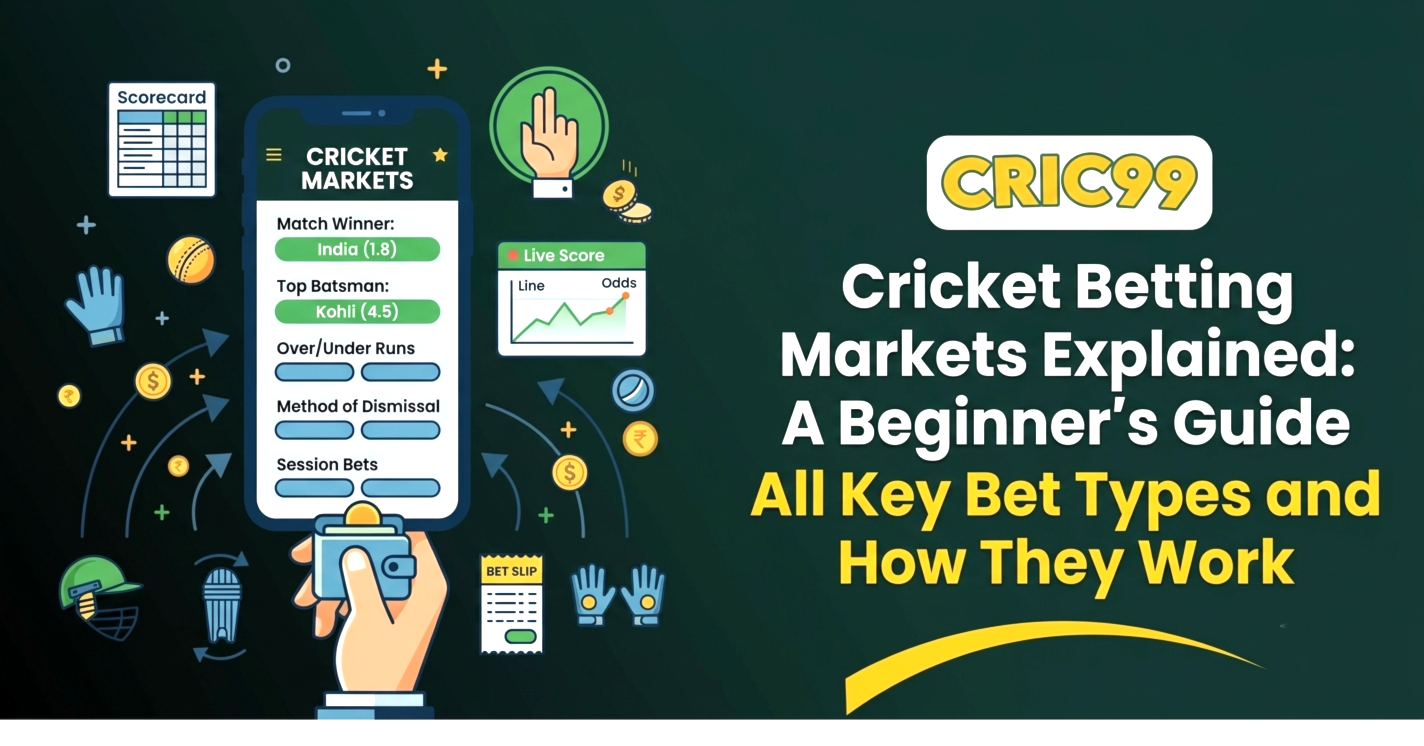
Cricket betting markets are the different types of outcomes or events that people can choose when placing a bet on a cricket match. A market can focus on the match winner, total runs, individual player performance, team performance, or another specific event.
For beginners, the number of available markets can initially feel confusing. The key is to understand what each market is asking you to predict before looking at the odds.
This guide explains common cricket markets in simple terms and shows how they fit into how cricket betting works.
What Is a Cricket Betting Market?
A cricket betting market is a category of possible outcomes associated with a match or competition.
For example, a match may have a match winner market asking which team will win. Another market might ask whether the total number of runs will be above or below a particular number.
The odds are attached to individual selections within a market.
A simple example could look like:
| Market | Selection | Example Odds |
|---|---|---|
| Match Winner | Team A | 1.70 |
| Match Winner | Team B | 2.10 |
| Total Runs | Over 300.5 | 1.90 |
| Total Runs | Under 300.5 | 1.90 |
These are illustrative examples only. Actual markets and prices can vary.
Understanding the difference between the market and the selection is one of the most useful cricket betting basics for beginners.
Why Are There Different Cricket Betting Markets?
Cricket has many measurable aspects, which allows markets to be created around different parts of a match.
A match can involve:
- Two competing teams
- Runs
- Wickets
- Overs
- Individual player performances
- Innings totals
- Match totals
- Partnerships
- Specific events
This means someone interested in cricket betting explained topics may encounter considerably more than simply choosing a match winner.
Different markets also require different types of analysis. A match-winner market and a player-runs market, for example, are not based on exactly the same information.
Match Winner Market
The match winner market is usually one of the easiest markets for beginners to understand.
The question is simple:
Which team will win the match?
For a hypothetical match between Team A and Team B, the market might show:
- Team A
- Team B
If the match has a tie, draw, abandoned result or another unusual outcome, the applicable market rules become important.
Always check how the specific market handles different match outcomes before relying on a price.
Toss Winner Market
The toss winner market concerns the result of the pre-match coin toss.
The selection is generally one of the competing teams.
For example:
- Team A to win the toss
- Team B to win the toss
This market is separate from the match winner market.
Winning the toss does not automatically mean winning the cricket match. The two events are different.
This is a good example of why identifying the exact market is essential.
Total Runs Market
A total-runs market focuses on the number of runs scored.
One common format is an over/under market.
For example, a hypothetical market could be:
- Over 300.5 runs
- Under 300.5 runs
The number in the middle is the market line.
If the final qualifying total is above the line, the over selection would meet the condition. If it is below the line, the under selection would meet it, subject to the market’s specific rules.
The exact settlement conditions can vary, so read the market description carefully.
Team Total Runs
Instead of considering both teams together, a market can focus on one team’s score.
For example:
Team A total runs — Over/Under 160.5
This market is different from a match total because it only concerns Team A’s score.
For beginners, the easiest way to understand it is to ask:
“Whose runs are being counted?”
That question can prevent mistakes when reading similar-looking markets.
Player Runs Market
A player-runs market focuses on the number of runs scored by an individual batter.
A hypothetical market could look like:
Player X — Over/Under 35.5 runs
The relevant outcome depends on the player’s final qualifying score and the rules attached to the market.
Player markets can have additional conditions, such as whether the player takes part in the match or innings.
This is why market rules matter just as much as the displayed odds.
Player Wickets Market
A similar concept applies to bowling markets.
A market could ask whether a particular bowler will take over or under a specified number of wickets.
For example:
Player Y — Over/Under 2.5 wickets
This focuses on one player’s performance rather than the team’s overall result.
Again, the exact settlement rules should be checked before interpreting the market.
Total Wickets Market
A total-wickets market focuses on the combined number of wickets during a specified part of a match.
Depending on the format and market, it could relate to:
- A team
- An innings
- A match
- A specified period
The wording is important because the same general idea can be presented across different timeframes.
Top Batter Market
A top-batter market asks which eligible batter will finish as the top run-scorer under the market’s rules.
The selections may include several players from one or both teams.
For example:
| Selection | Example Price |
|---|---|
| Batter A | 4.00 |
| Batter B | 5.50 |
| Batter C | 7.00 |
These prices are illustrative.
The market rules may specify how ties, non-participation or other situations are handled.
Top Bowler Market
A top-bowler market works similarly but focuses on bowling performance.
The market may ask which eligible bowler will take the most wickets.
As with other player markets, check the specific conditions before interpreting the selection.
First Innings Runs
Some cricket markets focus specifically on the first innings.
For example, a market might ask whether the first innings total will be above or below a particular number.
This can be useful for understanding how markets can be narrowed down to a particular stage of the match.
The exact innings definition depends on the format and market rules.
First Wicket Market
A first-wicket market can focus on the timing or circumstances surrounding the first wicket.
Depending on the specific market, it may relate to:
- The over in which the first wicket falls
- The player responsible
- A particular score range
Because several markets can use similar wording, read the full description rather than relying only on the market title.
Over-Specific Markets
Cricket also allows markets to focus on individual overs or groups of overs.
Examples may include questions about:
- Runs scored in an over
- Whether a wicket falls
- Runs within a particular range
- Events during a specified over
These markets can change quickly during live cricket because the outcome can depend on only a few deliveries.
Sixes and Fours Markets
Some markets focus on boundary counts.
Examples include:
- Total sixes
- Total fours
- Team sixes
- Player sixes
- Player fours
A market might ask whether the number of sixes will be above or below a particular line.
These markets illustrate why understanding the exact statistic being measured is important.
Partnership Markets
A partnership market can focus on runs scored by two batters while they are together at the crease.
Depending on the market, it may involve:
- Partnership runs
- First partnership
- A specific wicket partnership
- Over/under partnership totals
The relevant market rules determine which runs count and how the selection is settled.
Method of Dismissal Markets
Some cricket markets focus on how a batter will be dismissed.
Possible categories may include:
- Bowled
- Caught
- LBW
- Run out
- Stumped
Availability can vary depending on the match and service.
These markets require careful attention to settlement rules because unusual dismissals can raise questions about which category applies.
Innings Markets
An innings market focuses on a particular innings rather than the entire match.
For example, a market may concern:
- First innings total
- Second innings total
- Team innings runs
- Innings wickets
- Innings boundaries
The phrase innings is therefore important when reading the market description.
Series Betting Markets
Cricket betting is not limited to individual matches.
Some markets can relate to an entire series or tournament.
Examples may include:
- Series winner
- Tournament winner
- Top run-scorer
- Top wicket-taker
- Team performance across a series
These markets operate over a longer period, so their settlement conditions can be different from match-specific markets.
Tournament Markets
Tournament markets can cover competitions rather than individual matches.
Depending on the competition, examples may include:
- Tournament winner
- Finalist
- Top run-scorer
- Top wicket-taker
- Team qualification
The exact options available depend on the competition and the service offering the market.
Pre-Match Markets vs Live Markets
One of the most important distinctions in a cricket betting guide is whether a market is available before the match or during live play.
Pre-Match Markets
Pre-match markets are available before the match begins.
Prices can change as information becomes available, including team news, player availability, weather and other market developments.
Live Markets
Live markets operate while the match is taking place.
The match situation can change rapidly after:
- A wicket
- A boundary
- A change in required run rate
- A batting partnership
- A bowling spell
- A significant change in the score
Because conditions change quickly, live prices can move rapidly.
Cricket Betting Markets and Odds
A market tells you what you are predicting.
Odds tell you the price attached to that selection.
For example:
Market: Match Winner
Selection: Team A
Odds: 1.80
The market identifies the question, the selection identifies the outcome, and the odds provide the price.
This distinction is useful when learning how cricket betting works.
Why Market Rules Matter
Two markets can look similar while having different settlement conditions.
For example, a player-runs market may have rules concerning:
- Whether the player must face a delivery
- What happens if the player does not participate
- Whether a shortened match affects settlement
- What happens if the match is abandoned
- Which innings count
Do not assume that every market follows the same rules.
The specific terms attached to a market should always be checked.
Cricket Betting Markets and Odds Formats
Markets can display odds in different formats, including:
- Decimal
- Fractional
- American
For example, the same underlying price could be displayed as:
| Decimal | Fractional | American |
|---|---|---|
| 1.50 | 1/2 | −200 |
| 2.00 | 1/1 | +100 |
| 2.50 | 3/2 | +150 |
| 3.00 | 2/1 | +200 |
The market itself does not change simply because the odds format changes.
If you want to understand the American format in more detail, American Odds Explained: How the Plus and Minus Format Works explains how positive and negative prices are interpreted.
Cricket Betting Markets and Implied Probability
Odds can also be converted into implied probability.
For decimal odds:
Implied probability = 1 ÷ Decimal odds × 100
For example, odds of 2.00 imply:
1 ÷ 2.00 × 100 = 50%
However, implied probability is not a guarantee of the actual result. Market margins can also cause the combined implied probabilities of selections to exceed 100%.
Understanding probability can help you interpret prices, but it should not be confused with certainty.
Cricket Betting Markets and Cric99
When researching Cric99, it is useful to understand that market availability can vary by match, competition, timing and service conditions.
Do not assume that every market described in a general cricket betting guide is necessarily available on every platform.
For broader platform context, What Is Cric99? Complete Guide to the Cric99 Platform explains the basic concepts associated with the platform and exchange-style betting.
If you are learning about account identification at the same time, Cric99 Cricket ID Explained: What It Is and How It Works explains the difference between an account ID and other credentials.
Always check the current terms and market information provided by the relevant service rather than relying on a general list of markets.
How Beginners Can Choose Which Market to Understand First
If you are new to cricket betting, it is usually easier to learn one market at a time.
A simple progression could be:
1. Start With Match Winner
Understand what the market is asking and how the result is determined.
2. Learn Total Runs
Understand over/under lines and how the final score relates to the market.
3. Explore Team Markets
Learn the difference between a match total and an individual team total.
4. Learn Player Markets
Understand how player participation and performance affect settlement.
5. Explore Live Markets Carefully
Only after you understand how the underlying market works should you consider how that market changes during live play.
This approach can make the basics less overwhelming.
Common Mistakes When Reading Cricket Markets
Choosing a Market Without Reading the Rules
The market title alone may not explain every settlement condition.
Confusing Match and Team Totals
A match total includes the relevant combined score, while a team total focuses on one team’s performance.
Confusing the Market With the Selection
The market might be “Match Winner,” while the selection could be “Team A.”
These are not the same thing.
Assuming Every Market Is Available Everywhere
Market availability can differ by platform, match, competition and timing.
Ignoring Match Format
A Test match, ODI and T20 can have very different market structures and settlement conditions.
Treating Odds as Predictions
Odds represent a price. They do not guarantee a particular result.
A Simple Cricket Betting Markets Checklist
Before considering any market, ask:
- What exactly is the market asking?
- What is the selection?
- Which team, player, innings or period is involved?
- What are the applicable settlement rules?
- Are the odds decimal, fractional or American?
- Is the market pre-match or live?
- What happens if the match is shortened or abandoned?
- Are there player participation conditions?
- What is the potential financial risk?
These questions cover many of the most important cricket betting basics.
Responsible Approach to Cricket Betting
Learning different markets can make cricket betting easier to understand, but more markets do not mean better results.
Each market involves uncertainty, and betting carries financial risk.
If you choose to participate, understand the market before committing money, set limits that you can afford and avoid chasing losses.
Do not treat a particular market, price or statistical trend as a guaranteed way to make money.
A responsible cricket betting explained approach should include both the mechanics of markets and the risks involved.
Frequently Asked Questions
Cricket betting markets are different categories of outcomes that can be selected in relation to a cricket match, player, innings, series or tournament.
The match-winner market is often one of the simplest to understand because the basic question is which team will win.
However, the applicable rules should always be checked.
A total-runs market focuses on the number of runs scored. It may cover both teams combined or a particular team’s score, depending on the market.
Player markets focus on individual performances, such as runs, wickets, boundaries or another specified statistic.
Pre-match markets are available before the match begins. Live markets operate while the match is being played and can change as events occur.
Yes. Market availability and prices can change depending on the match, competition, timing and other conditions.
No. The markets offered can vary between services, matches and competitions.
Final Thoughts
Cricket betting markets cover much more than simply choosing which team will win. Depending on the match and service, you may encounter markets involving totals, players, wickets, innings, partnerships, boundaries, series and tournaments.
For beginners, the best approach is to understand the market first, then the selection, odds and settlement rules.
Once these basics are clear, it becomes easier to understand how cricket betting works and compare different markets without confusing one type of bet with another.
Remember that market availability can vary, and betting involves financial risk. Always check the current rules and applicable requirements before participating.
Disclaimer: This article is for general informational purposes only. Betting involves financial risk, and outcomes cannot be guaranteed. Check applicable laws, age requirements and the current terms of any service before participating.