
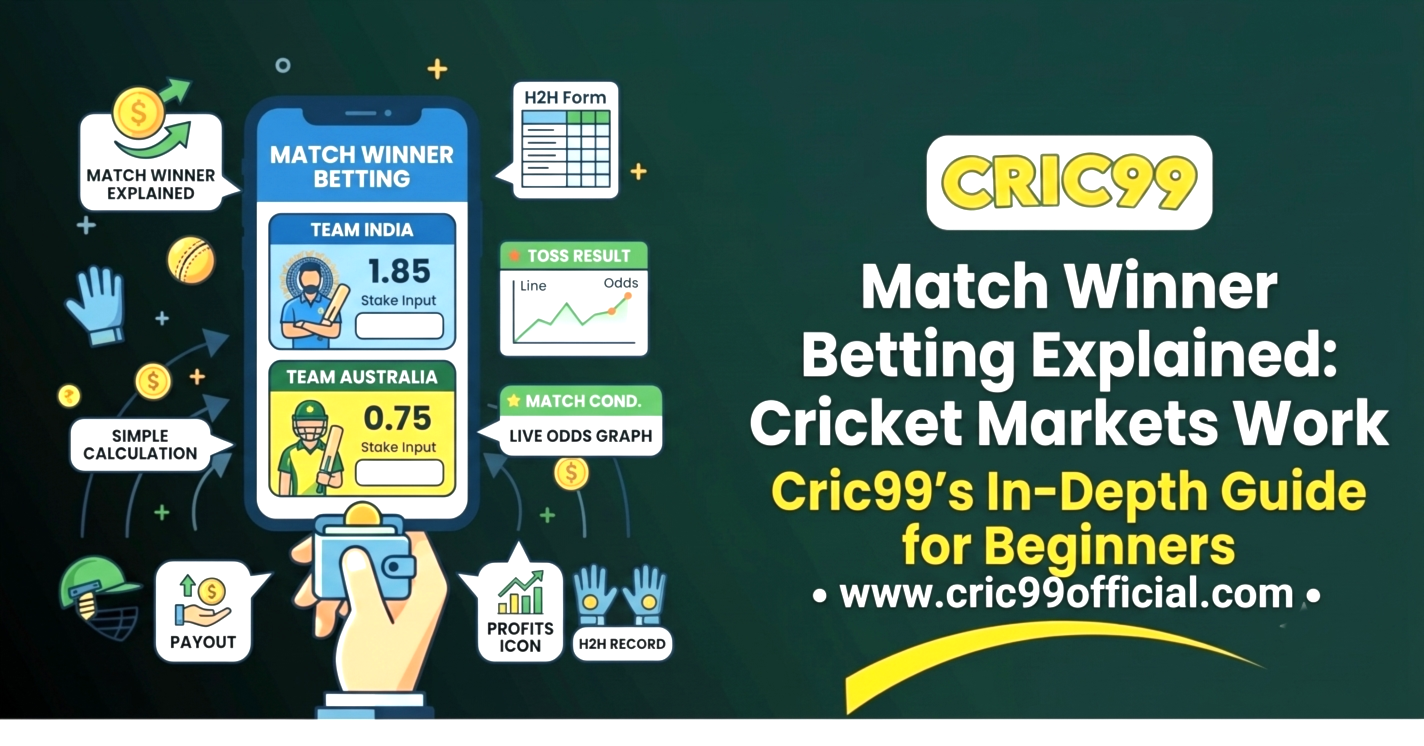
Match winner betting is one of the simplest cricket betting markets to understand. It involves selecting the team you think will win a cricket match. Before choosing a selection, it is important to understand the match format, the odds, the market rules, and what happens if a game ends in a draw or has no result.
This guide explains how match winner betting works, how to read the available odds, and what beginners should check before interpreting a cricket market.
What Is Match Winner Betting in Cricket?
Match winner betting is a market in which a participant selects the team expected to win a particular cricket match. Depending on the competition and market rules, the available options may include Team A, Team B, and sometimes a draw or tie.
For example, imagine India is playing Australia in a one-day international. A match winner market might display India at decimal odds of 1.80 and Australia at 2.10. These figures represent different prices for the two selections; they do not guarantee which team will win.
The available selections and settlement rules can vary according to the match format and the specific market.
How Cricket Match Winner Betting Works
Understanding how cricket betting works starts with knowing how a market, a selection, and odds fit together.
Here is a simple overview:
- Choose a match: Identify the cricket fixture and confirm the competition and match format.
- Review the market: Find the match winner market and check the available selections.
- Understand the odds: Compare the prices offered for each team.
- Check the rules: Read how the market handles a tie, draw, abandoned match, or no result.
- Understand the financial risk: If money is involved, know the amount at risk before making any decision.
These steps explain the structure of the market, not a method for predicting a guaranteed result. Cricket outcomes remain uncertain even when one team appears stronger on paper.
Match Winner Betting Examples
Consider a hypothetical T20 match between Team A and Team B.
| Selection | Decimal odds | Potential total return on a 100-unit stake |
|---|---|---|
| Team A | 1.80 | 180 units |
| Team B | 2.10 | 210 units |
At decimal odds of 1.80, a 100-unit stake would produce a potential total return of 180 units if the selection wins and the market settles as expected. This includes the original stake, so the potential profit would be 80 units.
At decimal odds of 2.10, the same stake would produce a potential total return of 210 units, including the original stake. The potential profit would be 110 units.
These examples are for explanation only. A higher price does not mean a team is more likely to win, and a lower price does not guarantee a successful outcome. The examples also exclude any applicable fees or other deductions.
How to Read Match Winner Odds
Odds indicate the price associated with a selection. Different formats express that price in different ways.
Decimal odds
Decimal odds are commonly used in many online betting markets. To calculate the potential total return, multiply the stake by the decimal odds.
Formula:
Potential total return = Stake × Decimal odds
For example, a 100-unit stake at odds of 1.80 gives a potential total return of 180 units if the selection wins.
Fractional odds
Fractional odds express potential profit relative to the stake. For example, odds of 4/1 indicate a potential profit of four units for every one unit staked, before applicable deductions.
American odds
American odds use positive and negative numbers. Positive odds generally show the potential profit from a 100-unit stake, while negative odds show how much would need to be staked to generate 100 units of profit.
For a more detailed explanation, see American Odds Explained: How the Plus and Minus Format Works.
Remember that odds can change before a match begins. Team news, player availability, pitch conditions, weather, and market activity may influence the prices. These factors can provide context, but none can establish the result in advance.
What Happens if a Cricket Match Is Tied, Drawn, or Abandoned?
This is one of the most important details to check before interpreting a match winner market.
Cricket has different match formats, and each can produce different outcomes:
- Tie: The teams finish with equal scores under the relevant match rules.
- Draw: A result is not achieved within the allotted playing time, a situation particularly associated with Test cricket.
- No result: A match cannot produce an official result, often because of weather or other interruptions.
- Abandoned match: Play is stopped without the match being completed.
The way a market settles in these circumstances depends on its specific rules. Some markets may include a draw selection, while others may use different settlement conditions. Do not assume that every platform handles these situations identically.
Always read the market rules before relying on a displayed price.
Match Winner Betting in T20, ODI, and Test Cricket
The match format affects how a winner is determined and which outcomes are possible.
T20 cricket
T20 matches have a limited number of overs per side. The match winner market usually focuses on which team wins the completed match, subject to the competition rules and the market’s settlement conditions.
One-day international cricket
ODIs generally involve longer innings than T20 matches. Rain interruptions, revised targets, and official result rules can affect how a winner is determined.
Test cricket
Test matches can last up to five days. A match can end in a win, a draw, or a tie, so it is particularly important to check whether the market includes a draw option and how it settles.
Understanding these differences is a basic part of any useful cricket betting guide. A market name alone does not tell you every rule that applies to a particular fixture.
Match Winner vs Other Cricket Betting Markets
Match winner betting is only one type of cricket market. Other markets focus on different events or statistics.
| Market type | What it focuses on |
|---|---|
| Match winner | Which team wins the match |
| Toss winner | Which team wins the toss |
| Top batter | Which eligible batter finishes as the leading run-scorer under the market rules |
| Top bowler | Which eligible bowler finishes as the leading wicket-taker under the market rules |
| Total runs | Whether a specified run total is exceeded or not reached |
| Team total | A particular team’s scoring total |
| Player performance | A specified player’s statistical performance |
Each market has its own conditions. For example, selecting the toss winner is not the same as selecting the match winner. A team can win the toss and still lose the match.
Beginners should learn what a market measures before comparing its odds with those of another market.
How Odds Relate to Implied Probability
Odds can be converted into an implied probability to help explain how a price represents an outcome.
For decimal odds, the basic calculation is:
Implied probability (%) = (1 ÷ decimal odds) × 100
At decimal odds of 2.00, the implied probability is 50%. At odds of 1.80, it is approximately 55.56%.
This calculation is a mathematical interpretation of the odds, not a verified prediction of the actual chance of winning. Market prices may include a margin, and the displayed odds can change.
To understand the calculation in more detail, read What Is Implied Probability in Betting Odds?
Understanding Match Winner Markets on Cric99
When reviewing Cric99, users should confirm that they are looking at the correct fixture, competition, and market. The availability of a particular event or selection can change, so do not assume that every cricket match offers identical markets.
If you use an account-based platform, understand how account access works and review its terms, eligibility requirements, and relevant rules before using any features. The guide What Is Cric99? Complete Guide to the Cric99 Platform provides background on the platform and its account-based structure.
Do not treat a displayed price, account balance, or market listing as a guarantee of a result or return. Check the market conditions carefully and use only services that are lawful where you live.
Common Mistakes Beginners Should Avoid
When learning cricket betting basics, it helps to recognise common misunderstandings:
- Choosing a team only because it is popular: Popularity does not determine the result.
- Assuming lower odds guarantee a win: Odds express a price, not certainty.
- Ignoring match format: T20, ODI, and Test matches have different conditions and possible outcomes.
- Overlooking settlement rules: Ties, draws, and abandoned games may be treated differently across markets.
- Confusing the toss with the match result: These are separate events.
- Ignoring the financial risk: Any money placed at risk can be lost.
- Assuming past performance guarantees future results: Previous results cannot ensure the next outcome.
A clear understanding of the market is more useful than making assumptions based on team names or short-term form.
A Beginner’s Checklist Before Reviewing a Match Winner Market
Before interpreting a match winner market, check the following:
- Is the fixture and match format correct?
- Are the participating teams listed correctly?
- Do you understand the odds format?
- Have you checked the rules for ties, draws, and no results?
- Do you understand the possible financial loss?
- Have you avoided treating any prediction as certain?
These checks help you understand what the market means without confusing its price with a promise of success.
Frequently Asked Questions
It refers to a market focused on which team wins a particular cricket match. The available selections and settlement rules depend on the match and the market conditions.
No. Rankings reflect a separate measure of team performance, while odds represent the price available for a selection in a specific market. They can be influenced by several factors.
Yes. Depending on the format and circumstances, a match may end in a draw, tie, or no result. The relevant market rules determine how the selection is settled.
It is often simpler to understand because it focuses on the match result. However, users still need to understand odds, settlement rules, and financial risk.
No. Lower odds may indicate that the market assigns a shorter price to a selection, but no odds guarantee the outcome.
Start by understanding match formats, market names, odds formats, and settlement conditions. Learning these basics helps prevent confusion when reading a cricket market
.
Final Thoughts
Match winner betting is a straightforward cricket market in concept: it focuses on which team wins a match. However, understanding the odds alone is not enough. Match format, possible outcomes, and settlement rules all matter.
If you are learning how cricket betting works, focus first on understanding each market and the risks involved rather than assuming that any team or price guarantees a result.
Responsible-use note: Betting involves financial risk and may be restricted by law. Only adults who are legally permitted to participate should consider it, and they should never risk money needed for essential expenses.
Disclaimer: This article is for general informational and educational purposes only. It does not guarantee results or provide financial advice. Check applicable laws and the specific terms and market rules of any service before using it.