
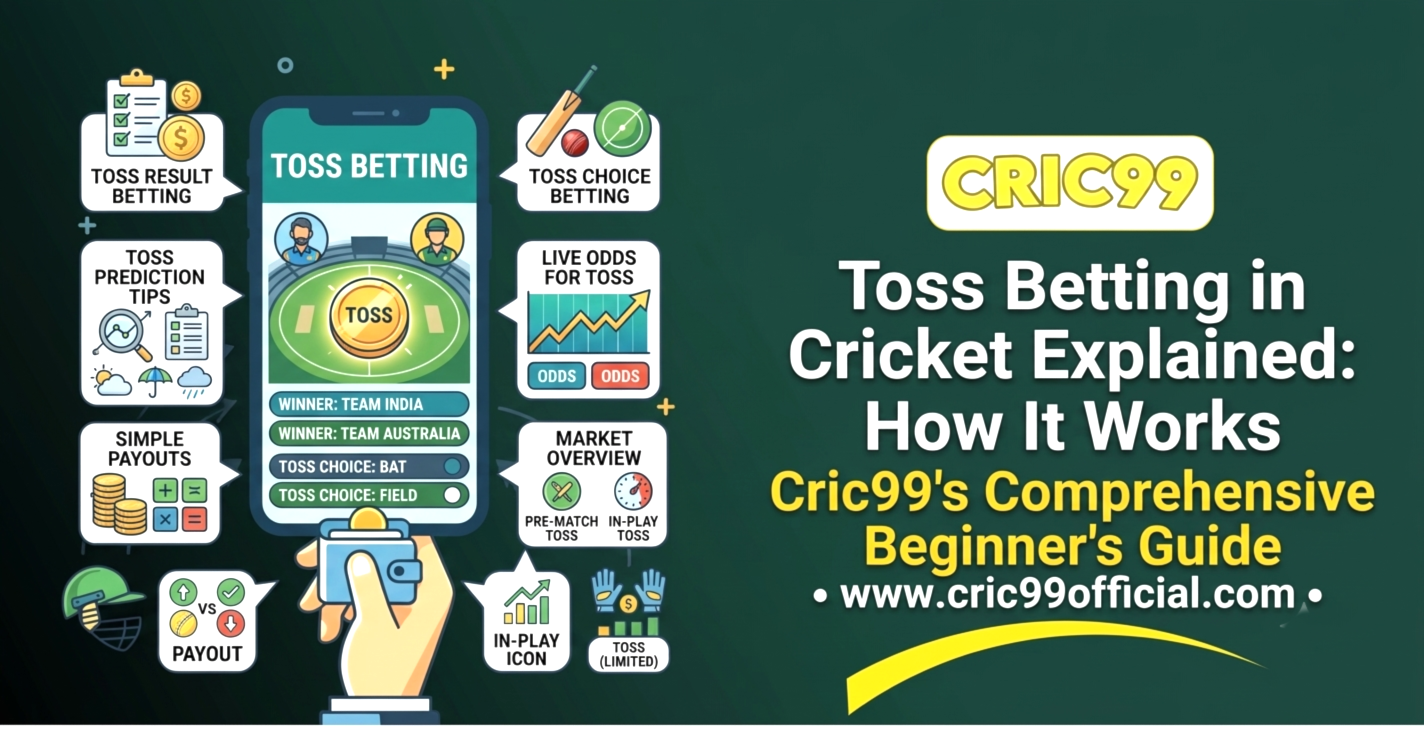
Toss betting in cricket refers to a market based on which team wins the coin toss before a match begins. Unlike match-winner markets, which focus on the final result, a toss market focuses on the outcome of the toss itself. Understanding this distinction is an important part of learning cricket betting basics.
This guide explains how cricket toss markets work, how their odds are displayed, how toss results differ from match results, and which market rules beginners should understand.
What Is Toss Betting in Cricket?
A cricket toss takes place before the match begins. The two team captains participate in the toss, and the winning captain generally gets to choose whether their team will bat or bowl first, subject to the format and competition rules.
A toss-winner market focuses on which team wins that toss. For example, before a hypothetical India versus Australia match, the market may list India and Australia as the two possible selections.
The toss result does not determine the match winner. A team can win the toss and still lose the match.
How Toss Betting in Cricket Works
Understanding how cricket betting works begins with knowing what the market measures.
A typical toss-winner market can be understood through these steps:
- Identify the fixture: Check that the correct teams and match are listed.
- Find the toss market: Confirm that the market specifically refers to the toss winner, not the match winner or another outcome.
- Review the odds: Understand the displayed price for each team.
- Check the rules: Read the conditions for postponed, abandoned, or cancelled matches and any other exceptional circumstances.
- Understand settlement: The result should be determined according to the market’s stated rules and the official toss outcome.
These steps explain the structure of a toss market. They do not provide a reliable way to predict or guarantee the result of a coin toss.
Toss Winner vs Match Winner
One of the most common beginner misunderstandings is confusing the toss winner with the match winner. They are separate outcomes.
| Feature | Toss-winner market | Match-winner market |
|---|---|---|
| What it measures | Which team wins the toss | Which team wins the match |
| When the outcome is determined | Before the match starts | After the match result is established |
| Main event | The coin toss | The match itself |
| Can the outcomes differ? | Yes | Yes |
For example, Australia might win the toss and choose to bowl first, but India could still win the match. The toss result and the final result are not the same event.
For a detailed explanation of match-result markets, read Match Winner Betting Explained: How Cricket Markets Work.
What Do Toss Market Odds Mean?
Odds express the price associated with a selection. They are not a guarantee of the outcome.
For example, a hypothetical toss market might display these decimal odds:
| Team | Example decimal odds |
|---|---|
| Team A | 1.90 |
| Team B | 1.90 |
These figures are illustrative only and do not represent live or verified prices. The odds shown by a provider may differ.
Decimal odds can be converted into an implied probability using this formula:
Implied probability (%) = (1 ÷ decimal odds) × 100
At odds of 1.90, the implied probability is approximately 52.63%. However, that figure is a mathematical conversion of the displayed price, not proof that the selection has that exact chance of occurring. Market prices may include a margin.
A coin toss has two possible sides, but the market’s rules, pricing, and settlement conditions still matter. Do not treat odds as a guarantee.
Does Winning the Toss Give a Team an Advantage?
Winning the toss gives the captain the opportunity to choose whether to bat or bowl first, where the format and competition rules allow that choice. The decision may depend on several match conditions.
Pitch conditions
A captain may consider whether the pitch is expected to change as the match progresses. The significance of pitch conditions varies by venue and match format.
Weather and dew
Weather forecasts and expected dew can influence a captain’s decision in some matches. These conditions do not guarantee that batting or bowling first will be better.
Match format
The considerations in a T20 match can differ from those in an ODI or Test match. The length of the game and the competition rules can affect the decision.
Team strategy
A captain may consider the team’s batting depth, bowling options, and preferred match approach.
These factors relate mainly to the decision made after winning the toss. They should not be confused with the toss result itself, which is determined independently of how the teams perform during the match.
Can You Predict the Toss Winner?
The toss is designed to be a random event. Team rankings, recent form, player statistics, and previous match results do not reliably establish which side will win the next toss.
Historical records may show how often a team has won tosses in the past, but past outcomes do not guarantee future results. A short sequence of toss wins or losses should not be treated as a dependable prediction method.
For beginners, the most useful approach is to understand what the market measures, how its odds are displayed, and how the result is settled rather than assuming a pattern will continue.
Toss Markets in T20, ODI, and Test Cricket
A toss takes place before many organised cricket matches, but market availability and rules depend on the competition and provider.
- T20 cricket: The toss takes place before the short-format match, and the captain’s decision may influence the initial batting or bowling order.
- One-day international cricket: The toss occurs before the ODI, with the captain choosing whether to bat or bowl first under the competition’s rules.
- Test cricket: The toss takes place before the match, and the decision may be influenced by pitch conditions, weather, and the length of the game.
The toss market remains distinct from markets based on the score, player performances, or final match result. Always check the specific market description rather than assuming that every provider offers the same options.
Toss Betting vs Over/Under Markets
Toss-winner and over/under markets measure different events.
| Feature | Toss-winner market | Over/under market |
|---|---|---|
| Main question | Which team wins the toss? | Will a specified statistic finish above or below a line? |
| Relevant outcome | Official toss result | Runs, wickets, or another defined statistic |
| Timing | Before the match begins | May be available before or during the match |
| Main rules to check | Toss result and exceptional circumstances | Line, measured period, and settlement conditions |
For more information about total-based markets, read Over/Under Betting in Cricket Explained for Beginners.
Understanding Toss Markets on Cric99
When reviewing Cric99, check the exact fixture, market description, displayed odds, and settlement rules. Market availability can vary, so do not assume that every match includes a toss-winner market.
If you use an account-based service, review its terms, eligibility requirements, and account-safety information. The guide Cric99 Terms and Conditions: Important Points to Understand provides a useful internal reference for understanding why service-specific rules matter.
Do not assume that a displayed price guarantees an outcome. Use only services that are lawful where you live, and understand the financial risks before using any betting-related service.
Common Mistakes Beginners Should Avoid
When learning cricket betting basics, keep these common mistakes in mind:
- Confusing the toss with the match result: Winning the toss does not mean a team will win the game.
- Treating past toss results as a prediction: Previous toss outcomes do not reliably determine the next one.
- Assuming odds guarantee the outcome: Prices represent a market price, not certainty.
- Ignoring the market description: Confirm that the market refers to the toss winner.
- Overlooking settlement conditions: Postponed, abandoned, or cancelled matches may be handled according to specific rules.
- Assuming every platform offers identical markets: Availability and conditions can differ between providers.
Understanding the event and its rules is more useful than making assumptions based on team reputation or past results.
Frequently Asked Questions
It refers to a market based on which team wins the coin toss before a cricket match begins. The exact settlement conditions depend on the market rules.
No. The toss winner chooses whether to bat or bowl first where the rules allow, but the final match result is a separate outcome.
No reliable prediction can be made from past toss results alone. Each toss is intended to be a random event.
No. Toss-winner odds relate to the toss result, while match-winner odds relate to the final match result. They measure different outcomes.
The settlement depends on the specific market’s terms. Check the provider’s rules for cancelled, postponed, or abandoned fixtures rather than assuming a universal outcome.
Start by understanding the difference between a toss market and a match-result market, how odds are displayed, and which settlement rules apply. These concepts form part of a basic cricket betting guide.
Final Thoughts
Toss betting in cricket focuses on which team wins the coin toss before the match begins. It is different from match-winner and over/under markets because it measures a separate event rather than the final score or result.
Learning how cricket betting works means understanding market definitions, odds, and settlement conditions without treating any outcome as certain.
Responsible-use note: Betting may be restricted by law and should only be considered by adults who are legally permitted to participate. Never risk money needed for essential expenses, and seek support if gambling becomes difficult to control.
Disclaimer: This article is for general informational and educational purposes only. It does not guarantee results or provide financial advice. Check applicable laws and the specific terms and market rules of any service before using it.