
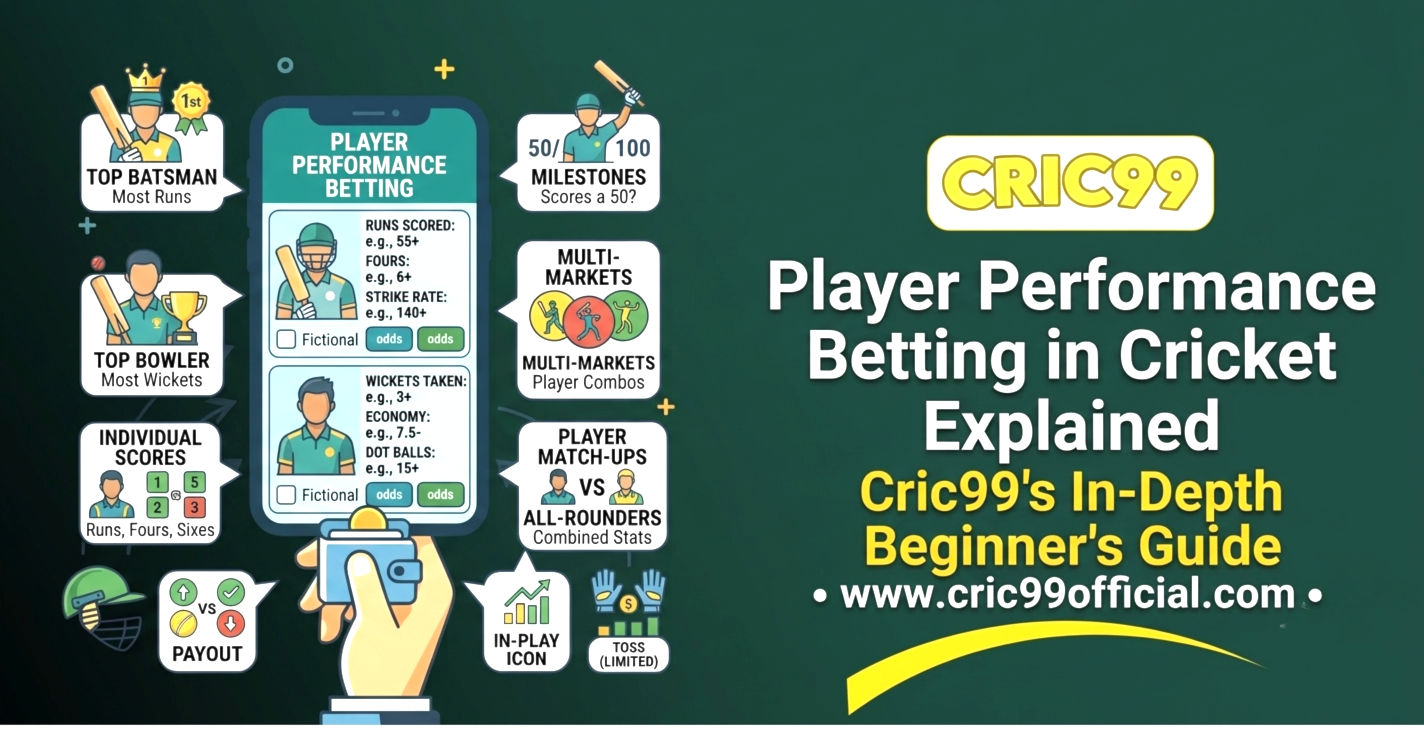
Player performance betting in cricket is a type of market where a selection is based on an individual player’s performance rather than only the final match result. Depending on the market, a prediction might involve a batter’s runs, a bowler’s wickets, or another measurable contribution during a match.
Understanding these markets is an important part of learning cricket betting basics. Before looking at any selection, beginners should understand what the market measures, which match conditions apply, and how the result will be settled. The available options and rules can differ between platforms and competitions.
This cricket betting guide explains common player performance markets, how cricket betting works in this context, how odds are displayed, and what to check before interpreting a market.
What Is Player Performance Betting in Cricket?
Player performance betting focuses on a statistic or achievement connected to a particular cricketer. Instead of predicting only which team will win, a market may ask whether a player will score above a stated run total or take a certain number of wickets.
For example, a hypothetical market might offer a batter’s total runs at an over/under line of 29.5. The two possible outcomes would be:
- Over 29.5 runs: The batter must score at least 30 runs for the over selection to qualify as a win, subject to the market’s settlement rules.
- Under 29.5 runs: The batter must score 29 runs or fewer for the under selection to qualify as a win, subject to the same rules.
This is an illustrative example, not a live market or a recommendation. The exact line, odds, and settlement conditions depend on the market being offered.
Common Types of Player Performance Markets
Player markets can cover several types of cricket statistics. Not every platform offers every market, and availability can vary by match format.
1. Batter runs
A batter-runs market focuses on how many runs a particular player scores in an innings or another defined period.
A hypothetical line might be 39.5 runs. The over selection would require the batter to score at least 40 runs, while the under selection would require 39 or fewer. The market rules determine how dismissals, interruptions, and incomplete innings are treated.
2. Bowler wickets
A bowler-wickets market focuses on the number of wickets credited to a particular bowler.
For example, a hypothetical line could be 1.5 wickets. An over selection would require at least two credited wickets, while an under selection would require one or none. Beginners should check which dismissals count and how the market handles a bowler who does not complete the expected spell.
3. Player boundaries and sixes
Some markets focus on a batter’s boundary count or number of sixes. These are different statistics: a four and a six may both count as boundaries in some markets, but a sixes market measures only sixes.
Read the market wording carefully. A selection about total boundaries should not be confused with one that counts sixes alone.
4. Player milestones
A market may focus on whether a player reaches a stated milestone, such as scoring a half-century or taking a specified number of wickets. The definition of the milestone and the period in which it must occur should be clear before interpreting the selection.
5. Other player statistics
Depending on the competition and platform, markets may cover additional performance measures. Always confirm the exact statistic, player, innings or time period, and settlement conditions rather than assuming that all platforms use the same rules.
How Does Player Performance Betting Work?
The general process is easier to understand when the market is broken into a few parts.
Step 1: Identify the player and statistic. Check the player’s name and whether the market concerns runs, wickets, boundaries, or another statistic.
Step 2: Read the market line. A line such as 24.5 runs separates the over and under outcomes. A different line can produce a different result from the same player performance.
Step 3: Understand the odds. Odds show the quoted price for a selection. They can be presented in decimal, fractional, or American format.
Step 4: Check the rules. Confirm how the market handles non-participation, substitutions, shortened matches, rain interruptions, retirements, and other unusual circumstances. These rules may differ between markets.
Step 5: Understand settlement. The result is determined using the statistic and conditions specified in the market rules. Do not assume that a selection is settled solely by the final score or by a player’s overall reputation.
This basic process helps explain how cricket betting works, but understanding the market does not make an outcome predictable or guarantee a positive result.
What Can Affect a Player’s Performance?
A player’s statistics can change with match conditions, team decisions, and the role they are given. No single factor reliably predicts an individual result.
| Factor | Why it may matter |
|---|---|
| Batting position | A batter’s position can affect the time and number of balls available to score. |
| Bowling role | A bowler’s expected overs and place in the attack can affect wicket opportunities. |
| Pitch and weather | Conditions may influence scoring, movement, interruptions, or the length of play. |
| Opposition | The opposing team’s bowling attack or batting approach can affect opportunities. |
| Match format | T20, ODI, and Test cricket provide different timeframes and tactical demands. |
| Team selection | A player’s participation and assigned role may differ from expectations. |
| Match situation | A required run rate, wickets remaining, or innings position can change how a player approaches the game. |
These are contextual considerations, not dependable ways to predict a specific statistic. Recent performance alone is not proof that a player will repeat the same result in the next match.
Player Performance Markets and Odds
Odds express the quoted return associated with a selection. The format changes how the price is displayed, but it does not remove the uncertainty of the outcome.
Decimal odds example
Suppose a hypothetical player market shows decimal odds of 2.00 for a selection. If a person places a stake of 100 units and the selection is settled as a win under the stated rules, the total return would be 200 units, including the original stake. The potential profit would be 100 units.
This example is only a mathematical illustration. It does not suggest that the selection is likely to win, and it excludes any fees or special settlement conditions that may apply.
For a more detailed explanation of how plus and minus prices work, see American Odds Explained: How the Plus and Minus Format Works.
Odds can change before an event or during live play. A displayed price is not a guarantee of the eventual result, and prices from different markets may not be directly comparable if their rules or conditions differ.
Player Performance Betting vs Cricket Handicap Betting
Player performance markets and handicap markets are not the same.
- Player performance betting focuses on an individual player’s statistic, such as runs scored or wickets taken.
- Cricket handicap betting applies a stated advantage or disadvantage to a team or selection under the market’s rules, often adjusting the effective result by a specified margin.
For example, a batter-runs line measures that batter’s runs, while a team handicap market evaluates the result after applying the stated handicap. Both require careful reading of the market terms, but they answer different questions.
If you are learning cricket betting basics, study the market definition before comparing odds or trying to interpret the outcome.
Player Performance Markets Before and During a Match
Some player markets may be available before the match begins, while others may be offered during live play. Availability depends on the platform, competition, and specific event.
Before the match
Pre-match prices are quoted before play starts. They may reflect expectations about the player’s role, team selection, opposition, format, and conditions. However, team changes or unexpected circumstances can make those assumptions outdated.
During live play
Live markets may change as the innings develops. A batter’s current score, balls faced, wickets remaining, and match situation can affect the available lines and odds. Markets may also be suspended temporarily while an important event is being reviewed or updated.
Live prices can move quickly, and there may be limited time to assess the rules. For more context on live-market mechanics, read Over/Under Betting in Cricket Explained for Beginners.
Understanding the Market Rules
Before interpreting a player market, check the details that determine how it will be settled.
- Participation: Does the player need to take the field or face a ball for the market to stand?
- Innings or match period: Does the statistic cover one innings, a complete match, or a specified period?
- Interrupted matches: What happens if rain or another event shortens play?
- Retirement or injury: How does the market handle a player who leaves the field or cannot continue?
- Official statistics: Which source or official scoring record is used to determine the result?
- Settlement terms: Are there special conditions for abandoned matches, no-result outcomes, or incomplete innings?
Do not assume that two markets with similar names have identical rules. Read the actual terms supplied for the specific selection.
What to Check on Cric99
If you use Cric99, treat the market description and applicable terms as the starting point for understanding what is offered. Do not assume that a particular player market, odds format, or settlement rule is available without checking the information shown for that event.
For account access and general platform information, the What Is Cric99? Complete Guide to the Cric99 Platform article provides background, while Cric99 Account Security: How to Protect Your Account covers basic account-safety considerations.
Keep account credentials private, use only access routes you have verified, and review the applicable terms before using any platform. Availability, market wording, and rules can change, so confirm details directly rather than relying on assumptions.
Common Mistakes Beginners Should Avoid
People learning cricket betting explained topics can overlook important details when they focus only on a player’s name or recent statistics.
- Ignoring the exact line: A market at 24.5 runs is different from one at 34.5 runs.
- Confusing player and team markets: A player’s statistic is not the same as a team’s total or match result.
- Assuming recent form guarantees a result: Past performance does not ensure the same outcome in a future match.
- Overlooking participation rules: A market may be affected if a player does not participate or the match is interrupted.
- Comparing prices without checking terms: Similar-looking odds can apply to markets with different conditions.
- Making rushed live decisions: Fast-moving prices can leave little time to review the details.
- Treating betting as income: Outcomes are uncertain, and losses are possible. Never stake money needed for essentials or borrow to participate.
A clear understanding of the market can help you interpret its wording, but it cannot eliminate the financial risk.
Frequently Asked Questions
What is player performance betting in cricket?
It is a market based on an individual player’s statistic or achievement, such as runs scored, wickets taken, or boundaries hit, rather than only the match result.
What are common player performance markets?
Examples include batter runs, bowler wickets, boundaries, sixes, and player milestones. The available markets vary by competition and platform.
How do over and under player markets work?
An over/under market sets a statistical line. The selection is assessed against the player’s result using the market’s stated rules. Half-unit lines, such as 29.5, avoid an exact tie with a whole-number statistic, although other settlement conditions can still matter.
Is player performance betting the same as cricket handicap betting?
No. Player performance betting focuses on an individual statistic, while cricket handicap betting applies a stated advantage or disadvantage under the relevant market rules.
Can player performance odds change during a match?
Yes, where live markets are offered. Prices and lines may change as play develops, and markets can be suspended. Availability and timing depend on the platform and event.
Does a player’s recent form guarantee the outcome?
No. Recent statistics provide context but cannot guarantee a future result. Conditions, player roles, opposition, and match circumstances can all differ.
What should beginners check before interpreting a player market?
Confirm the player, statistic, line, odds format, participation requirements, relevant innings or period, and settlement terms. Avoid relying on the market name alone.
Final Thoughts
Player performance betting in cricket centres on individual statistics rather than only the final match result. Understanding the difference between runs, wickets, boundaries, milestones, and team handicap markets helps beginners read market descriptions more accurately.
A useful cricket betting guide should explain the market’s definition, odds, and settlement conditions without presenting any outcome as certain. Learn the terminology, check the applicable rules, and remember that no analysis can remove the financial risk associated with betting.
Responsible-use note: This article is for general educational purposes only, not financial advice or a recommendation to place a bet. Betting may be restricted by age and local law. Check the laws that apply to you, set firm limits, and do not use money you cannot afford to lose.