
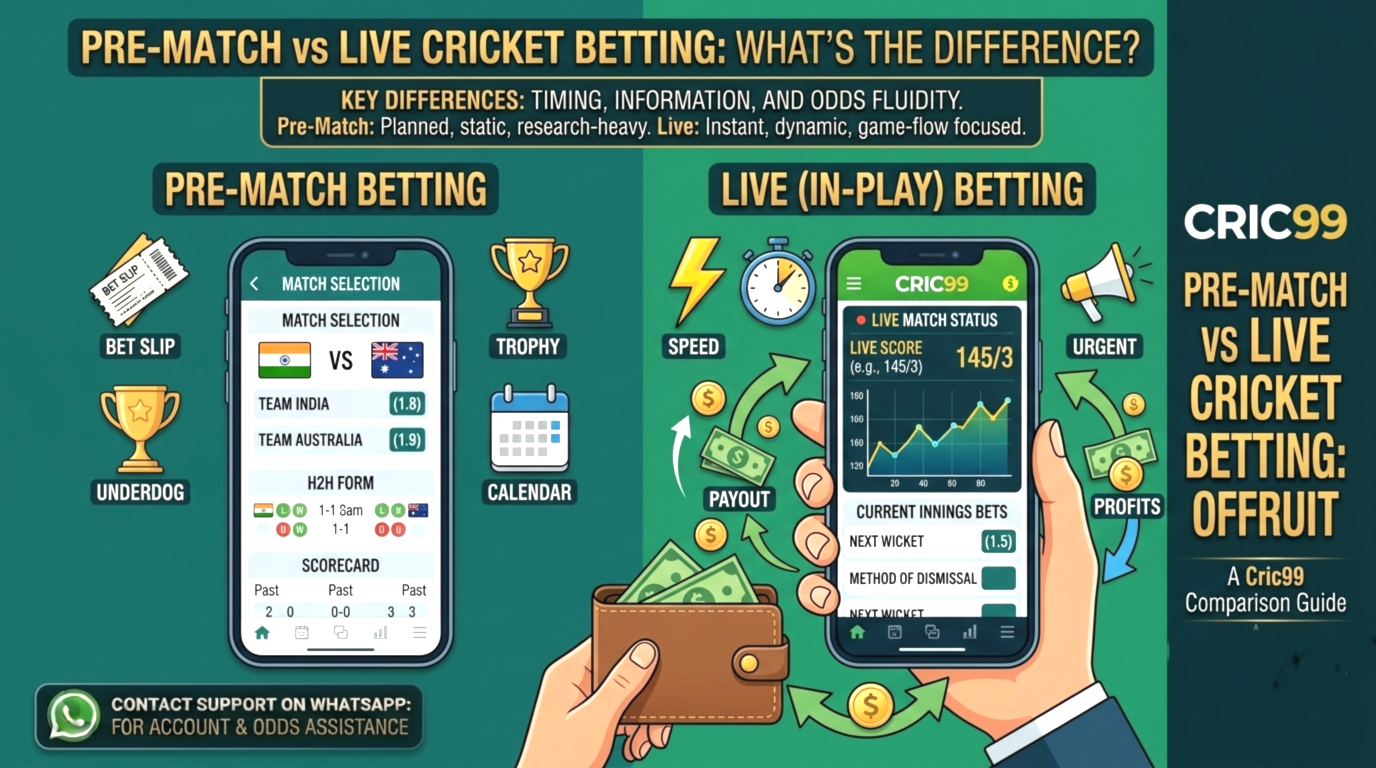
The main difference between pre-match and live cricket betting is when the market is available. Pre-match betting refers to markets offered before a cricket match begins, while live cricket betting refers to markets available during the match. Both can involve match-winner selections and other cricket markets, but the information available and the way odds change are different.
This cricket betting guide explains how both types of markets work, how their odds can move, and what beginners should understand before interpreting them.
What Is Pre-Match Cricket Betting?
Pre-match cricket betting refers to markets available before the first ball of a match is bowled. Prices are based on information available before play, which may include team announcements, player availability, pitch reports, weather forecasts, and previous performances.
For example, before a T20 match between India and Australia, a market might display odds for each team to win. These prices can change before the match starts as new information becomes available or market activity changes.
Common pre-match markets may include:
- Match winner
- Toss winner
- Tournament winner
- Top batter or top bowler
- Team totals
- Total runs
The exact markets offered depend on the competition and provider. A market’s name and settlement rules should always be checked before interpreting its price.
What Is Live Cricket Betting?
Live cricket betting, also called in-play betting, refers to markets offered while a match is underway. Prices may change as runs are scored, wickets fall, overs are completed, or the match situation develops.
Imagine Team A is chasing a target in a T20 match. Its chances may appear different after a quick start compared with a situation where it loses two early wickets. Market prices may respond to those developments, but they cannot guarantee the final result.
Live markets may also be suspended temporarily during significant events, such as a wicket, an umpire review, or a delivery. Availability and timing depend on the provider’s rules and systems.
For more detail about in-play markets, read Live Cricket Betting Explained: How In-Play Markets Work.
Pre-Match vs Live Cricket Betting: Key Differences
| Feature | Pre-match betting | Live cricket betting |
|---|---|---|
| Availability | Before the match begins | During the match |
| Information | Pre-match team and match information | Pre-match information plus developments during play |
| Odds movement | Can change before the start | May change repeatedly during play |
| Match events | Not yet known | Runs, wickets, and other events are unfolding |
| Market availability | Depends on the fixture and provider | Markets may be suspended or updated during play |
| Decision environment | More time to review information before the game | Conditions can change quickly |
| Settlement | Based on the stated market rules | Also based on the stated market rules, including any in-play conditions |
Neither type of market guarantees a correct prediction. The key difference is the timing and amount of match information available when the prices are viewed.
How Cricket Betting Odds Work Before and During a Match
Understanding odds is an important part of learning how cricket betting works. Odds represent the price associated with a particular selection, not a promise that the outcome will occur.
Example of pre-match odds
Suppose a hypothetical match-winner market shows:
| Team | Decimal odds |
|---|---|
| Team A | 1.80 |
| Team B | 2.10 |
These prices show different returns for the two selections. At decimal odds of 1.80, a hypothetical 100-unit stake would have a potential total return of 180 units if the selection wins and the market settles as expected. This includes the original stake.
Example of live odds
Now imagine Team A starts the match strongly. The displayed odds may change as the market responds to the developing situation. If Team A loses several wickets, its price may move in the other direction.
These movements depend on market activity and the provider’s pricing. The example is illustrative: actual odds may differ, and a price change does not confirm what will happen next.
Understanding implied probability
Decimal odds can be converted into an implied probability using this formula:
Implied probability (%) = (1 ÷ decimal odds) × 100
For example, odds of 2.00 correspond to an implied probability of 50% before accounting for any market margin. This is a mathematical interpretation of the price, not a guarantee or a verified estimate of the true chance of winning.
If you want to understand another odds format, see American Odds Explained: How the Plus and Minus Format Works.
What Can Affect Pre-Match Odds?
Before a match begins, several factors may influence market prices.
Team selection and player availability
A change to the playing XI or the absence of an important player may affect expectations about a team’s performance.
Pitch and weather conditions
The pitch, expected weather, and the possibility of interruptions can be relevant to a cricket match. Their importance varies by venue and format.
Recent performances
Recent results can provide context, but they do not guarantee that a team will perform the same way in its next match.
Market activity
Odds may move as market participants react to information or change their positions. The direction and size of a movement are not reliable proof of the final result.
What Can Affect Live Cricket Betting Odds?
During a match, the market can respond to developments that were unknown before play began.
- Runs scored: A changing score can affect the match situation.
- Wickets lost: Losing a key batter may alter a team’s position.
- Overs remaining: The time left to reach a target matters in limited-overs cricket.
- Required scoring rate: The number of runs needed relative to the remaining overs can influence expectations.
- Match interruptions: Rain, reviews, or revised targets can change the conditions.
- Market updates: Providers may suspend or adjust markets as match information is processed.
These factors help explain why live odds can move quickly. They do not make the next delivery or final result predictable with certainty.
Which Is Easier for Beginners to Understand?
Pre-match markets may be easier for beginners to review because the match has not yet started and there is usually more time to read the market information. A beginner can check the teams, format, odds, and settlement conditions without following a live score at the same time.
Live markets can change quickly. Someone who does not understand the match format or market rules may find it harder to interpret what a price represents.
For beginners learning cricket betting basics, a sensible starting point is to understand:
- What the market measures.
- How the odds format works.
- What conditions determine settlement.
- What financial risk is involved.
- Why no market price guarantees an outcome.
Understanding these concepts is more important than choosing one market type over another.
Can the Same Cricket Market Be Available Before and During a Match?
Yes, some markets, such as match winner, may be available both before the match and while it is being played. However, the available selections, prices, and conditions can change.
Other markets may be available only at certain times or for particular competitions. A market can also be suspended or removed. Always read the specific market details instead of assuming that a pre-match market will remain available in the same form throughout the game.
Pre-Match and Live Markets on Cric99
When reviewing Cric99, check which fixture and markets are actually displayed, along with the applicable terms and settlement rules. Availability can vary, and it should not be assumed that every match offers the same pre-match or live options.
Users should also understand account access, security, and service conditions before using an account-based platform. Cric99 Account Security: How to Protect Your Account explains general account-safety considerations, while the platform’s own terms should be checked for its specific rules.
Do not treat changing prices as guaranteed predictions, and never assume that a displayed market or account feature removes the financial risk involved.
Common Mistakes to Avoid
Beginners can misunderstand the difference between pre-match and live markets in several ways:
- Assuming pre-match odds stay fixed: Prices can change before the game starts.
- Treating live odds as certain predictions: In-play prices reflect a changing market, not a guaranteed result.
- Ignoring settlement rules: Different markets can have different conditions.
- Confusing market availability with reliability: A market being displayed does not mean its outcome can be predicted.
- Reacting to every match event: Rapid changes can encourage rushed decisions.
- Overlooking financial risk: Any money placed at risk can be lost.
A clear understanding of the market is more useful than making assumptions based on a single price movement or match event.
Frequently Asked Questions
Pre-match markets are available before a game begins. Live markets are available during the match and may change as events unfold.
Yes. Prices can move before the start because of team news, player availability, weather, or market activity.
Live prices may respond to runs, wickets, overs remaining, interruptions, and other developments. The speed of updates depends on the provider and market.
No. Markets may be unavailable, suspended, updated, or removed depending on the event and the provider’s rules.
Neither format guarantees an accurate prediction. They reflect prices at different stages of a match, and outcomes remain uncertain.
Start with market definitions, cricket formats, odds, implied probability, and settlement conditions. These cricket betting basics help explain how markets are structured without promising a result.
Final Thoughts
The difference between pre-match and live cricket betting comes down to timing and the information available. Pre-match markets are viewed before play starts, while live markets may change as runs, wickets, and other events affect the match situation.
If you are learning how cricket betting works, focus on understanding the market, reading the odds correctly, and checking the settlement rules. No price guarantees a win, and betting involves financial risk.
Responsible-use note: Betting may be restricted by law and should only be considered by adults who are legally permitted to participate. Never use money needed for essential expenses, and seek support if gambling becomes difficult to control.
Disclaimer: This article is for general informational and educational purposes only. It does not guarantee results or provide financial advice. Check applicable laws and the specific terms and market rules of any service before using it.