
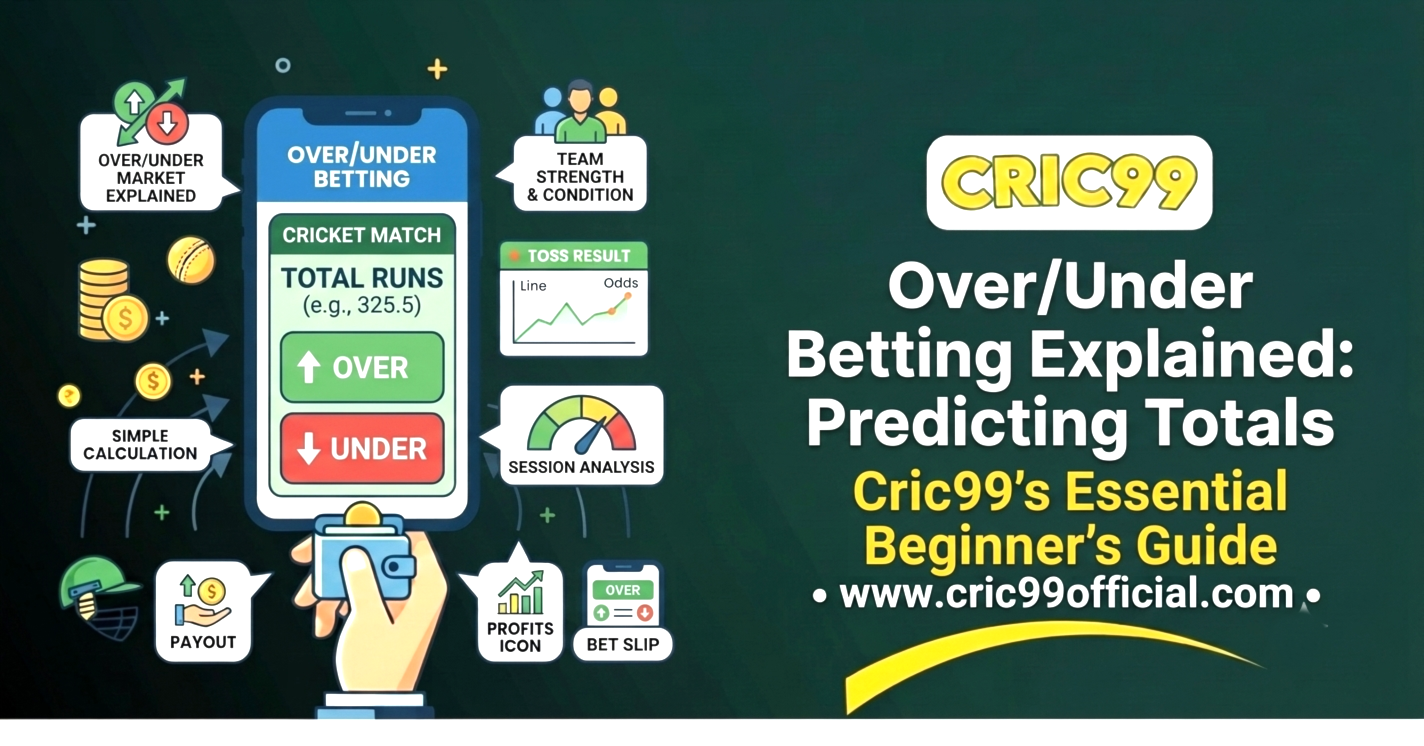
Over/under betting in cricket is a market based on whether a specified statistic, such as total runs or wickets, will finish above or below a number set by the market. Instead of choosing which team will win, the market focuses on whether the final result will be higher or lower than the stated line.
This guide explains how over/under markets work, how to read the line and odds, and what beginners should understand about market rules and financial risk.
What Is Over/Under Betting in Cricket?
Over/under betting is a type of cricket market that focuses on a statistical total. The market displays a number, often called the line, and the available selections relate to whether the final total will be over or under that number.
For example, a market might set a line of 320.5 total runs for a specified match or innings.
- Over 320.5: The relevant total must be 321 runs or more for the selection to win.
- Under 320.5: The relevant total must be 320 runs or fewer for the selection to win.
The example assumes the market measures the final total for the stated period. The actual market description and settlement rules determine which runs count and what happens if the match is interrupted.
Over/under markets can apply to different statistics, so always check what the displayed line represents.
How Over/Under Cricket Betting Works
Understanding how cricket betting works starts with identifying three things: the statistic, the line, and the settlement conditions.
- Identify the market: Check whether it covers total match runs, an innings, a team total, or another statistic.
- Read the line: Note the number that separates the over and under selections.
- Understand the odds: Review the price attached to each selection.
- Check the rules: Find out how interruptions, shortened matches, abandoned games, or other unusual situations are handled.
- Understand the risk: Any money placed at risk can be lost, even when a selection seems likely.
These steps help you interpret the market. They do not provide a reliable way to guarantee the result.
Common Types of Over/Under Markets in Cricket
The exact markets available depend on the match, competition, and provider. Common examples include the following.
Total match runs
This market relates to the combined runs scored by both teams, if that is what the market definition specifies. Check whether extras and other scoring details are included under the stated rules.
Team total runs
A team total focuses on one team’s score rather than the combined match total. For example, a market might set a line of 165.5 runs for a team’s innings.
First-innings total
This market focuses on the score made in the first innings. The conditions may differ between T20, ODI, and Test cricket, so the exact innings covered must be clear.
Runs in a particular over
Some markets focus on the number of runs scored in a specified over. These markets have a much narrower scope than a full-innings total, and the relevant delivery and settlement rules matter.
Wickets or player statistics
Depending on the provider, a market may use over/under lines for wickets or other player statistics. Do not assume every type of statistic is available for every fixture.
For a broader introduction to the different options, read What Is Cric99? Complete Guide to the Cric99 Platform.
Over/Under Betting Examples
Consider a hypothetical T20 innings with an over/under line of 165.5 runs.
| Final innings total | Over 165.5 | Under 165.5 |
|---|---|---|
| 150 runs | Does not win | Wins |
| 165 runs | Does not win | Wins |
| 166 runs | Wins | Does not win |
| 180 runs | Wins | Does not win |
Because the line ends in .5, the total cannot equal the line in this example. A whole-number final score will fall either above or below it.
Some markets use whole-number lines instead. Those can have different settlement outcomes, including a possible push or refund if the total exactly matches the line. The specific rules determine how that situation is handled.
What Do Over and Under Odds Mean?
Odds express the price attached to a selection. Decimal odds are commonly used to show the potential total return, including the original stake, if a selection wins and settles as expected.
For example, suppose a hypothetical over selection is priced at decimal odds of 1.90.
With a 100-unit stake:
Potential total return = 100 × 1.90 = 190 units
The potential profit would be 90 units, because the total return includes the original 100-unit stake. This example excludes any applicable fees or deductions and does not imply that the selection is likely to win.
Over and under prices can differ. A lower price does not guarantee a result, and a higher price does not automatically represent better value.
Over/Under vs Match Winner Betting
These markets focus on different questions.
| Feature | Over/under market | Match winner market |
|---|---|---|
| Main question | Will a statistic finish above or below a line? | Which team will win? |
| Main focus | A specified total or statistic | The match result |
| Possible outcomes | Over or under, depending on the market | One or more result selections |
| Important rules | The statistic, line, and relevant period | Match result and settlement conditions |
A team can win a match without exceeding a particular run total. Likewise, a total-runs selection can win even if the team expected to score more does not win the match.
To understand match-result markets separately, see Match Winner Betting Explained: How Cricket Markets Work.
How Match Format Affects Over/Under Markets
The format of a cricket match matters because the length of an innings and the possible scoring patterns vary.
T20 cricket
T20 matches have a limited number of overs per side, so total-runs markets often focus on relatively short innings. Early wickets, scoring rates, and remaining overs can affect the match situation.
One-day international cricket
ODIs generally have longer innings than T20 matches. Run totals depend on the overs available, wickets remaining, playing conditions, and any interruptions or revised targets.
Test cricket
Test matches can extend over several days and include multiple innings. A market might refer to a particular innings, a team total, or another defined period. Always confirm exactly which statistic and timeframe are covered.
Do not compare over/under lines across different formats without first understanding the match conditions and market definition.
What Happens if Rain Interrupts a Match?
Weather interruptions can affect over/under markets, particularly in limited-overs cricket where the number of available overs may change.
Depending on the market rules, an interrupted match might be settled using a defined condition, adjusted under specified rules, or treated as void. There is no universal settlement rule that applies to every provider or market.
Before interpreting a line, check:
- Whether the market requires a completed innings or match.
- Whether revised targets or shortened innings affect settlement.
- How abandoned or abandoned-after-start matches are treated.
- Whether the market refers to the original line or a particular defined period.
These details are important because the same market name does not guarantee identical conditions across services.
Common Mistakes Beginners Should Avoid
A useful cricket betting guide should explain the mistakes that can lead to confusion.
- Ignoring the line: Over or under only makes sense in relation to the exact number displayed.
- Confusing team totals with match totals: One may cover a single team, while the other may combine both teams’ scores.
- Assuming a whole-number line works like a half-number line: An exact match with a whole-number line may have a different settlement outcome.
- Ignoring match interruptions: Rain or a shortened innings may affect settlement under the market rules.
- Treating odds as predictions: Odds express a price, not certainty about the final total.
- Assuming a high-scoring team always clears the line: A team’s reputation does not guarantee a particular score.
- Risking more because the market looks simple: Every selection carries financial risk.
Understanding the market definition is more useful than making assumptions from a team’s name or previous results.
Over/Under Markets and Cric99
When reviewing Cric99, check the exact market description, line, odds, and settlement rules displayed for the relevant fixture. Market availability and conditions can vary, so do not assume every match offers the same over/under options.
If you use an account-based service, take time to understand account access and security. Cric99 Account Security: How to Protect Your Account explains general account-safety practices, while the service’s own terms should be checked for its specific conditions.
Never assume that a displayed price guarantees an outcome or removes the possibility of losing money. Use only services that are lawful where you live and meet the applicable eligibility requirements.
A Beginner’s Checklist
Before interpreting an over/under market, check the following:
- What statistic does the market measure?
- Does the line apply to a team, an innings, an over, or the whole match?
- Is the line a whole number or a half number?
- Do I understand the displayed odds?
- Have I checked the rules for rain, interruptions, and abandoned matches?
- Do I understand the amount I could lose?
This checklist helps clarify what a market means without treating the outcome as certain.
Frequently Asked Questions
It refers to a market in which the outcome depends on whether a specified statistic finishes above or below a stated line. The statistic might be total runs, a team total, or another defined measure.
You identify the statistic and line, review the available over and under selections, understand the odds, and check the settlement conditions. The result depends on the final statistic under the stated market rules.
Over/under markets focus on a specified total or statistic. Match winner markets focus on which team wins the match. They measure different outcomes.
It depends on the line and the market rules. A half-number line such as 165.5 cannot be matched by a whole-number score. A whole-number line may have a push, refund, or another specified settlement condition.
Can rain affect over/under markets?
Yes. Rain can shorten an innings or interrupt a match, and the applicable rules determine how the market is settled.
No. Odds represent a price and do not guarantee the final score or statistic.
Final Thoughts
Over/under betting in cricket focuses on whether a specified statistic finishes above or below a market line. To understand it, beginners need to identify the statistic, read the line correctly, understand the odds, and check the rules for interruptions and settlement.
Learning these cricket betting basics can help you interpret market terminology more clearly, but it cannot remove uncertainty or financial risk.
Responsible-use note: Betting may be restricted by law and should only be considered by adults who are legally permitted to participate. Never use money needed for essential expenses, and seek support if gambling becomes difficult to control.
Disclaimer: This article is for general informational and educational purposes only. It does not guarantee results or provide financial advice. Always check applicable laws and the specific terms and market rules of any service before using it.