
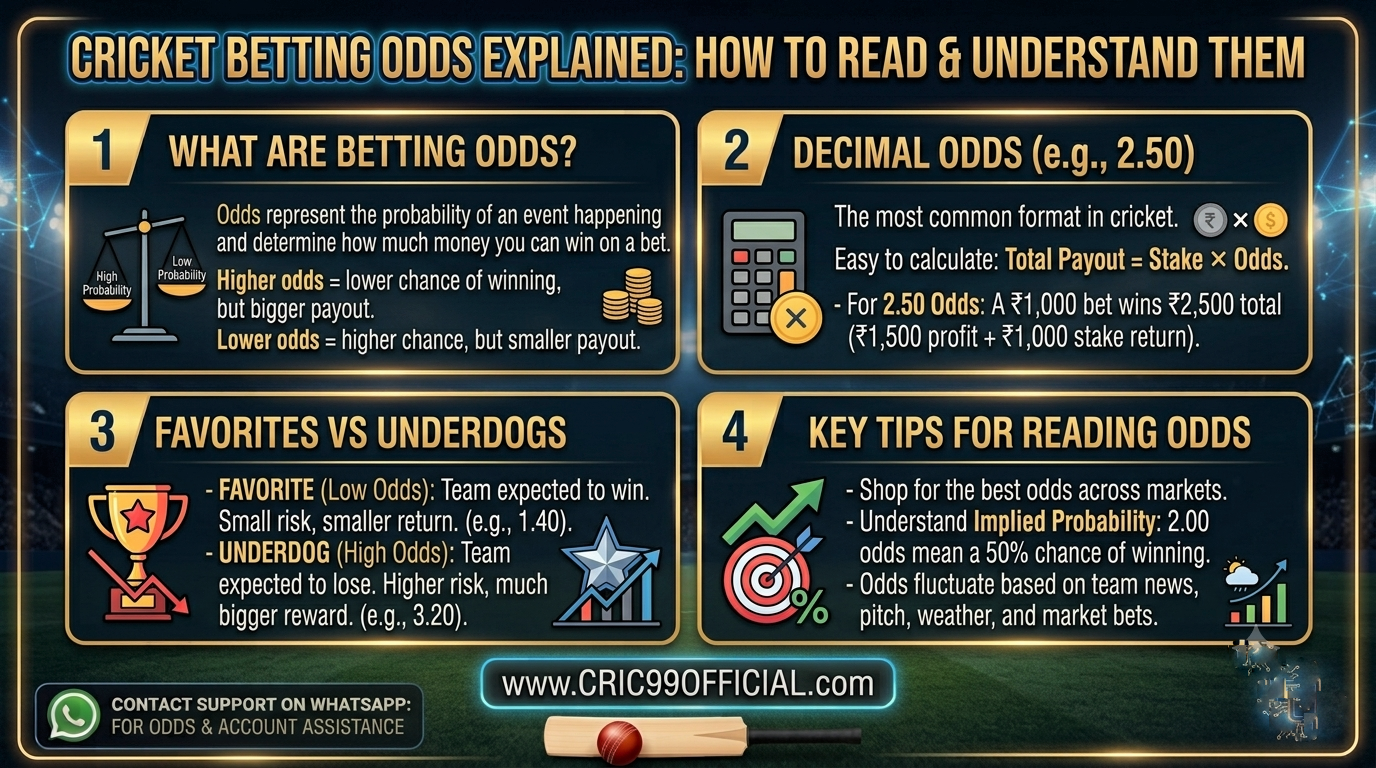
Cricket betting odds show the price attached to a particular betting outcome. They help you understand the potential return from a stake and, more importantly, compare different prices within a market.
For anyone new to cricket betting, understanding odds should come before placing a wager. A number such as 1.50, 2.00 or 4.00 is not a guarantee of what will happen in the match. It is a price offered for a particular outcome.
This cricket betting guide explains how odds work, how to calculate potential returns, why prices change, and what beginners should check before accepting a betting price.
What Are Cricket Betting Odds?
Cricket betting odds represent the price available on a particular outcome.
For example, imagine a cricket match where Team A is listed at decimal odds of 2.00 to win.
If someone places a ₹100 stake at those odds and the bet wins:
- Total return: ₹200
- Original stake: ₹100
- Potential profit: ₹100
The calculation is:
Stake × Decimal Odds = Total Return
So:
₹100 × 2.00 = ₹200
This is why learning to read odds is one of the most important parts of cricket betting basics.
Understanding Decimal Odds
Decimal odds are commonly used because they make potential returns relatively easy to calculate.
Here are some simple examples:
| Decimal odds | ₹100 stake | Total return | Potential profit |
|---|---|---|---|
| 1.50 | ₹100 | ₹150 | ₹50 |
| 2.00 | ₹100 | ₹200 | ₹100 |
| 2.50 | ₹100 | ₹250 | ₹150 |
| 3.00 | ₹100 | ₹300 | ₹200 |
| 5.00 | ₹100 | ₹500 | ₹400 |
The total return includes the original stake.
The potential profit is the return minus the original stake.
These examples are for explaining the mathematics only. They do not indicate which team or player is more likely to win.
What Does 2.00 Odds Mean?
Odds of 2.00 mean that the total return is twice the stake if the bet wins, before any applicable commission or other platform conditions.
For example:
- ₹50 stake → ₹100 total return
- ₹100 stake → ₹200 total return
- ₹500 stake → ₹1,000 total return
The profit would be the total return minus the stake.
However, 2.00 odds do not mean that an outcome is certain to happen.
What Do Low and High Odds Mean?
Generally, lower decimal odds represent a smaller potential profit relative to the stake, while higher odds represent a larger potential return.
For example:
- 1.50 offers ₹50 potential profit on a ₹100 stake.
- 3.00 offers ₹200 potential profit on a ₹100 stake.
- 5.00 offers ₹400 potential profit on a ₹100 stake.
But higher potential returns also come with greater uncertainty about the selected outcome.
This is an important distinction for beginners: higher odds do not automatically mean better value, and lower odds do not mean guaranteed results.
How to Calculate Cricket Betting Returns
The basic decimal-odds formula is straightforward:
Total Return = Stake × Odds
To calculate potential profit:
Potential Profit = Total Return − Stake
Example
Suppose the odds are 2.40 and the stake is ₹200.
₹200 × 2.40 = ₹480 total return
Potential profit:
₹480 − ₹200 = ₹280
If the bet loses, the stake may be lost according to the applicable betting rules.
Always check the specific market and platform conditions before placing a wager.
Odds Are Not Guarantees
One of the most important parts of cricket betting explained is understanding what odds do—and what they do not do.
Odds provide a price for an outcome. They do not guarantee that the outcome will occur.
A cricket match can change quickly because of:
- Wickets
- Partnerships
- Injuries
- Weather
- Pitch conditions
- Tactical decisions
- Individual performances
- Changes in the required run rate
Even a short-priced selection can lose.
Previous results also cannot guarantee the next result.
How Odds Can Reflect Probability
Decimal odds can be converted into a simple implied probability estimate using:
Implied probability = 1 ÷ decimal odds
For example:
- 2.00 → 50%
- 4.00 → 25%
- 5.00 → 20%
These are mathematical implied probabilities based on the quoted price. They should not automatically be interpreted as the bookmaker or market’s exact prediction of the true probability because margins, commission and market conditions can affect the relationship.
This distinction is important when using odds as part of a cricket betting guide.
What Is the Betting Margin?
In a bookmaker market, the prices offered across possible outcomes can include a built-in margin.
For a simple two-outcome example:
- Team A: 1.80
- Team B: 2.00
The implied probabilities are:
- 1 ÷ 1.80 = 55.56%
- 1 ÷ 2.00 = 50%
Together they equal 105.56%.
The amount above 100% illustrates the mathematical margin in this simplified example.
Real cricket markets can be more complicated, particularly where there are several possible outcomes or additional conditions.
Why Cricket Betting Odds Change
Odds are not necessarily fixed from the moment a market opens.
Prices can change because of new information or activity in the market.
Before a match, changes may be connected with:
- Team announcements
- Player injuries
- Playing XI information
- Weather updates
- Pitch information
- Betting activity
During a live match, prices can change much faster.
A wicket, boundary, change in required run rate or other significant event can cause the available price to move immediately.
This means a price seen earlier may not still be available when you return to the market.
Pre-Match Cricket Betting Odds
Pre-match odds are displayed before the match or relevant market begins.
Beginners may look at:
- Recent team form
- Player availability
- Venue
- Pitch conditions
- Weather
- Previous meetings
- Expected playing XI
These factors can provide useful context, but they should not be treated as a guarantee.
A strong-looking statistical profile does not remove the uncertainty of a cricket match.
Live Cricket Betting Odds
Live odds are available while a match is taking place, where the platform supports live markets.
The price can change rapidly as the match develops.
For example, if a team loses several wickets in quick succession, the odds connected with different match outcomes may change.
Live betting therefore requires an understanding of both the odds and the current match situation.
Beginners should be especially careful because rapidly changing markets can encourage decisions based on emotion or pressure rather than careful consideration.
Back and Lay Odds on a Betting Exchange
A betting exchange introduces another important concept: back and lay positions.
A back bet means taking a position that an outcome will happen.
A lay bet means taking a position against an outcome happening.
The distinction matters because lay betting involves liability.
As explained in What Is Cric99? Complete Guide to the Cric99 Platform, an exchange differs from a traditional bookmaker because users can take opposing positions against one another.
The amount entered into a lay position should therefore not automatically be treated as the maximum amount that can be lost.
Always check the displayed liability before confirming a lay position.
Matched and Unmatched Odds
Another part of exchange betting is understanding whether a position has been matched.
A matched bet means an opposing position has been found at the requested price and amount.
An unmatched bet means that some or all of the requested amount has not yet been matched.
For example, you might request odds of 3.00 for ₹500, but only ₹200 may be available from another participant at that price.
Depending on the platform’s rules, the remaining amount may stay unmatched until another participant takes the opposite position.
This is different from simply accepting a fixed price from a traditional bookmaker.
Cricket Betting Odds vs Actual Probability
It is useful to separate three ideas:
- Odds — the price available for a particular outcome.
- Implied probability — the mathematical probability suggested by those odds.
- Actual probability — the real likelihood of the outcome occurring, which cannot be known with certainty before a match.
For example, odds of 4.00 correspond mathematically to 25% implied probability.
But that does not mean the outcome has exactly a 25% chance of happening.
Market margins, commission, information quality and other factors can affect the relationship.
Understanding this difference prevents a common beginner mistake: treating the odds themselves as a prediction that must come true.
Common Cricket Betting Markets and Their Odds
Cricket betting odds can appear across many types of markets.
Depending on the platform and match, these may include:
| Market | What the odds relate to |
|---|---|
| Match winner | The team that wins |
| Total runs | A specified team or match total |
| Player performance | A defined performance by a player |
| Innings markets | An outcome within a particular innings |
| Toss markets | A result connected with the toss |
| Live markets | Outcomes while the match is in progress |
Not every market is available for every match.
Market rules can also differ, so read the conditions before placing a wager.
What Beginners Should Check Before Accepting Odds
Before placing a cricket bet, ask five simple questions.
1. What Does the Market Mean?
Do not select an outcome until you understand exactly what the market is asking.
2. What Are the Odds?
Check the current price and understand the potential return.
3. How Much Is at Risk?
Know your stake for a back bet and your potential liability for a lay bet.
4. What Are the Settlement Rules?
Check what happens if a match is abandoned, shortened or affected by unusual circumstances.
5. Can You Afford the Loss?
Never treat a potential return as guaranteed money.
Only risk money you can afford to lose.
Common Mistakes When Reading Cricket Odds
Assuming Low Odds Mean a Guaranteed Win
They do not.
A low price indicates a smaller potential return relative to the stake, but the outcome can still lose.
Choosing High Odds Simply for a Bigger Return
High odds produce larger potential returns, but the selected outcome may be less likely.
Forgetting That the Stake Is Included in the Return
At 2.00 odds, a ₹100 winning stake produces a ₹200 total return—not ₹200 profit.
Ignoring Lay Liability
On an exchange, the potential loss from a lay position can be different from the amount entered as the stake.
Treating Historical Statistics as Certainty
Past performance can provide context but cannot determine a future cricket result.
Ignoring Changes in Price
The odds displayed earlier may change before a bet is confirmed.
How Cric99 Fits Into the Bigger Picture
When researching cricket betting, it is useful to understand the underlying concepts separately from any particular platform.
For readers exploring account access, Cric99 Cricket ID Explained: What It Is and How It Works explains the role of an account identifier, while Cric99 Terms and Conditions: Important Points to Understand can help readers understand why platform rules matter.
The exact odds, markets, account procedures and other features available on any platform can change. Users should check the current platform information rather than assuming that a particular market or price will always be available.
Frequently Asked Questions
Cricket betting odds are prices attached to particular outcomes in a cricket betting market. They can be used to calculate potential returns and can change as market conditions change.
With decimal odds, multiply the stake by the odds to calculate the total potential return. Subtract the original stake from that return to calculate potential profit.
Odds of 2.00 mean that a winning ₹100 stake would produce a ₹200 total return before applicable commission or other conditions. The potential profit would be ₹100.
Higher odds provide a larger potential return for the same stake, but they do not guarantee a better outcome. Odds should be assessed in the context of the market and the uncertainty involved.
The exact process varies between bookmakers and exchanges. Prices can reflect market expectations, available information, betting activity, margins and other factors.
Yes. Odds can change before a match and during live play. Team news, player availability, match events and market activity can all affect prices.
Implied probability is a mathematical conversion of decimal odds using the formula 1 ÷ odds. For example, odds of 4.00 correspond to a 25% implied probability before considering market margins or commission.
No. Odds are prices, not guarantees. Cricket outcomes remain uncertain, and a bet can lose regardless of how short the odds are.
Back betting takes a position that an outcome will happen. Lay betting takes a position against that outcome. Lay betting can involve liability, which should be checked before confirming the position.
Final Thoughts
Understanding odds is one of the foundations of responsible cricket betting.
Start with the mathematics: know what the odds mean, calculate the potential return, understand implied probability and recognise that prices can change. If you are using an exchange, also learn the difference between back and lay positions and pay close attention to liability and matching.
Most importantly, odds should never be confused with certainty. Cricket is unpredictable, and no price, statistic or strategy can guarantee a winning result.
Disclaimer: This article is provided for informational and educational purposes only. Cricket betting involves financial risk, and there is no guarantee of profit or a particular sporting outcome. Betting laws, age requirements, market availability, platform rules and account procedures may vary by jurisdiction and can change over time. Check the applicable laws in your location and the current terms of the relevant betting service before participating in real-money betting.