
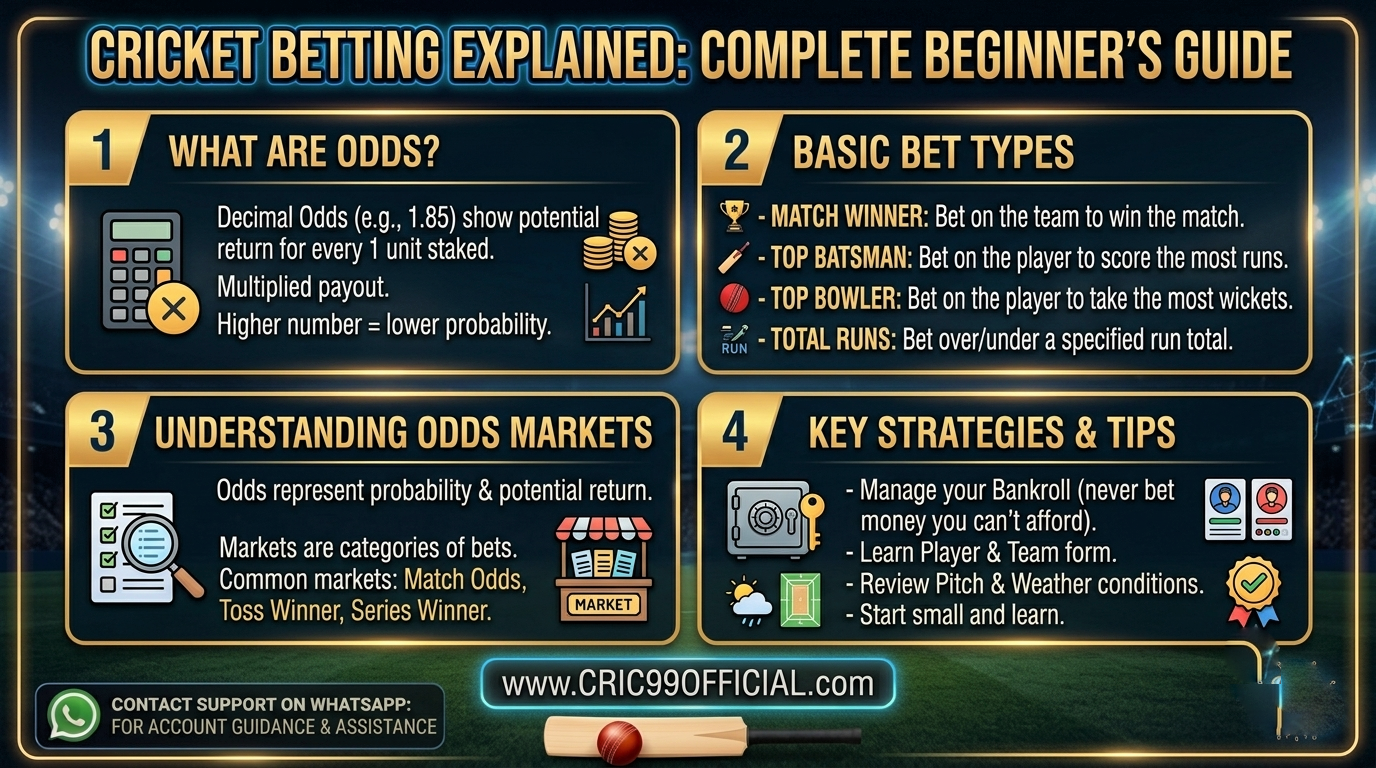
Cricket betting means predicting an outcome in a cricket match and placing a wager based on that prediction. Depending on the market, a bet may relate to the match winner, runs, wickets, individual player performance, or another defined event.
This cricket betting guide explains the basics in simple terms, including how odds work, the difference between back and lay betting, common cricket markets, what a matched bet means on an exchange, and the risks beginners should understand before using real money.
For readers researching Cric99, it is also useful to understand the underlying concepts rather than treating the platform itself as a shortcut to better predictions.
What Is Cricket Betting?
Cricket betting is the practice of placing a wager on a predicted cricket outcome.
For example, before a match, a betting market might allow users to take a position on which team will win. Other markets may focus on specific events or statistics within the match.
The important point is that a cricket bet is based on an uncertain future outcome. Even a team that appears stronger on paper can lose because cricket is affected by many variables, including player performance, conditions, tactics and unexpected events.
That is why understanding cricket betting basics is more useful for a beginner than simply following a prediction.
How Cricket Betting Works
At a basic level, the process involves four things:
- A cricket event is offered as a betting market.
- Different possible outcomes are displayed with prices or odds.
- A user selects an outcome or position.
- The bet is accepted or matched according to the rules of the particular platform.
Traditional bookmakers generally offer their own prices. A betting exchange works differently because users can take opposing positions against other users.
As explained in What Is Cric99? Complete Guide to the Cric99 Platform, an exchange can involve both back and lay positions rather than only betting with a bookmaker.
The exact markets, odds and available options can change from one match to another.
Understanding Cricket Betting Odds
Odds indicate the price associated with a particular betting outcome.
Suppose a market displays odds of 2.00 for an outcome. In simple decimal-odds terms, a ₹100 stake would produce a total return of ₹200 if the bet wins, including the original stake, before considering any applicable commission or platform rules.
The potential profit in that example would therefore be ₹100.
However, odds should not be interpreted as a guarantee. They represent the price available for a particular position, and cricket outcomes remain uncertain.
Why Do Cricket Betting Odds Change?
Odds can move when information or market activity changes.
For example, prices may change after:
- A player is ruled out
- The toss takes place
- The pitch conditions become clearer
- A team changes its playing XI
- The match situation develops
- Other users place positions in an exchange market
For live markets, prices can move particularly quickly.
Beginners should therefore avoid assuming that an earlier price will remain available throughout a match.
Back Betting Explained
A back bet means taking a position that an outcome will happen.
For example, if you back Team A to win a cricket match, your position benefits if Team A wins according to the market’s settlement rules.
The basic relationship is:
Back = betting for an outcome
Before confirming a back bet, a user should understand:
- The selected outcome
- The odds
- The stake
- The potential return
- The market’s settlement rules
The displayed return should never be confused with guaranteed profit.
Lay Betting Explained
Lay betting takes the opposite position.
If you lay Team A, you are taking a position that Team A will not win according to the relevant market rules.
The important concept here is liability.
With a lay position, the amount at risk can be different from the amount entered as the stake. A beginner should always check the potential liability before confirming the position.
This distinction is especially important when learning how cricket betting works on an exchange.
Matched and Unmatched Bets
Exchange betting can also involve matched and unmatched positions.
A matched bet means another position has taken the opposite side of your requested bet at the required price and amount.
An unmatched bet means some or all of the requested position has not yet been matched.
For example, you might request a particular price, but there may not be enough opposing activity at that price. The position could remain unmatched until another user takes the opposite side, depending on the platform’s rules.
This is one reason exchange betting can feel different from a traditional fixed-odds betting service.
Common Cricket Betting Markets
Cricket markets can vary depending on the competition, match and platform.
Some commonly encountered market types include:
| Market type | What it focuses on |
| Match winner | Which team wins the match |
| Total runs | Whether the combined or team total reaches a specified level |
| Top player markets | Performance of a selected player |
| Innings markets | Events or totals within a particular innings |
| Toss-related markets | Outcomes connected with the toss |
| Live markets | Positions based on the match as it develops |
Not every market will be available for every match.
The rules also matter. A market may have specific conditions covering abandoned matches, shortened games, player participation or other circumstances. Always read the relevant market rules before placing a wager.
Pre-Match vs Live Cricket Betting
Cricket betting can generally be divided into pre-match and live markets.
Pre-Match Betting
Pre-match betting takes place before the relevant match or market begins.
At this stage, users may consider information such as:
- Recent team performances
- Squad availability
- Playing conditions
- Venue characteristics
- Head-to-head history
- Expected playing XI
Historical information can provide context, but it cannot predict the result with certainty.
Live Cricket Betting
Live betting takes place while a match is in progress.
The available information changes rapidly because users can see developments such as wickets, runs, partnerships and changes in the required run rate.
Live prices can also move quickly. A position that appeared available a few seconds earlier may no longer be available at the same price.
Beginners should be particularly careful with live betting because the speed of changing information can make impulsive decisions easier.
What Beginners Should Understand About Cricket Statistics
Statistics can be useful when researching a match, but they need context.
A team’s recent winning record does not automatically mean it will win the next match. Similarly, a player’s previous performance does not guarantee another strong performance.
Useful information can include:
- Recent form
- Player availability
- Batting and bowling performance
- Venue conditions
- Weather
- Team composition
- Historical performance in relevant conditions
The key is to distinguish information from certainty.
Statistics can help someone understand a match, but they cannot remove the financial risk involved in betting.
How to Think About a Cricket Betting Decision
A beginner can use a simple checklist before placing any position:
1. What exactly is the market asking?
Make sure you understand the outcome being selected.
2. What are the odds?
Check the price rather than focusing only on the team or player.
3. How much money is at risk?
For back betting, consider the stake and potential return. For lay betting, pay particular attention to liability.
4. What are the market rules?
Check how unusual circumstances such as abandoned or shortened matches are handled.
5. Can you afford the potential loss?
Only use money you can afford to lose.
This approach is more useful than relying on a prediction simply because it appears confident.
Cricket Betting on an Exchange vs a Traditional Bookmaker
The basic difference is how the opposing side of a position is handled.
| Feature | Traditional bookmaker | Betting exchange |
| Price | Generally offered by bookmaker | Can be offered by users |
| Back betting | Common | Common |
| Lay betting | Usually not directly available | Available in exchange markets |
| Opposing position | Generally bookmaker | Another market participant |
| Matching | Usually not a central feature | Important to exchange betting |
An exchange can provide more flexibility, but that does not make the outcome more predictable.
The concepts of odds, liability, matching and market liquidity become particularly important when using an exchange.
Cricket Betting and Account Basics
Before using a betting platform, beginners should understand the account side as well as the betting side.
An account may involve:
- A login ID or username
- A password
- Verification procedures
- Deposit and withdrawal arrangements
- Account terms
- Security requirements
If you are unfamiliar with account access, Cric99 Cricket ID Explained: What It Is and How It Works provides a separate explanation of the distinction between an account ID, password and OTP.
Similarly, Cric99 Account Security: How to Protect Your Account covers practical precautions for protecting account credentials.
These account topics are separate from understanding cricket markets themselves, but both areas matter when real money is involved.
Why Cricket Betting Is Not Risk-Free
There is no betting strategy that can guarantee a winning result.
A match can develop differently from expectations because of:
- Injuries
- Weather
- Pitch behaviour
- Tactical decisions
- Player mistakes
- Unexpected individual performances
- Changes in match conditions
Even detailed research cannot eliminate uncertainty.
A sensible approach is to treat betting as a financial risk rather than as a dependable source of income.
Responsible Cricket Betting
Responsible betting starts with setting limits before placing a wager.
Consider deciding in advance:
- How much money you can afford to lose
- How much time you are willing to spend
- When you will stop
- Whether betting is affecting other financial responsibilities
Avoid chasing losses by increasing stakes simply because an earlier bet did not work out.
If betting stops feeling like an occasional recreational activity and starts creating financial, emotional or relationship problems, taking a break and seeking appropriate support is more important than trying to recover losses through additional bets.
For a broader discussion of safer habits, see Cric99 Responsible Gaming Guide: Safer Ways to Play.
Common Beginner Mistakes in Cricket Betting
Betting Without Understanding the Market
Selecting an outcome without knowing exactly how the market settles can lead to avoidable mistakes.
Confusing Odds With Probability
Odds provide a price for a position. They do not guarantee that the outcome will happen.
Ignoring Lay Liability
A lay position can involve a larger potential loss than a beginner expects. Always check liability.
Chasing Losses
Trying to recover a loss immediately by increasing the next stake can make financial losses worse.
Assuming Past Results Guarantee Future Results
Previous matches provide historical information, not certainty about the next result.
Using Unverified Information
Social-media claims, anonymous tips and messages promising guaranteed winners should be treated cautiously.
Frequently Asked Questions
Cricket betting is placing a wager on an uncertain outcome connected with a cricket match or event. Markets can cover match results, player performances, totals and other defined outcomes.
A user selects a cricket market, reviews the available odds or prices, chooses a position and confirms the wager according to the platform’s rules. On an exchange, the position may need to be matched by another participant.
The main cricket betting basics include understanding markets, odds, stakes, potential returns, back and lay positions, liability, matching and market rules.
A lay bet means taking a position against a selected outcome. Lay betting can involve liability, so users should understand the maximum potential loss before confirming a position.
No. Cricket outcomes are uncertain, and no strategy, prediction or betting system can guarantee profit.
Statistics can help beginners understand teams, players and match conditions, but they should be treated as information rather than a guarantee of a particular result.
Live betting can involve rapidly changing prices and match conditions. The speed of the market can make impulsive decisions easier, so beginners should be particularly cautious.
Final Thoughts
A good cricket betting explained approach starts with understanding the market rather than simply choosing a team.
Learn how odds work, understand the difference between back and lay positions, check liability when relevant, read market rules and recognise that every wager carries financial risk. Research can improve your understanding of a match, but it cannot make an uncertain sporting outcome predictable.
Account-related subjects such as registration, verification and security should also be considered separately from betting strategy. Most importantly, never treat cricket betting as guaranteed income and never risk money you cannot afford to lose.
Disclaimer: This article is for informational and educational purposes only. Cricket betting involves financial risk, and there is no guarantee of profit or a particular sporting outcome. Betting laws, minimum-age requirements, platform rules, available markets and account procedures can vary by jurisdiction and may change over time. Readers should check the laws applicable to their location and the current terms of any betting service before participating in real-money betting.