
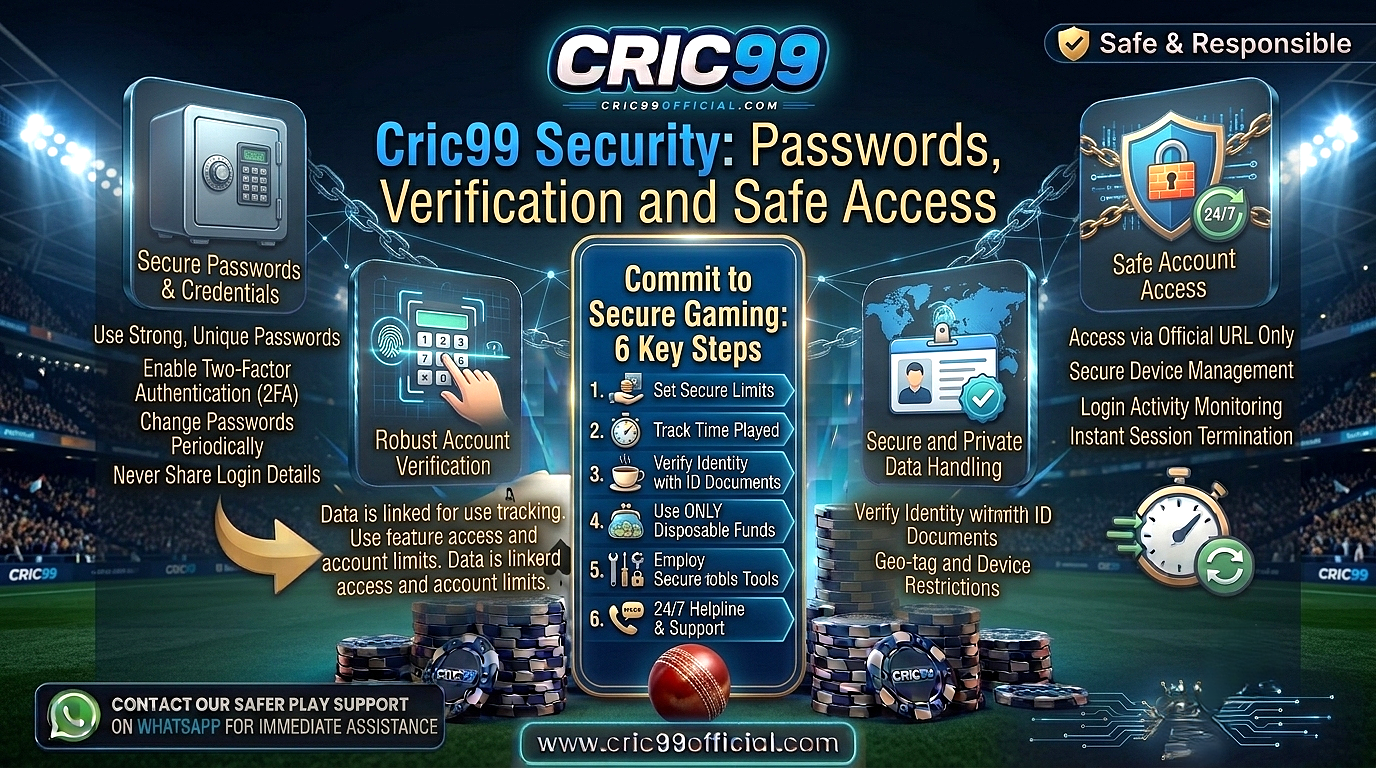
Cric99 security is not limited to choosing a difficult password. Safe account access also depends on how users handle OTPs, verification requests, login links, mobile devices and payment-related messages. A strong password offers limited protection if it is entered on a fake login page or shared with another person.
For everyday users, Cric99 safe access comes down to knowing which information should remain private, checking where you are entering account details, and reacting carefully when something unusual happens.
This guide looks at Cric99 security from three practical angles—passwords, verification and access—so you can understand which security habit matters at each stage of using an account.
Think of Cric99 Security as Three Doors
Rather than treating security as one large technical subject, imagine that your account has three doors.
Door 1: Password
This controls ordinary account authentication.
Door 2: Verification
This may confirm a phone number, account action or identity information.
Door 3: Access
This concerns the website, device, browser or application through which you reach the account.
Protecting only one door is not enough.
For example, a unique password cannot help if you deliberately enter it into a convincing fake website. Similarly, accessing the correct website does not protect an account if another person already knows the password.
Good Cric99 account protection comes from securing all three.
Passwords: Your First Line of Defence
A password should be difficult for another person to guess and, just as importantly, unique to the account.
Users sometimes create passwords using predictable combinations:
Name@123
Cricket2026
India12345
Adding a capital letter or symbol does not automatically make a predictable password strong.
A better approach is to use a sufficiently long, unique password that is unrelated to obvious personal information.
And do not reuse it.
Your Cric99 password should not also be the password for your email, social-media account or another website.
Why Password Reuse Creates Extra Risk
Imagine that you use the same password on five websites.
One unrelated website suffers a data breach.
Someone obtains the email-password combination from that breach and tries the same credentials elsewhere.
They do not need to “hack Cric99” to attempt access. They only need you to have reused the same credentials.
This is why unique passwords matter.
A compromise on one service should not automatically create an access risk for every other account you use.
If remembering different passwords becomes difficult, a reputable password manager can help generate and store unique credentials.
Your Email Can Be Part of Account Security
Users often secure the betting account while ignoring the email account associated with it.
If an email address is involved in account communication or recovery, that email deserves strong protection as well.
Use a different password for your email.
Enable additional security options offered by your email provider where appropriate, and protect the device on which that email is already signed in.
If someone controls both your email and a reused Cric99 password, recovering control can become more difficult.
Cric99 online security therefore extends beyond the Cric99 login screen.
OTP Security: Temporary Does Not Mean Unimportant
An OTP may be valid only briefly, but during that period it can be extremely sensitive.
Depending on the action, an OTP may be used to confirm a login, registration, password reset or another account process.
Follow one rule:
Enter OTPs yourself. Do not read them to someone else.
A person might tell you:
“I am from support. Tell me the code so I can verify the account.”
But an authentication code is designed to prove control of the registered contact method.
Giving it to another person can allow them to complete an action that you should be completing yourself.
Unexpected OTP? Don’t Ignore the Context
Suppose an OTP arrives while you are actively resetting your password.
That makes sense.
Now suppose one arrives while you are not using Cric99 at all.
That deserves attention.
An unexpected OTP does not prove someone has gained access. Someone could have entered incorrect information by mistake.
But if unexpected codes continue, consider whether someone may be attempting an account action.
Do not share the codes.
If you have reason to believe your password is known by someone else, change it through the appropriate account process.
Verification Is Not the Same as Giving Someone Your Password
This distinction is important.
A legitimate verification process can ask users to establish certain account or identity information.
That does not mean another person needs to know your login password.
Similarly, KYC may involve identity-related information where required, but your password and OTP serve different purposes.
Think of it this way:
Password: authenticates account access.
OTP: temporarily confirms a particular action or contact method.
KYC: may establish identity or account information.
Do not combine them into one idea called “verification.”
If an account specifically requires identity checks, Cric99 Account Verification: Why KYC May Be Required explains how verification differs from ordinary login authentication.
Only Submit the Information Actually Requested
More information is not always better.
If a legitimate verification process asks for one specific piece of information, sending additional identity documents unnecessarily increases the amount of sensitive information being shared.
Read the request first.
If documentation is required, use the appropriate submission process and make sure the information is readable.
Do not send identity documents to an unfamiliar WhatsApp number or Telegram account simply because someone claims they can “verify Cric99 faster.”
For users dealing with the detailed verification process, Cric99 KYC Verification: Requirements and Process Explained covers document-related checks separately.
Safe Access Begins Before the Login Button
A password protects you only when it is entered in the right place.
Fake login pages can imitate branding, buttons and layouts. Their purpose may simply be to collect whatever credentials users type into them.
This makes the website address more important than appearance alone.
Be especially cautious when you reach a login page through:
- Unsolicited SMS
- WhatsApp messages
- Telegram groups
- Social-media posts
- Unexpected emails
- Pop-up advertisements
- Unknown shortened links
If you already know and have verified the access route you normally use, returning to it directly is generally safer than relying on an unsolicited login link.
“Your Account Will Close Today” Is Designed to Make You Hurry
Security scams often use urgency.
The message may claim that your account will be suspended unless you log in immediately.
Another may say your withdrawal has been frozen and requires “urgent verification.”
The pressure is intentional.
Instead of using the link in the message, independently access your account and check whether the same warning appears.
If there is genuinely an account issue, investigate it through the normal account process.
Do not let a countdown timer in a message decide where you enter your password.
Safe Access on a Smartphone
A smartphone can hold almost everything needed to reach an online account:
- Saved password
- Active browser session
- Registered email
- SMS messages containing OTPs
- Payment applications
That makes device security particularly important.
Use a PIN, password or supported biometric lock on your phone.
Do not leave the device unlocked in shared environments.
If another person needs to borrow your phone, close sensitive account pages first.
Users who primarily access the platform through a phone can read Cric99 Mobile Guide: How to Access Cric99 on Your Phone for mobile-browser and device-specific guidance.
Be Careful With Cric99 App Downloads
An application adds another question to the security process:
Where did the software come from?
A file using the Cric99 name or logo is not automatically an official application.
This is particularly relevant to APK files shared outside ordinary application stores or platform-controlled channels.
An unknown APK can potentially request permissions or behave differently from what the user expects.
Before installing anything claiming to provide Cric99 access, verify how the application is currently distributed.
Cric99 App Guide: What Users Should Know About Mobile Access explains mobile apps, browser access and third-party APK considerations in more detail.
Shared Computers Need Different Security Habits
A personal computer and a public computer should not be treated the same way.
Avoid saving your Cric99 password on a shared device.
Do not select “remember me” if other people regularly use the computer.
After finishing, log out rather than simply closing the browser window.
Be particularly careful with computers in hotels, cybercafés, workplaces or other public environments.
Even if the account itself is secure, you do not control what software, browser extensions or saved information exists on an unknown device.
For sensitive account or payment activity, a device you personally control is preferable.
Public Wi-Fi: Convenience vs Control
Public networks are convenient, but you have less control over them than your own connection.
For routine browsing, that may not always matter.
For actions involving passwords, identity documents or financial information, using a network and device you trust is the more cautious approach.
Avoid conducting sensitive account activity simply because public Wi-Fi is available.
If you need to access the account while travelling, pay additional attention to both the connection and the page you are using.
Security Becomes Even More Important Around Payments
Payment issues create urgency.
If a deposit is missing or a withdrawal is delayed, users naturally want a quick solution.
That urgency can make an unexpected message more convincing.
Someone may claim:
“Your withdrawal needs account verification. Send your OTP.”
Or:
“Pay this additional amount to activate your payout.”
Do not act on such instructions solely because someone contacted you.
Check the transaction inside the account and review the actual payment status.
Cric99 Payment Methods Explained: Deposits and Withdrawals covers payment flows and transaction statuses, while security guidance answers a different question: is the person or request asking for information they should not need?
Payment Proof Can Reveal More Than You Think
If you need assistance with a transaction, a screenshot can be useful.
But inspect it before sharing.
Payment screenshots may contain:
- Full name
- Account numbers
- Mobile number
- Bank information
- QR codes
- Transaction references
- Current balance
Share only what is necessary through an appropriate support process.
A screenshot intended to prove a ₹500 transaction does not need to expose every other piece of financial information on the screen.
How Phishing Can Look Surprisingly Convincing
Phishing does not always involve badly written messages.
A fake page can copy logos, fonts and wording from a legitimate service. A message can also contain your name or other information and still be fraudulent.
Instead of asking:
“Does this look professional?”
ask:
“Did I expect this request, and can I confirm it independently?”
That question is much more useful.
A professional-looking page is an appearance.
A verified access route is evidence.
Watch for Social Engineering, Not Just Technical Attacks
Many account compromises do not require sophisticated hacking.
Someone simply persuades the user to provide what they need.
They might pretend to be:
- Customer support
- An account manager
- A payment representative
- A verification agent
- Someone offering a bonus
- Someone promising to recover funds
The attacker creates a reason for the request and waits for the user to supply the password, OTP or financial information voluntarily.
This is known as social engineering.
The best defence is not technical expertise. It is refusing to disclose authentication information because of an unsolicited request.
Someone Knows Your Cric99 ID—Should You Panic?
An account ID is not the same thing as a password.
Knowing an identifier does not automatically give someone authenticated access.
Still, avoid publishing unnecessary account information.
The greater concern is when someone has several pieces of information together—for example, your ID, password and access to the device receiving verification codes.
If you are unsure what information an account ID represents, Cric99 Cricket ID Explained: What It Is and How It Works provides the broader account-ID explanation.
What Does Suspicious Account Activity Look Like?
Security incidents are not always obvious.
Pay attention to changes you cannot explain, such as:
A password suddenly stops working.
Password-reset codes arrive without your request.
Registered information changes unexpectedly.
Transactions appear that you do not recognize.
You receive unfamiliar account-security notifications.
An active session behaves differently from normal.
One event can have an innocent explanation.
Several unexplained changes deserve prompt attention.
If You Think Someone Has Access to Your Cric99 Account
If you can still log in, change your password through the appropriate account settings.
Do not make a tiny variation of the existing password. Create a genuinely new one.
Review account information and any available recent activity.
If the old password was reused elsewhere, change it on those accounts too—particularly your email.
If you cannot access Cric99, use the account-recovery process.
Cric99 Login Problems: Common Issues and What to Check can help distinguish a compromised account from an ordinary browser, credential or OTP problem.
Don’t Accidentally Help an Attacker During Recovery
Account recovery is another moment when users can become vulnerable.
Suppose you post publicly:
“Can’t access Cric99. Need help.”
Someone contacts you privately five minutes later and claims they can restore the account.
That timing does not make them legitimate support.
Do not send them an OTP, password, identity document or payment.
If normal recovery fails, use the appropriate support process.
Our Cric99 Support Guide: What to Check Before Requesting Help explains how to describe an account issue without exposing the information needed to take control of the account.
Security and Responsible Gaming Are Different
Account protection keeps other people from misusing your account.
Responsible gaming helps you manage your own use of it.
Both are important, but one does not replace the other.
A perfectly secured account can still be used to make financially harmful betting decisions.
Similarly, strict spending limits do not protect an account from a stolen password.
Users looking at the financial-control side can read Cric99 Responsible Gaming Guide: Safer Ways to Play for information about budgets, time limits, chasing losses and warning signs.
A Cric99 Security Check You Can Do in Five Minutes
Every so often, ask yourself:
| Check | Question |
| Password | Is it unique to Cric99? |
| Does it use a different password? | |
| OTP | Would I refuse to give it to another person? |
| Phone | Is my device properly locked? |
| Browser | Am I using a trusted access route? |
| Saved login | Is it stored only on my own device? |
| Apps | Do I know where installed software came from? |
| Account activity | Is there anything I do not recognize? |
| Payments | Are there unexplained transactions? |
| Recovery | Can I still access my registered recovery method? |
If one answer concerns you, deal with that specific weakness rather than waiting for an account problem to expose it.
Frequently Asked Questions About Cric99 Security
Cric99 security refers to the practices used to protect account access, credentials, verification information, devices and sensitive account activity.
Use a unique password, secure your email and phone, keep OTPs private, check login pages carefully and investigate account activity you do not recognize.
Use a unique password, secure your email and phone, keep OTPs private, check login pages carefully and investigate account activity you do not recognize.
Do not share the code. If unexpected authentication requests continue, review your account security and change your password if you believe your credentials may be known by someone else.
No. Passwords authenticate account access, while verification may confirm a contact method, account action or identity information.
Check the website address and how you reached it before entering credentials. Be particularly cautious with unsolicited links received through messages, email or social media.
Shared devices carry additional risk. Avoid saving credentials, log out when finished and prefer a device you control for sensitive account or financial activity.
Change the password if you still have access, review account and transaction activity, secure any other accounts using the same password and use legitimate account recovery if you have lost access.
Conclusion
Cric99 security works best when passwords, verification and access are treated as separate but connected layers.
Use a unique password and protect the email or phone involved in account recovery. Keep OTPs private regardless of who asks for them. When verification is required, submit only the requested information through the appropriate process.
Safe access matters just as much. Check where you are entering credentials, be cautious with unfamiliar applications and avoid letting urgent messages push you into clicking unknown login links.
And if something changes unexpectedly, investigate early. An unfamiliar OTP, changed account detail or unrecognized transaction may have a simple explanation—but it should not be ignored.
Strong Cric99 online security is ultimately built from small habits repeated consistently, not from one security setting activated once.
Disclaimer: This article provides general online-security information and does not confirm specific security features currently offered by Cric99. Authentication, verification, recovery and account-security procedures may change. Users should follow current platform instructions, protect sensitive credentials and comply with applicable platform terms, minimum-age requirements and laws in their jurisdiction. Real-money betting involves financial risk and does not guarantee profit.