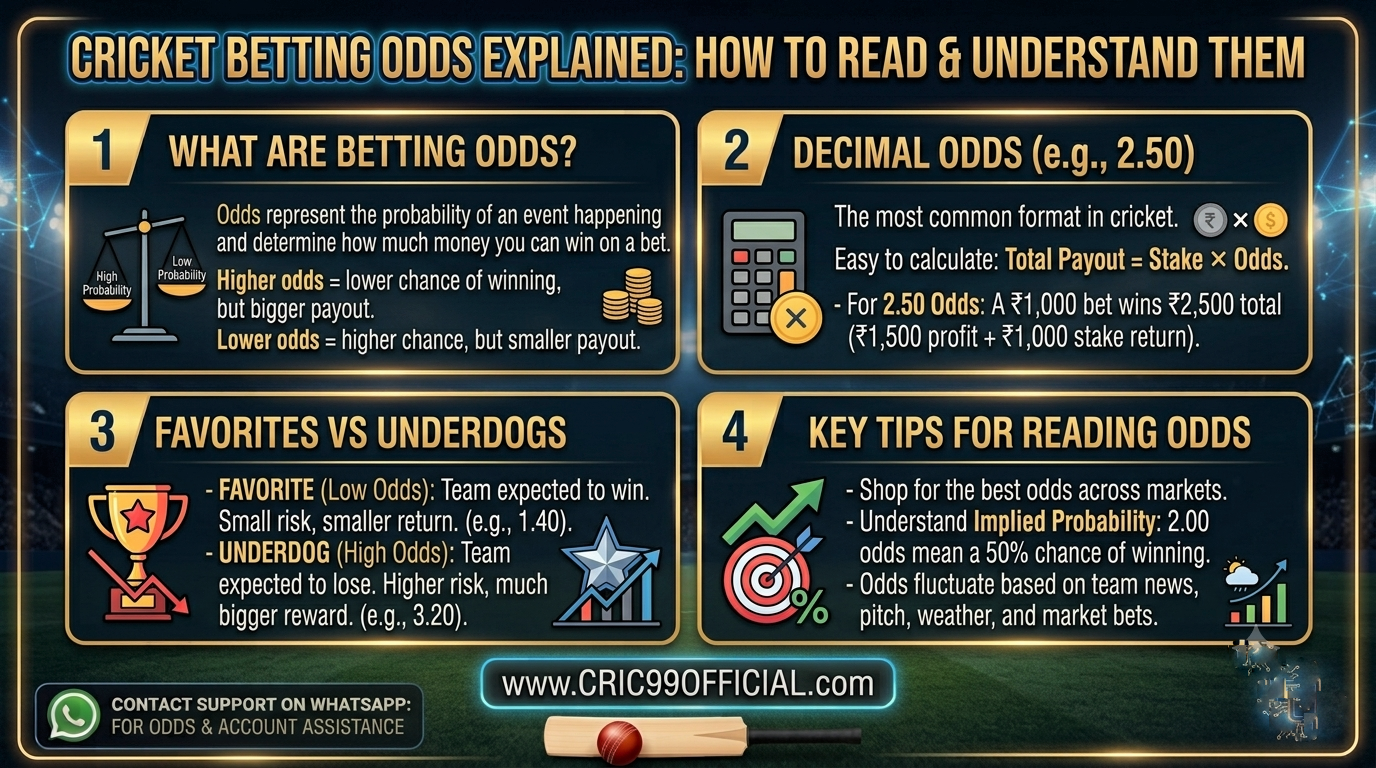
How to Read Cricket Betting Odds starts with understanding what the numbers actually represent. Odds are the price attached to a particular outcome in a cricket betting market. They can help you calculate a potential return, compare available prices and understand how a market is being presented.
For beginners, the numbers can look confusing at first. A price such as 1.50, 2.00 or 5.00 is easy to see but less useful if you do not know what it means.
This guide explains cricket betting odds from the ground up, including decimal odds, potential returns, implied probability, changing prices, back and lay positions, and common mistakes to avoid.
What Are Cricket Betting Odds?
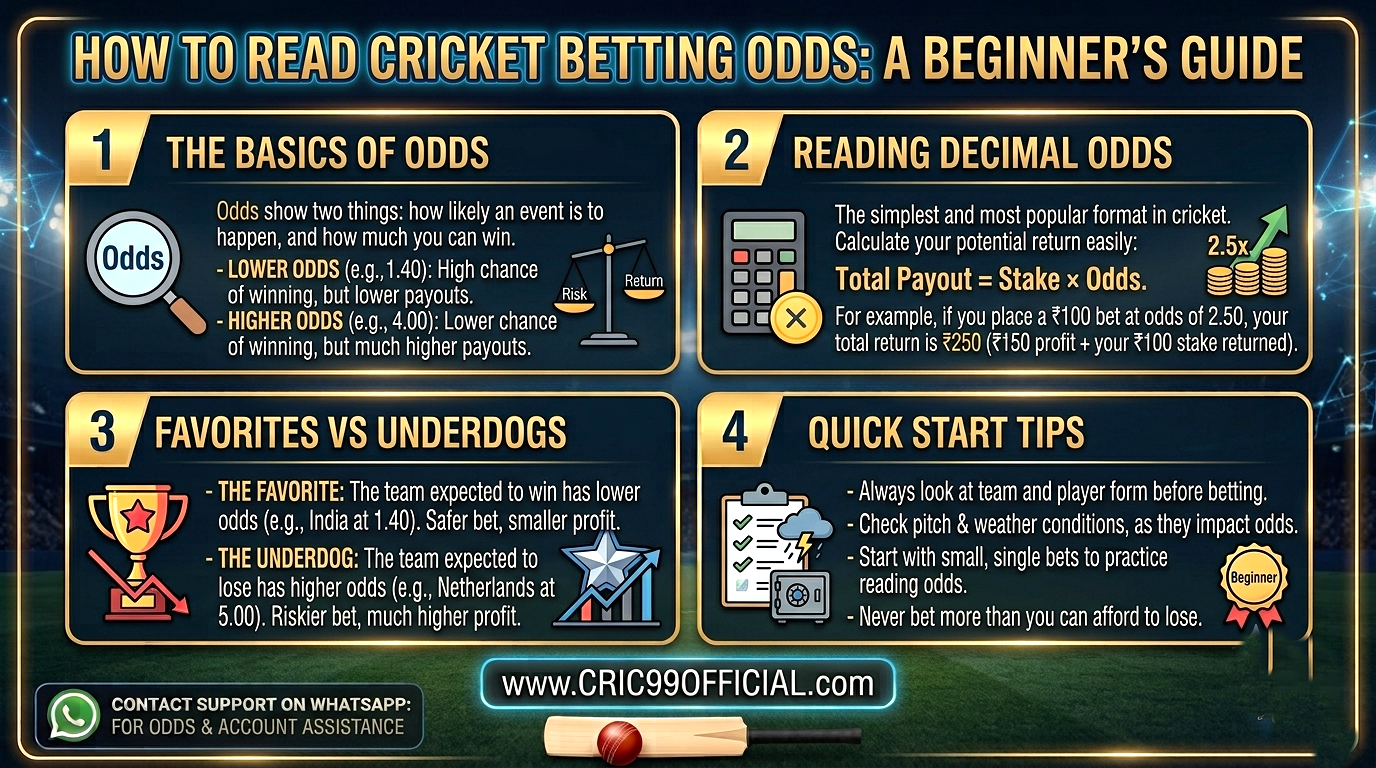
Cricket betting odds show the price available for a selected outcome.
Decimal odds are particularly straightforward because the stake is multiplied by the displayed price to calculate the total return.
For example, suppose a cricket market shows odds of 2.00 and you place a ₹100 stake.
₹100 × 2.00 = ₹200 total return
The ₹200 includes the original ₹100 stake, so the potential profit would be ₹100 if the bet wins, subject to the applicable rules or commission.
The important thing to remember is that odds represent a price. They do not guarantee that the selected outcome will happen.
A Simple Cricket Odds Example
Imagine a cricket match with the following prices:
| Team | Decimal odds | ₹100 total return |
|---|---|---|
| Team A | 1.50 | ₹150 |
| Team B | 2.50 | ₹250 |
If Team A’s odds are 1.50, a ₹100 winning stake would produce ₹150 in total return.
If Team B’s odds are 2.50, the same ₹100 stake would produce ₹250 in total return.
The difference is the potential return, not a guarantee about which team will win.
This is one of the first concepts to understand when learning how cricket betting works.
How to Read Decimal Cricket Betting Odds
Decimal odds are widely used because the calculation is simple.
The basic formula is:
Total Return = Stake × Odds
To calculate potential profit:
Potential Profit = Total Return − Stake
Example 1: Odds of 1.80
With a ₹100 stake:
₹100 × 1.80 = ₹180 total return
Potential profit:
₹180 − ₹100 = ₹80
Example 2: Odds of 3.00
With a ₹100 stake:
₹100 × 3.00 = ₹300 total return
Potential profit:
₹300 − ₹100 = ₹200
Example 3: Odds of 5.00
With a ₹100 stake:
₹100 × 5.00 = ₹500 total return
Potential profit:
₹500 − ₹100 = ₹400
These examples explain the mathematics only. They should not be interpreted as predictions of actual cricket results.
What Do Low Cricket Odds Mean?
Lower decimal odds generally mean a smaller potential return compared with higher odds for the same stake.
For example:
- 1.25 → ₹125 total return from ₹100
- 1.50 → ₹150 total return from ₹100
- 2.00 → ₹200 total return from ₹100
A lower price does not mean a guaranteed result.
A cricket team can be given relatively short odds and still lose because sporting outcomes remain uncertain.
This distinction is one of the most important pieces of a beginner cricket betting guide.
What Do High Cricket Odds Mean?
Higher odds produce a larger potential return for the same stake.
For example, ₹100 at 5.00 odds would produce a ₹500 total return if the bet wins.
But the larger potential return should not be confused with a higher likelihood of success.
High odds may reflect a market price associated with a less likely outcome, although the exact relationship depends on the market and pricing process.
The basic rule is simple:
Higher odds = higher potential return, not guaranteed success.
Understanding 2.00 Odds
The number 2.00 is often useful for beginners because the calculation is easy.
At 2.00 decimal odds:
| Stake | Total return | Potential profit |
|---|---|---|
| ₹50 | ₹100 | ₹50 |
| ₹100 | ₹200 | ₹100 |
| ₹250 | ₹500 | ₹250 |
| ₹500 | ₹1,000 | ₹500 |
The total return includes the original stake.
So, if you see 2.00 odds, do not mistake the total return for the profit.
How to Calculate Implied Probability
Another useful part of understanding cricket odds is implied probability.
For decimal odds, a simple calculation is:
Implied Probability = 1 ÷ Decimal Odds × 100
For example:
2.00 odds
1 ÷ 2.00 × 100 = 50%
4.00 odds
1 ÷ 4.00 × 100 = 25%
5.00 odds
1 ÷ 5.00 × 100 = 20%
This is the probability mathematically implied by the displayed price.
However, it should not automatically be treated as the true probability of the outcome. Bookmaker margins, exchange conditions, commission and market dynamics can affect the relationship.
Odds and Probability Are Not the Same Thing
This distinction is easy to miss.
Odds tell you the price available for a position.
Implied probability converts that price into a percentage.
Actual probability refers to the real chance of an outcome occurring, which cannot be known with certainty before a cricket match.
For example, 4.00 odds correspond to a 25% implied probability.
That does not mean someone can know with certainty that the outcome has exactly a 25% chance of happening.
Understanding this difference makes cricket betting explained more meaningful than simply memorising odds numbers.
Why Cricket Betting Odds Change
Odds can change before and during a cricket match.
Several factors can contribute to price movements, including:
- Team selection
- Player injuries
- Weather updates
- Pitch information
- Match conditions
- Betting activity
- Wickets and runs during live play
For example, if a key player is unexpectedly left out of the playing XI, prices may change once the information becomes known.
During a live match, prices can move even faster.
A wicket, boundary, partnership or change in the required run rate can affect the available prices.
Therefore, an odds figure you saw earlier may not still be available when you return to the market.
Pre-Match Cricket Betting Odds
Pre-match odds are available before the relevant match begins.
Someone researching a market may look at information such as:
- Recent results
- Player availability
- Expected playing XI
- Venue conditions
- Weather
- Pitch characteristics
- Previous performances
These factors can help someone understand a match, but none can guarantee its result.
Historical statistics describe what happened previously. They do not determine what will happen next.
Live Cricket Betting Odds
Live cricket betting takes place while the match is underway, where such markets are offered.
The information available is different from pre-match betting because the actual match is developing in front of you.
For example, users may see changes following:
- A wicket
- A six or boundary
- A major partnership
- A batting collapse
- A change in required run rate
Because prices can change rapidly, beginners should take extra care with live markets.
Fast-moving markets can make it easier to make decisions without properly considering the amount at risk.
Back and Lay Odds Explained
If a platform operates as a betting exchange, you may encounter both back and lay positions.
A back bet means taking a position that an outcome will happen.
A lay bet means taking a position against an outcome happening.
The distinction is important because a lay position can involve liability.
As described in What Is Cric99? Complete Guide to the Cric99 Platform, exchange betting differs from the traditional bookmaker model because users can take opposing positions.
Before confirming a lay position, always check the displayed liability rather than assuming that the amount entered is the maximum possible loss.
Matched and Unmatched Bets
Exchange markets can also contain matched and unmatched positions.
A matched bet means another participant has taken the opposite side of the position at the required price and amount.
An unmatched bet means that some or all of the requested position has not found an opposing participant.
For example, you could request ₹500 at particular odds, but only ₹200 may currently be available to match.
Depending on the platform’s rules, the remaining amount could stay unmatched until more market activity becomes available.
This is an important part of understanding how cricket betting works on an exchange.
Reading Cricket Odds in Different Markets
Cricket odds are not limited to the overall match winner.
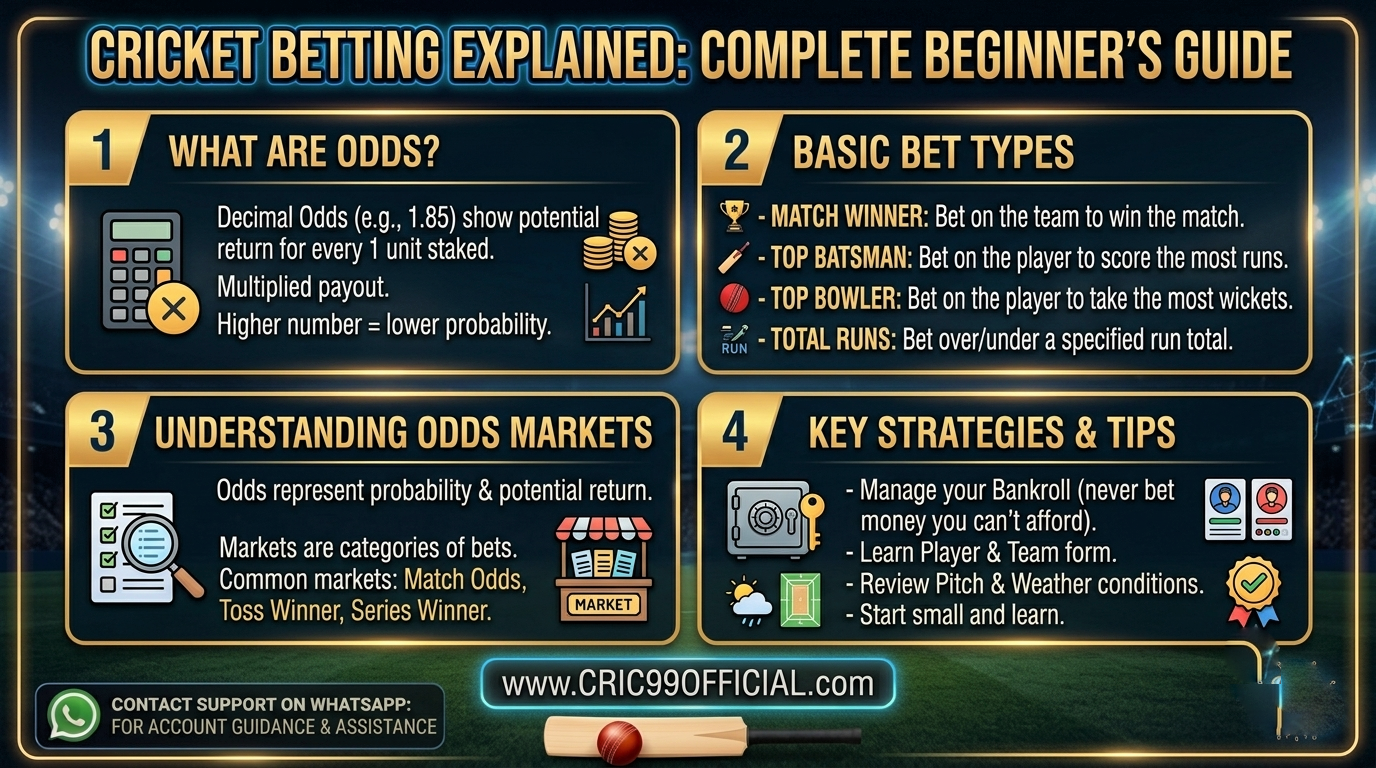
Depending on the match and platform, markets can relate to:
| Market type | What the odds relate to |
|---|---|
| Match winner | Which team wins |
| Total runs | A specified team or match total |
| Player markets | A defined player outcome |
| Innings markets | An event or result within an innings |
| Toss markets | A toss-related outcome |
| Live markets | Outcomes while the match is in progress |
The exact markets available can change.
A beginner should read the market name and rules carefully rather than assuming that two markets with similar wording settle in the same way.
What Does a Cricket Betting Price Actually Tell You?
An odds price can tell you several useful things:
- The potential return from a stake
- The mathematical implied probability
- How the current price compares with another available price
- Whether the price has changed
- The potential financial exposure involved
But the price cannot tell you with certainty what will happen.
For example, odds of 1.30 do not mean an outcome must happen. They simply represent a particular price.
This is why understanding the numbers is only one part of a complete cricket betting guide.
Common Mistakes Beginners Make
Mistake 1: Thinking Short Odds Mean Guaranteed Wins
Short odds can still lose.
A lower price does not remove sporting uncertainty.
Mistake 2: Confusing Return With Profit
If ₹100 is placed at 2.00 odds, the total return is ₹200.
The profit is ₹100.
Mistake 3: Ignoring the Stake
The stake is included in the total return calculation.
Mistake 4: Chasing Higher Odds
Choosing a higher price simply because the potential return is larger does not make the outcome more likely.
Mistake 5: Ignoring Lay Liability
On an exchange, a lay position can expose you to liability beyond the amount you might initially think of as the stake.
Mistake 6: Assuming Prices Stay Fixed
Odds can move because of new information and market activity.
Mistake 7: Treating Statistics as Guarantees
Past performance can provide context, but it cannot guarantee a future cricket result.
A Beginner’s Checklist Before Reading Cricket Odds
Before placing any cricket bet, work through this short checklist:
Understand the market.
Know exactly what outcome you are betting on.
Check the odds.
Read the current decimal price carefully.
Calculate the return.
Multiply your stake by the odds.
Separate return from profit.
Subtract the stake from the total return.
Check the risk.
Understand your potential loss and, where relevant, lay liability.
Read the rules.
Check settlement conditions for unusual match situations.
Consider your budget.
Only risk money you can afford to lose.
This simple process can prevent many avoidable beginner mistakes.
Cricket Betting Odds and Account Information
Understanding odds is separate from understanding your betting account.
If you are using a platform such as Cric99, account-related information may include login credentials, an account identifier and verification procedures. These should be handled securely.
For example, Cric99 Cricket ID Explained: What It Is and How It Works explains the distinction between an account ID, password and OTP.
For account protection, Cric99 Account Security: How to Protect Your Account covers basic precautions for keeping account credentials private.
The exact account procedures, available markets and platform features can change, so current information should always be checked through the relevant platform.
Frequently Asked Questions
Start by identifying the market and reading the decimal price. Multiply the odds by your stake to calculate the total potential return. Then subtract your stake to determine potential profit.
Decimal odds of 1.50 mean that a ₹100 winning stake would produce a ₹150 total return before applicable conditions. The potential profit would be ₹50.
Odds of 2.00 mean that a ₹100 winning stake would produce a ₹200 total return, including the original stake.
Odds of 5.00 mean that a ₹100 winning stake would produce a ₹500 total return if successful, before applicable conditions.
Lower odds provide a smaller potential return relative to the stake, but they do not guarantee that the selected outcome will happen.
Prices can change because of team news, player availability, weather, pitch information, betting activity and events during live play.
Conclusion
Learning How to Read Cricket Betting Odds is mainly about understanding the numbers before making any decision.
Start with decimal odds and learn how to calculate total return and potential profit. Then move on to implied probability, changing prices, live markets and the difference between back and lay positions.
The most important lesson is that odds describe a price, not a guaranteed result. Cricket remains unpredictable, and no number, statistic or strategy can remove the possibility of losing money.
If you understand the market, know how much is at risk and read the relevant rules before acting, you have a much clearer foundation for understanding cricket betting.
Disclaimer: This article is for informational and educational purposes only. Cricket betting involves financial risk, and there is no guarantee of profit or any particular sporting outcome. Betting laws, minimum-age requirements, platform rules, market availability and account procedures can vary by jurisdiction and may change over time. Check the laws applicable to your location and the current terms of the relevant betting service before participating in real-money betting.